
Intelligence Synonyms: 49 Words for Smart Thinking
Intelligence describes a person’s ability to learn, understand, reason and handle new situations, but the best word depends on the kind of thinking you mean. These 49 intelligence synonyms cover mental ability, practical judgment, knowledge, everyday speech and gathered information.
Quick Answer
The best synonym for intelligence depends on your meaning:
- General mental ability: Intellect or brainpower.
- Sharp practical judgment: Acumen or discernment.
- Learning and experience: Knowledge or wisdom, although neither means intelligence itself.
- Gathered secret facts: Information or intel.
- Everyday praise: Brains, smarts or common sense.
One grammar point matters: intelligence is a noun, while smart, clever and brilliant are adjectives. You can call someone smart, but you cannot replace the noun intelligence with smart in a sentence.
What Does Intelligence Mean?
Intelligence is a noun that describes the ability to learn, understand, think and solve problems. Oxford Advanced Learner’s Dictionary defines its main ability sense as the ability to learn, understand and think logically about things. It also refers to how well someone can do these things.
For example, you might describe someone as having high, average or low intelligence. Oxford also gives these examples:
“He didn’t even have the intelligence to call for an ambulance.”
“Please don’t insult my intelligence by lying to me.”
Merriam-Webster gives a similar definition. It describes intelligence as the ability to learn or understand things or deal with new or difficult situations. Its related definition of mental acuteness refers to sharpness of mind.
Cambridge Dictionary describes intelligence as the ability to learn, understand and make judgments or form opinions based on reason.
However, intelligence has another important meaning.
Intelligence as Secret Information
Intelligence can also mean secret information collected about another country, especially an enemy. It can refer to the people who collect that information, too.
Examples include:
- The head of military intelligence.
- The collection of foreign intelligence.
- An intelligence officer or agent.
- The intelligence community.
This meaning has nothing to do with praising someone’s mental ability. A military intelligence report and a person’s intellect describe two different things.
Intelligence Is a Noun, Not an Adjective
This is one of the most common grammar mistakes.
Intelligence is a noun. It names a mental capacity. Words such as smart, clever, brilliant, bright, sharp, brainy and gifted are adjectives. They describe a person or their qualities.
Compare these sentences:
Wrong: Her smart impressed me.
Right: Her intelligence impressed me.
Right: She is smart.
Smart, clever, brilliant, bright, sharp, brainy and gifted are adjectives, not noun synonyms for intelligence; genius is a person, not the general capacity; memory and recall are only one part of thinking; education is a process, not a capacity; IQ is a test score, not the ability itself; artificial intelligence is a technology; cunning, guile, slyness, sneakiness, wiliness and deviousness imply trickery and are never praise for intelligence; and intelligentsia is a group of intellectual people, not the ability itself.
You also need to remember that intelligence is uncountable when it refers to mental ability.
Wrong: He has an intelligence.
Right: He has great intelligence.
The expression “an intelligence” can refer to an intelligent person or being, or to an intelligence agency. It does not mean a quantity of someone’s mental ability.
Related Forms of Intelligence
These related words and expressions have different grammatical jobs:
| Word or phrase | Meaning or use |
|---|---|
| Intelligent | Adjective describing someone who can learn and understand well |
| Intelligently | Adverb describing an action done with intelligence |
| Intellectual | Adjective or noun connected with thinking and the mind |
| Intellect | Noun describing the thinking faculty |
| Artificial intelligence | Computer technology that performs functions associated with intelligence |
| Emotional intelligence | Ability connected with understanding and handling emotions |
| Intelligence test | A test intended to assess mental abilities |
| Intelligence quotient (IQ) | A score from a test that claims to measure intelligence |
Merriam-Webster also includes the ability to perform computer functions under its artificial intelligence-related meaning. Oxford cross-references artificial intelligence and emotional intelligence.
Keep these distinctions clear. A test score is not the same thing as a person’s full ability, and artificial intelligence is a technology, not another name for human intelligence.
When to Use Intelligence Synonyms
The right synonym makes your meaning more precise. A word that works in a research paper may sound strange in a friendly conversation.
Here are four useful settings.
1. Essays and Reports
Formal writing often needs a more specific term than intelligence.
Try these:
Intellect: Use it when discussing someone’s general thinking faculty.
Reasoning ability: Use it when the subject involves reaching conclusions through logic.
Cognitive ability: Use it in academic or research writing about mental processes.
For example, an essay about learning might discuss cognitive ability, while a paper about logical decisions might focus on reasoning ability.
2. Business and Resumes
Professional writing often needs words that describe judgment, experience or specialist skill.
Try these:
Acumen: Good for practical judgment in business or finance.
Expertise: Useful when someone has deep knowledge in a particular field.
Discernment: Suitable for someone who can recognize important differences and make sound choices.
A resume might describe a candidate’s financial acumen rather than simply calling the person intelligent.
3. Everyday Talk
Casual conversations usually sound better with familiar words.
Try these:
Smarts: Informal praise for practical mental ability.
Brains: A casual way to refer to someone’s mental ability.
Common sense: Useful when praising sensible everyday decisions.
For example, you might say that a friend used common sense when checking a confusing bill.
4. Stories and Character Descriptions
Stories often need words that reveal how a character thinks or reacts.
Try these:
Wit: Useful for quick thinking, especially when humor is involved.
Quick-wittedness: Describes someone who understands or answers quickly.
Ingenuity: Shows a character’s ability to invent a clever solution.
A detective might use ingenuity to solve a difficult case, while a comedian might rely on wit.
One important rule: Keep the word intelligence when you mean general mental ability and no narrower synonym is accurate. A more unusual word isn’t always a better choice.
Benefits of Using Intelligence Synonyms
Using different words for intelligence can improve your writing, but only when each word fits the meaning.
Here are four reasons to choose carefully.
1. Avoid Repeating the Same Word
Repeating intelligence several times can make an essay or report sound dull.
You can use intellect, reasoning ability or cognitive ability when those words match your point. Each one adds a slightly different meaning.
For example, a report about problem-solving might use reasoning ability instead of repeating intelligence in every paragraph.
2. Match the Tone to Your Audience
Some words belong in formal writing. Others sound natural in everyday speech.
Intellect and perspicacity suit formal settings. Smarts and brains are more casual. Using the wrong register can make an otherwise clear sentence sound awkward.
3. Explain the Exact Kind of Thinking
Intelligence is a broad term. A more specific word tells readers what you mean.
General ability: intellect.
Practical judgment: acumen.
Learned facts: knowledge.
Experience-based judgment: wisdom.
Gathered facts: information.
These words are related, but they do not mean the same thing.
4. Avoid Giving the Wrong Kind of Praise
Calling someone knowledgeable does not always mean they have strong general intelligence. They may know a great deal about one subject without being quick at solving unfamiliar problems.
Likewise, cunning and guile suggest trickery or deceit. They are not suitable words for praising someone’s intelligence.
Choose a word that describes the quality you actually want to praise.

49 Best Intelligence Synonyms at a Glance
The following table contains all 49 words, divided into five groups.
General mental ability: 12 words covering the capacity to think, learn and understand.
Sharp thinking and judgment: 12 words about practical decisions, perception and clear thinking.
Knowledge and wisdom: 10 words connected with learning, experience and specific abilities.
Everyday and casual: 9 words used in ordinary conversation or informal writing.
Intelligence as information: 6 words describing gathered facts and reports. These belong to the second sense of intelligence, not the mental-ability sense.
| Synonym | Tone | Best for |
|---|---|---|
| Intellect | Formal | Essays, academic writing, formal description |
| Brainpower | Neutral, everyday | Everyday talk, casual writing, team praise |
| Mental ability | Neutral, plain | General discussion, school feedback, plain writing |
| Cognitive ability | Formal, academic | Psychology, education, research writing |
| Reasoning ability | Formal, academic | Essays, assessments, workplace feedback |
| Comprehension | Neutral, academic | School, reading and listening tasks, reports |
| Understanding | Neutral | Everyday writing, explanations, essays |
| Cognition | Formal, academic | Academic and psychology writing |
| Mental capacity | Formal, neutral | Reports, assessments, formal writing |
| Intellectual capacity | Formal | Formal assessments, education writing |
| Reasoning | Formal, neutral | Essays, analysis, formal writing |
| Rationality | Formal, academic | Academic writing, philosophy, analysis |
| Acumen | Formal, business | Resumes, business writing, professional praise |
| Discernment | Formal | Reviews, essays, decisions, evidence |
| Perspicacity | Very formal, literary | Literary and academic writing |
| Sagacity | Formal, literary | Formal praise, literary writing |
| Astuteness | Formal, business | Business, politics, professional writing |
| Shrewdness | Neutral, business | Business writing, stories, character description |
| Judgment | Neutral, formal | Essays, reports, workplace feedback |
| Insight | Neutral | Essays, reports, everyday writing |
| Perception | Neutral, formal | Academic writing, reviews, analysis |
| Alertness | Neutral | Everyday writing, safety and work contexts |
| Sharpness | Neutral, approving | Everyday praise, stories, casual writing |
| Wit | Neutral, literary | Stories, essays, character description |
| Wisdom | Neutral, approving | Reflective writing, praise of decisions, essays |
| Knowledge | Neutral | Essays, reports, school and work writing |
| Expertise | Formal, professional | Resumes, professional writing, specialist praise |
| Erudition | Very formal, academic | Scholarly writing, high-register praise |
| Brilliance | Elevated, approving | Praise, essays, standout achievement |
| Aptitude | Neutral, formal | School, careers, assessments |
| Cleverness | Neutral, everyday | Everyday talk, stories, casual writing |
| Savvy | Casual, modern | Workplace talk, casual writing, modern business |
| Ingenuity | Neutral, approving | Essays, design and problem-solving writing |
| Foresight | Neutral, formal | Business, planning, reflective writing |
| Smarts | Casual, spoken | Everyday talk, casual writing, friendly praise |
| Brains | Casual, spoken | Everyday talk, stories, humor |
| Gray matter | Casual, humorous | Casual writing, humor, light stories |
| Common sense | Neutral, everyday | Everyday talk, advice, plain writing |
| Horse sense | Casual, old-fashioned | Stories, old-fashioned speech, casual writing |
| Mother wit | Old-fashioned, literary | Old texts, literary writing, proverbs |
| Quick-wittedness | Neutral | Stories, descriptions, everyday writing |
| Mental sharpness | Neutral, informal | Personal description, casual writing |
| Nous | Casual, British slang | British casual writing, everyday talk |
| Information | Neutral | Reports, news, everyday and formal writing |
| Intel | Casual, informal | Casual workplace talk, stories, journalism |
| Reports | Neutral | News, committees, formal writing |
| Findings | Formal, neutral | Research, surveys, investigations |
| Data | Neutral, technical | Research, technical writing, reports |
| Evidence | Formal, neutral | Essays, law, research, arguments |
The final six words describe the information sense of intelligence. They should never be used as replacements for intellect or general mental ability.
Synonyms for General Mental Ability
These 12 words describe the basic ability to learn, think, understand and reason. Some are close alternatives to intelligence, while others refer to one part of mental activity.
1. Intellect
Tone: Formal. Uses: Essays, academic writing, formal description.
Meaning: The capacity for thinking, understanding and reasoning.
Explanation: Intellect is the closest formal synonym for intelligence because it describes the thinking faculty itself. It refers to the capacity, not the way someone uses that capacity in a particular situation.
Examples:
- Her intellect helped her understand the difficult theory.
- The professor admired his intellect and thoughtful questions.
2. Brainpower
Tone: Neutral, everyday. Uses: Everyday talk, casual writing, team praise.
Meaning: Mental power and the ability to think hard or solve problems.
Explanation: Brainpower is a familiar way to talk about mental ability. It has an informal flavor, so it works well in speech but is weaker than intellect in a formal essay.
Examples:
- The puzzle required plenty of brainpower.
- Our team used its brainpower to solve the design problem.
3. Mental ability
Tone: Neutral, plain. Uses: General discussion, school feedback, plain writing.
Meaning: The ability to think, learn or solve problems.
Explanation: Mental ability is a broad, straightforward phrase for intelligence. Tie it to a specific activity, such as mental ability in math, or the phrase may say very little.
Examples:
- The teacher noticed her mental ability in math.
- His mental ability helped him learn the new rules.
4. Cognitive ability
Tone: Formal, academic. Uses: Psychology, education, research writing.
Meaning: The mental capacities used in learning, remembering and reasoning.
Explanation: Cognitive ability is a technical term used in academic and research settings. Do not use it as a diagnosis or a test score unless a real assessment supports that claim.
Examples:
- The study examined cognitive ability during early learning.
- Researchers discussed cognitive ability in their report.
5. Reasoning ability
Tone: Formal, academic. Uses: Essays, assessments, workplace feedback.
Meaning: The capacity to connect ideas and reach conclusions from evidence.
Explanation: Reasoning ability describes one part of intelligence, not the whole capacity. It is useful when you mean logical thinking, but it does not cover every mental skill.
Examples:
- Her reasoning ability helped her assess the evidence.
- The assessment measured reasoning ability through several problems.
6. Comprehension
Tone: Neutral, academic. Uses: School, reading and listening tasks, reports.
Meaning: The ability or act of understanding information.
Explanation: Comprehension is narrower than intelligence because it focuses on understanding. A poor comprehension result may come from unfamiliar language or confusing material, not low mental ability.
Examples:
- His reading comprehension improved during the semester.
- The teacher tested comprehension after the science lesson.
7. Understanding
Tone: Neutral. Uses: Everyday writing, explanations, essays.
Meaning: Grasping the meaning, relationship or importance of something.
Explanation: Understanding can describe mental ability, but it can also mean sympathy toward another person. Keep the subject clearly connected to thinking when using it as an intelligence-related term.
Examples:
- Her understanding of the problem impressed the group.
- The assignment tested his understanding of basic algebra.
8. Cognition
Tone: Formal, academic. Uses: Academic and psychology writing.
Meaning: The mental process of knowing, perceiving and reasoning.
Explanation: Cognition is a very formal term for mental activity. Most general readers will find thinking easier to understand, so save cognition for subjects that need an academic term.
Examples:
- The course introduced cognition and its role in learning.
- The research examined cognition during problem-solving tasks.
9. Mental capacity
Tone: Formal, neutral. Uses: Reports, assessments, formal writing.
Meaning: The amount of thinking, learning and understanding a person can manage.
Explanation: Mental capacity is a measured phrase often used in formal discussions. Do not present it as a fixed, permanent limit because a person’s performance can vary with the task and situation.
Examples:
- The report discussed his mental capacity for complex tasks.
- Her mental capacity allowed her to manage several difficult questions.
10. Intellectual capacity
Tone: Formal. Uses: Formal assessments, education writing.
Meaning: The scope and depth of a person’s thinking power.
Explanation: Intellectual capacity sounds objective and measured. Use it carefully, and make sure any claim about someone’s ability has evidence behind it.
Examples:
- The assessment considered her intellectual capacity.
- His intellectual capacity became clear during the debate.
11. Reasoning
Tone: Formal, neutral. Uses: Essays, analysis, formal writing.
Meaning: Thinking through a problem in a logical, step-by-step way.
Explanation: Reasoning is a process word. It names the activity of thinking through ideas, not the whole ability to learn, understand and handle new situations.
Examples:
- Her reasoning helped the committee reach a decision.
- The student’s reasoning was clear throughout the discussion.
12. Rationality
Tone: Formal, academic. Uses: Academic writing, philosophy, analysis.
Meaning: Thinking based on reason and logic rather than emotion.
Explanation: Rationality covers logical thinking, but intelligence includes more than logic. It does not fully describe creativity, quick learning or every other mental ability.
Examples:
- The essay examined rationality in human decisions.
- His rationality helped him compare the two arguments.
Synonyms for Sharp Thinking and Judgment
These words focus on how someone notices details, judges situations and makes decisions. They can describe intelligence in action, but each has a different shade of meaning.
13. Acumen
Tone: Formal, business. Uses: Resumes, business writing, professional praise.
Meaning: Sharp practical judgment in a particular field.
Explanation: Acumen usually appears with a field or subject. Phrases such as business acumen and financial acumen sound natural, while using acumen without a clear setting can leave readers wondering what skill you mean.
Examples:
- Her business acumen helped the company avoid a costly mistake.
- The manager showed strong financial acumen during the review.
14. Discernment
Tone: Formal. Uses: Reviews, essays, decisions, evidence.
Meaning: The ability to recognize relevant differences and judge their value.
Explanation: Discernment describes careful judgment and the ability to see what matters. It does not mean rejecting everything; someone with discernment can recognize strengths as well as weaknesses.
Examples:
- Her discernment helped the panel select the strongest proposal.
- The editor showed discernment when reviewing the manuscript.
15. Perspicacity
Tone: Very formal, literary. Uses: Literary and academic writing.
Meaning: Clear-sighted and penetrating understanding of a matter.
Explanation: Perspicacity is rare and has a high-register tone. It can sound showy in everyday writing, so use it only when the formal or literary setting calls for it.
Examples:
- The historian’s perspicacity helped explain the political dispute.
- Her perspicacity revealed a flaw in the argument.
16. Sagacity
Tone: Formal, literary. Uses: Formal praise, literary writing.
Meaning: Wise, far-seeing judgment associated with a sage.
Explanation: Sagacity has an old-fashioned flavor and often suggests experience-based judgment. Wisdom is the more familiar everyday word, so most general readers will find it easier to understand.
Examples:
- The mayor’s sagacity helped guide the difficult discussion.
- Her sagacity became clear when she advised the younger team.
17. Astuteness
Tone: Formal, business. Uses: Business, politics, professional writing.
Meaning: Keen perception and shrewd judgment in practical matters.
Explanation: Astuteness often suggests that someone can spot an advantage or opportunity. It can sound slightly calculating, so make sure the sentence praises good judgment rather than manipulation.
Examples:
- Her astuteness helped the firm choose a better supplier.
- The report praised his astuteness during the negotiations.
18. Shrewdness
Tone: Neutral, business. Uses: Business writing, stories, character description.
Meaning: Practical, sharp judgment, often in deals and decisions.
Explanation: Shrewdness often describes someone who understands practical situations and makes clever decisions. It can also suggest calculation, so praise the decision rather than the person’s cunning.
Examples:
- His shrewdness helped him negotiate a fair price.
- The novel describes her shrewdness during the family dispute.
19. Judgment
Tone: Neutral, formal. Uses: Essays, reports, workplace feedback.
Meaning: The ability to make considered decisions or assessments.
Explanation: Judgment focuses on the quality of decisions rather than every part of intelligence. Use the US spelling judgment throughout your writing; judgement is the UK spelling.
Examples:
- Her judgment helped the team choose a safer plan.
- The manager trusted his judgment during the review.
20. Insight
Tone: Neutral. Uses: Essays, reports, everyday writing.
Meaning: A clear understanding that reveals something important.
Explanation: Insight suggests that someone has understood something meaningful. It needs a clear basis, so explain what the person understood instead of using insight as empty praise.
Examples:
- Her insight helped the team understand the customer complaint.
- The essay offers insight into the character’s choices.
21. Perception
Tone: Neutral, formal. Uses: Academic writing, reviews, analysis.
Meaning: The ability to notice and understand things through the senses and mind.
Explanation: Perception is broader than thinking because it also includes noticing and interpreting what the senses receive. It does not describe reasoning alone.
Examples:
- His perception of the room changed after the discussion.
- The study examined perception during difficult visual tasks.
22. Alertness
Tone: Neutral. Uses: Everyday writing, safety and work contexts.
Meaning: Quickness in noticing and understanding what is happening.
Explanation: Alertness describes readiness and the speed of noticing things. It does not necessarily show deep thought or careful reasoning, so use it when quick awareness is the point.
Examples:
- Her alertness helped the driver avoid the obstacle.
- The coach praised his alertness during the match.
23. Sharpness
Tone: Neutral, approving. Uses: Everyday praise, stories, casual writing.
Meaning: Quick, clear thinking and a keen mind.
Explanation: Sharpness can describe mental ability, but it also refers to blades and clear images. Make the mental meaning clear from the surrounding sentence.
Examples:
- Her sharpness became clear during the interview.
- The teacher noticed his sharpness when he solved the puzzle.
24. Wit
Tone: Neutral, literary. Uses: Stories, essays, character description.
Meaning: Quick, clever thinking, often shown through words and humor.
Explanation: Wit often carries a strong connection with humor and clever remarks. Do not use it as a direct replacement for slow, careful reasoning when humor or quick responses are not involved.
Examples:
- Her wit kept the dinner conversation lively.
- The writer used wit to reveal the character’s personality.
Synonyms for Knowledge and Wisdom
These ten words connect intelligence with learning, experience, specialist skill and original ideas. Some describe related qualities rather than the ability itself, so their limits matter.
25. Wisdom
Tone: Neutral, approving. Uses: Reflective writing, praise of decisions, essays.
Meaning: Considered understanding and good judgment built through experience.
Explanation: Wisdom is not the same as raw intelligence. It develops through experience over time and describes how someone uses what they have learned to make thoughtful decisions.
Examples:
- Her wisdom helped the family settle the disagreement.
- The leader showed wisdom by listening before making a decision.
26. Knowledge
Tone: Neutral. Uses: Essays, reports, school and work writing.
Meaning: Information and understanding gained through learning or experience.
Explanation: Knowledge means what someone has learned, not their capacity to learn. A person can know a great deal about one subject and still think slowly, while a quick thinker may know little about an unfamiliar subject.
Examples:
- Her knowledge of local history helped the research team.
- The course gave students knowledge of basic accounting.
27. Expertise
Tone: Formal, professional. Uses: Resumes, professional writing, specialist praise.
Meaning: A high level of knowledge or skill in a particular field.
Explanation: Expertise applies to a specific subject or area of work. It needs real study, training or experience behind it, so do not use it as a general label for intelligence.
Examples:
- Her expertise in biology helped the research project.
- The company hired him for his expertise in computer security.
28. Erudition
Tone: Very formal, academic. Uses: Scholarly writing, high-register praise.
Meaning: Deep and extensive learning gained through serious study.
Explanation: Erudition describes broad or deep learning, often connected with books and academic study. It is very formal, so use it sparingly or it may sound pretentious.
Examples:
- The professor’s erudition impressed the visiting scholars.
- Her erudition was clear throughout the history lecture.
29. Brilliance
Tone: Elevated, approving. Uses: Praise, essays, standout achievement.
Meaning: Exceptional and impressive mental ability.
Explanation: Brilliance is a strong word that suggests outstanding ability. Save it for exceptional work or thinking rather than ordinary success, and remember that brilliant is an adjective while brilliance is the noun.
Examples:
- Her brilliance was clear when she solved the complex problem.
- The team recognized his brilliance during the research project.
30. Aptitude
Tone: Neutral, formal. Uses: School, careers, assessments.
Meaning: A natural or developed capacity to learn or perform a particular activity.
Explanation: Aptitude should always connect to an activity or subject. Someone may have an aptitude for languages, music or mathematics, but the word is not a general label for intelligence.
Examples:
- Her aptitude for languages became clear at school.
- The test measured his aptitude for mechanical work.
31. Cleverness
Tone: Neutral, everyday. Uses: Everyday talk, stories, casual writing.
Meaning: Quick and resourceful thinking when solving problems.
Explanation: Cleverness can describe mental sharpness, but it may sound shallow next to intelligence. Calling an adult clever can also suggest that the person is being crafty rather than showing deep understanding.
Examples:
- Her cleverness helped her solve the puzzle.
- The story reveals his cleverness through a series of quick decisions.
32. Savvy
Tone: Casual, modern. Uses: Workplace talk, casual writing, modern business.
Meaning: Practical know-how and an understanding of how things work.
Explanation: Savvy is informal and common in everyday speech. It works well when describing practical awareness, but avoid it in a formal essay where a word such as acumen may fit better.
Examples:
- Her financial savvy helped her manage the family budget.
- The new employee showed impressive technical savvy.
33. Ingenuity
Tone: Neutral, approving. Uses: Essays, design and problem-solving writing.
Meaning: Inventive and original thinking that finds clever solutions.
Explanation: Ingenuity describes the ability to create useful answers to difficult problems. It focuses on invention and original solutions, not general brainpower.
Examples:
- Her ingenuity helped the team repair the old machine.
- The designer used ingenuity to make the small room more useful.
34. Foresight
Tone: Neutral, formal. Uses: Business, planning, reflective writing.
Meaning: The ability to predict what may happen and plan for it.
Explanation: Foresight concerns the future. It is one part of good judgment, not a complete measure of intelligence or a person’s general thinking ability.
Examples:
- Her foresight helped the company prepare for higher costs.
- The family showed foresight by saving money for repairs.
Everyday Synonyms for Intelligence
These nine expressions sound more natural in casual conversations, stories and personal descriptions. Some are humorous or regional, while others are old-fashioned.
35. Smarts
Tone: Casual, spoken. Uses: Everyday talk, casual writing, friendly praise.
Meaning: Practical intelligence and the ability to handle situations.
Explanation: Smarts is informal and used mainly in American English. It works in friendly conversation, but it does not belong in formal essays or professional reports.
Examples:
- Her smarts helped her handle the difficult situation.
- He used his smarts to find a cheaper way home.
36. Brains
Tone: Casual, spoken. Uses: Everyday talk, stories, humor.
Meaning: Mental ability, expressed as a plural noun for a person’s mind.
Explanation: Brains is a casual way to praise someone’s intelligence. The expression “she has brains” sounds natural in conversation, while intellect is a better choice for formal writing.
Examples:
- Her brains helped the team solve the difficult puzzle.
- He relied on his brains rather than expensive equipment.
37. Gray matter
Tone: Casual, humorous. Uses: Casual writing, humor, light stories.
Meaning: The brain, used as a light expression for mental ability.
Explanation: Gray matter is a humorous expression, not a formal replacement for intelligence. Use the US spelling gray; grey is the UK spelling.
Examples:
- The crossword puzzle gave his gray matter a workout.
- She used her gray matter to solve the tricky riddle.
38. Common sense
Tone: Neutral, everyday. Uses: Everyday talk, advice, plain writing.
Meaning: Sound and practical judgment in everyday situations.
Explanation: Common sense describes practical judgment, not academic ability. Someone can have strong academic skills and still make poor everyday choices, just as someone without formal education can have good common sense.
Examples:
- Her common sense told her to check the price first.
- He used common sense when choosing a safe route.
39. Horse sense
Tone: Casual, old-fashioned. Uses: Stories, old-fashioned speech, casual writing.
Meaning: Plain, practical good sense and down-to-earth judgment.
Explanation: Horse sense is an old-fashioned, folksy expression. Merriam-Webster lists it as a related term, but common sense is what modern writers usually say.
Examples:
- Her horse sense helped the family avoid a bad purchase.
- The farmer relied on horse sense when planning the repairs.
40. Mother wit
Tone: Old-fashioned, literary. Uses: Old texts, literary writing, proverbs.
Meaning: Natural, inborn good sense and quick understanding.
Explanation: Mother wit is an old-fashioned expression that appears in traditional writing. Recognize it when reading older texts, but do not use it as a normal modern synonym for intelligence.
Examples:
- The old story praises the woman’s mother wit.
- His mother wit helped him find a way out of trouble.
41. Quick-wittedness
Tone: Neutral. Uses: Stories, descriptions, everyday writing.
Meaning: The ability to understand or respond quickly, often with a clever remark.
Explanation: Quick-wittedness focuses on speed of response. A person who thinks slowly and carefully can still be intelligent, so this word describes only one part of mental ability.
Examples:
- Her quick-wittedness saved the conversation from an awkward silence.
- The audience enjoyed his quick-wittedness during the interview.
42. Mental sharpness
Tone: Neutral, informal. Uses: Personal description, casual writing.
Meaning: Alert, clear and quick thinking at a particular moment.
Explanation: Mental sharpness describes how someone is thinking right now. It is not a permanent measure of ability, and a person’s alertness can change with tiredness or the situation.
Examples:
- Her mental sharpness impressed everyone during the quiz.
- The coach noticed his mental sharpness during the final minutes.
43. Nous
Tone: Casual, British slang. Uses: British casual writing, everyday talk.
Meaning: Practical intelligence and common sense with a sharp edge.
Explanation: Nous is a British slang term listed by Collins. Many American readers may not recognize it, and it is unsuitable for formal writing.
Examples:
- Her nous helped the group choose the right supplier.
- He showed real nous when planning the trip.
Synonyms for Intelligence as Information
The final six words belong to a different sense of intelligence. They refer to gathered facts, recorded details and material used in reports or investigations.
They are not synonyms for someone’s mental ability. Do not use them to praise a person’s mind.
44. Information
Tone: Neutral. Uses: Reports, news, everyday and formal writing.
Meaning: Facts or details communicated about something.
Explanation: Information is the broadest word in this group. It does not tell readers whether the facts are secret, analyzed or reliable, so explain their source and quality when those details matter.
Examples:
- The agency collected information about the border crossing.
- Her information helped the committee understand the complaint.
45. Intel
Tone: Casual, informal. Uses: Casual workplace talk, stories, journalism.
Meaning: Short for intelligence, referring to gathered useful details.
Explanation: Intel is an informal term for gathered information. It belongs to the secret-information sense of intelligence and never means a person’s mental ability.
Examples:
- The reporter received intel about the planned meeting.
- The team checked the intel before sharing its report.
46. Reports
Tone: Neutral. Uses: News, committees, formal writing.
Meaning: Accounts that present information about an event or investigation.
Explanation: Reports can contain facts, opinions or uncertain claims. The existence of a report does not prove that everything inside it is accurate.
Examples:
- The committee reviewed reports about the factory accident.
- Several reports described the movement of military vehicles.
47. Findings
Tone: Formal, neutral. Uses: Research, surveys, investigations.
Meaning: Results or conclusions reached through inquiry or examination.
Explanation: Findings usually represent more than raw information because someone has examined the material. Still, their strength depends on the method and quality of the work behind them.
Examples:
- The research findings changed the team’s original conclusion.
- Her findings appeared in the final investigation report.
48. Data
Tone: Neutral, technical. Uses: Research, technical writing, reports.
Meaning: Recorded observations or measurements used for analysis.
Explanation: Data is raw material that needs examination before it can support a useful conclusion. A pile of data is not intelligence by itself.
Examples:
- The researchers collected data from three separate surveys.
- The data helped the team compare the two results.
49. Evidence
Tone: Formal, neutral. Uses: Essays, law, research, arguments.
Meaning: Information that supports or challenges a claim.
Explanation: Not every gathered detail is strong evidence. Explain why the evidence matters, where it came from and what limits affect the conclusion.
Examples:
- The lawyer presented evidence from the original records.
- Her evidence helped the researchers test their claim.
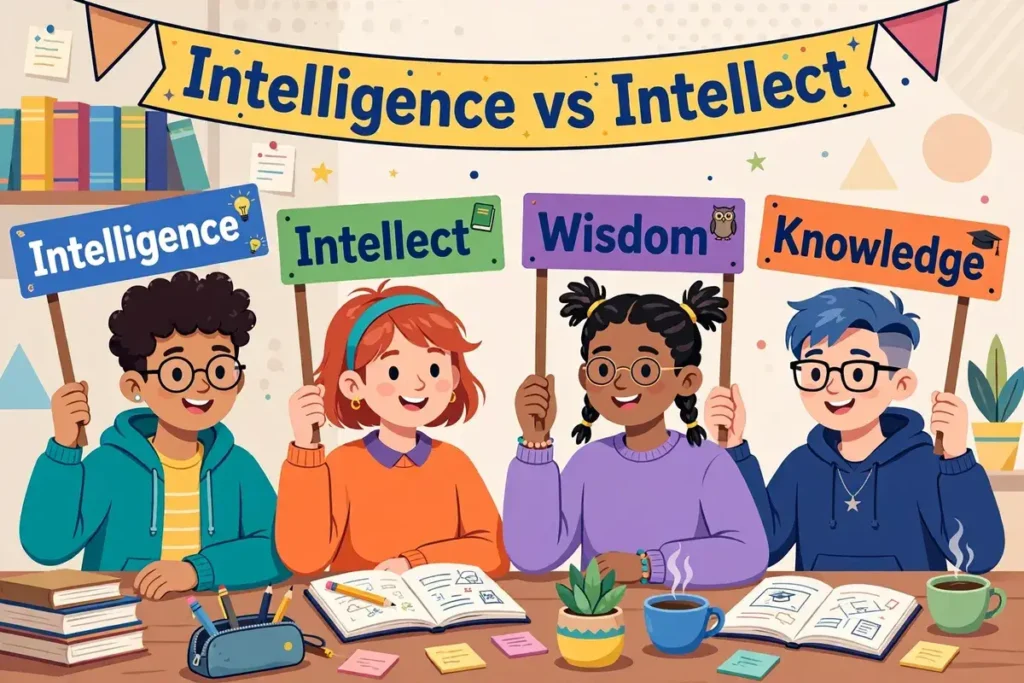
Intelligence vs Intellect vs Wisdom vs Knowledge
Intelligence, intellect, wisdom and knowledge are related, but each word describes a different idea. Choosing the right one prevents confusion in essays, reports and everyday writing.
| Word | Core idea | What it covers | Best use | Example |
|---|---|---|---|---|
| Intelligence | The general capacity to learn, understand and solve problems | The whole ability, including learning, reasoning and adapting | General description of a person’s mind | Her intelligence showed in how fast she learned the new system. |
| Intellect | The thinking faculty itself | The power to think, understand and reason | Formal and academic writing | The essay explores the link between intellect and experience. |
| Wisdom | Good judgment built from experience | Decisions shaped by a lifetime of learning | Reflective writing and praise of a careful choice | His wisdom showed when he listened first and decided later. |
| Knowledge | What someone has learned | Facts, information and skills already gained | School, work and subject writing | Her knowledge of the archive helped identify the photograph. |
Intelligence vs IQ
Intelligence is a person’s mental capacity. IQ is a score from a test that claims to measure intelligence. An IQ score is not the ability itself or a complete measure of a person.
Intelligence vs Smart
Intelligence is a noun for mental capacity. Smart is an adjective that describes a person. You can say someone is smart, but intelligence is the correct noun when naming the ability.
Intelligence Is the Capacity, Intellect Is the Faculty That Does the Thinking, Knowledge Is What You Have Already Learned, and Wisdom Is What Experience Teaches You to Do With It All
This is the simplest way to keep the four words apart.
Intelligence describes the general ability. Intellect refers to the thinking faculty. Knowledge is the information and skills a person has gained. Wisdom describes the good judgment that grows through experience.
For example, a student may have strong intelligence and learn a new subject quickly. The student gains knowledge through study. Over time, experience may develop wisdom about how to use that knowledge well.

Other Ways to Say “Intelligence”
Sometimes a short phrase sounds more natural than a single synonym. These six expressions can help you praise someone’s thinking, describe quick decisions or refer to a large amount of learned information.
1. A Sharp Mind
Tone: Casual.
Meaning: A person who thinks clearly and understands things quickly.
Example: He’s got a sharp mind and notices details others miss.
A sharp mind is a friendly way to praise someone’s thinking. It works in casual conversations and personal descriptions. It is not a formal technical term.
2. Quick Thinking
Tone: Neutral, everyday.
Meaning: Fast and clear thinking in a particular moment.
Example: Her quick thinking saved the meeting.
Quick thinking describes how someone reacts to an unexpected situation. It is useful when praising a fast decision or a clever response, rather than someone’s general mental ability.
3. A Brilliant Mind
Tone: Elevated, approving.
Meaning: A person with outstanding thinking ability.
Example: She has a brilliant mind for math.
A brilliant mind is strong praise for exceptional ability. It suits formal praise and personal descriptions, but it can sound exaggerated when describing ordinary work.
4. Street Smarts
Tone: Casual.
Meaning: Practical know-how gained from real-life situations rather than books.
Example: He has street smarts and knows how to handle difficult customers.
Street smarts describes practical knowledge and awareness. It is useful in everyday conversation, but it does not mean academic ability or formal education.
5. Good Sense
Tone: Neutral, everyday.
Meaning: Practical judgment about what is sensible or safe.
Example: She had the good sense to check first.
Good sense works well in everyday advice and plain writing. It describes sensible decisions rather than general intelligence or a person’s ability to learn.
6. A Wealth of Knowledge
Tone: Neutral, slightly formal.
Meaning: A large store of learned facts and information.
Example: He brings a wealth of knowledge to the team.
A wealth of knowledge is useful when praising someone’s learning or experience. It refers to what someone knows, not their general capacity to think or understand.
Antonyms of Intelligence
The direct opposite of intelligence is stupidity, but several other words describe different kinds of difficulty with thinking, learning or making decisions.
These words are not interchangeable. Some describe a lack of knowledge, while others describe poor judgment or difficulty understanding something.
1. Stupidity
Stupidity is the direct opposite of intelligence. It refers to a severe lack of understanding or reasoning ability.
Example: The decision showed serious stupidity rather than careful thought.
2. Ignorance
Ignorance means a lack of knowledge or education about a subject. It does not mean someone has low mental ability. A person can be intelligent and still be unfamiliar with a particular topic.
Example: His ignorance of local rules caused the problem.
3. Dullness
Dullness describes a lack of mental sharpness or quickness. It can refer to slow thinking or difficulty responding to ideas.
Example: The long period of tiredness left her with a dullness of thought.
4. Foolishness
Foolishness describes poor judgment or actions taken without enough sense. An intelligent person can still make a foolish decision.
Example: His foolishness became clear when he ignored the warning.
5. Misunderstanding / Misconception
A misunderstanding or misconception means getting the meaning wrong. It does not mean someone lacks the ability to think or understand.
Example: A misunderstanding about the instructions delayed the project.
Inexperience is a soft opposite in function: it means a lack of practice, not a lack of ability.
FAQs
Frequently Asked Questions
1. What is another word for intelligence?
Intellect and brainpower are useful words for general mental ability. Acumen describes practical judgment, while information and intel refer to gathered facts. Choose the word that matches the meaning and setting.
2. Are intelligence and knowledge the same?
No. Intelligence is the capacity to learn, understand and use what you know. Knowledge is what you have already learned through study or experience. Someone can have extensive knowledge without strong general reasoning.
3. What is a professional synonym for intelligence?
Acumen works well for practical business judgment, while expertise describes specialist knowledge or skill. Reasoning ability suits analytical work. For gathered facts, use information or findings instead of a mental-ability term.
4. What is the difference between intelligence and wisdom?
Intelligence is the ability to learn, reason and adapt to new situations. Wisdom is good judgment shaped by experience over time. Someone can learn quickly without having the experience needed to make wise decisions.
5. What is the opposite of intelligence?
Stupidity is the direct opposite of intelligence. Ignorance means a lack of knowledge, not low mental ability. Dullness describes reduced mental sharpness, while foolishness refers to poor judgment or unwise actions.
6. Can data replace intelligence?
Sometimes, when intelligence means gathered information. However, data is raw recorded material, while intelligence usually suggests information examined and interpreted for a purpose. A collection of measurements alone may not support a sound conclusion.