
Implement Synonyms: 43 Words to Put Plans Into Action
Implement means putting a plan, decision, policy or system into practical use. The best synonym depends on what you are doing, whether you are starting a process, carrying out instructions or making a system work.
Quick Answer
- For a plan, task or instruction, use carry out or execute.
- For a law, policy or formal rule, use enact or institute.
- For software or a system going live, use deploy or roll out.
- For a physical object (the noun sense), use tool or instrument.
- Core grammar rule: Implement is usually a transitive verb: it needs an object (implement a plan, a policy, a system). Saying only ‘we will implement’ without saying what leaves the sentence unfinished.
What Does Implement Mean?
Implement is a verb and a noun, and keeping those two jobs separate makes the synonyms easier to choose.
Oxford gives the verb as making something that has been officially decided start to happen or be used. Its listed synonym is carry out. As a noun, Oxford defines an implement as a tool or instrument, often simple and used outdoors, such as agricultural implements.
Merriam-Webster gives the verb as taking steps to put something into practice, giving practical effect by concrete measures. As a noun, Merriam-Webster describes a device used in the performance of a task.
Cambridge, verified from search-result text rather than from a direct read of the English Cambridge page, gives the learner meaning as starting to use a plan or system.
As a verb, implement describes action. As a noun, it describes an object. Confusing those jobs leads to strange sentences: a plan needs a verb, while a garden tool needs a noun.
Implement is transitive. It always needs an object. Name the plan, policy or system in the sentence. “We will implement” sounds unfinished unless the sentence also says what will be implemented. Use “We will implement the new timetable.” instead.
Related forms are implementation and implementer. The noun implementation refers to the act of starting to use a plan or system.
In computing, to implement also means to realize or instantiate an element in a program.
Word origin: Late Middle English, from medieval Latin implementa / late Latin implementum, meaning “filling up, fulfillment,” from Latin implere, “fill up,” later “employ.”
When to Use Implement Synonyms
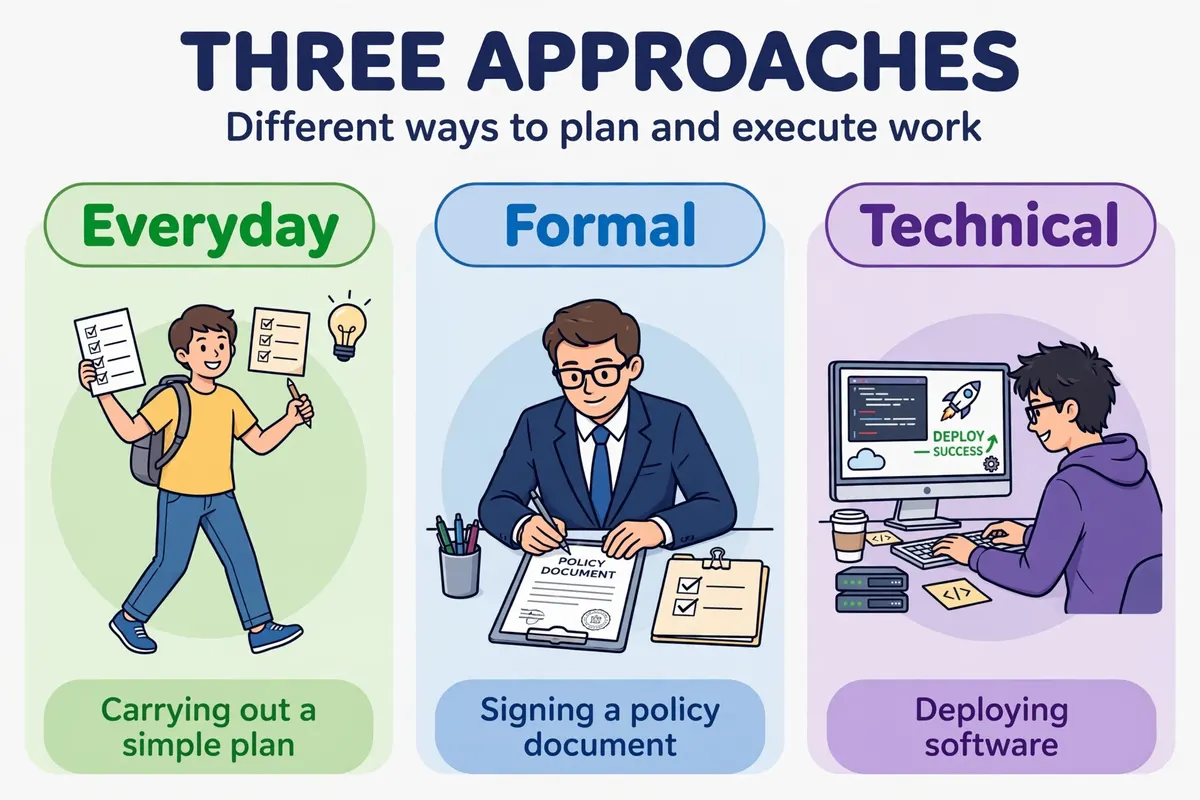
When you are writing a business report or essay, choose a word that matches the setting. Execute, institute and establish can work when the subject is formal and precise.
Laws and policies have a clear order. Enact a law or policy when it is formally approved. Institute can describe the formal setup that follows. After that step, enforce the rule when compliance needs attention.
Software and technology need a different set of words. Deploy, roll out, integrate and configure fit systems, code and settings. They describe concrete technical work.
In everyday talk and email, choose plain language. Carry out, set up, put into practice and put in place are easier to read. They keep the focus on the work, not the vocabulary.
For a CV or resume, strong achievement verbs often work better than repeated use of implemented. Words such as spearheaded, piloted or pioneered can describe what you led or tested. They are achievement words, not direct synonyms for implement, so use them only when the achievement is real.
You can also keep implement when it is the most honest choice. If the whole decision-to-use process is the point, and no single stage word describes it, implement is the clear word. Do not swap it for launch, install or activate when those words describe only part of the work.
Benefits of Using Implement Synonyms
1. It Stops Repetition
Repeating implement in every sentence can make a report feel dull. A synonym keeps the writing clear while adding variety.
2. It Names the Stage of the Work
Different words describe different stages. Launch and set up describe the start. Deploy and roll out describe release and distribution. Enforce describes compliance after the rule is in place.
3. It Matches the Tone
Formal writing needs words such as enact, institute and effectuate. Everyday writing needs plain words such as carry out, set up and begin. Technical writing needs deploy, integrate and configure.
4. It Avoids Vague Claims
“We will implement the solution” says nothing about who will do what by when. A precise synonym helps the reader see the action. It can also prompt the writer to add the missing details.
43 Best Implement Synonyms at a Glance
The list has 10 core action verbs, 9 formal and policy words, 8 starting and setting-up words, 8 tech and business words, and 8 noun-sense tools. The last eight are noun-only, not verb swaps.
| Synonym | Tone | Best for |
|---|---|---|
| Carry out | Neutral, everyday | Plans, tasks, instructions, everyday and business writing |
| Execute | Formal, business | Plans, strategies, operations, business and tech writing |
| Apply | Neutral | Rules, methods, lessons, policies |
| Put into practice | Neutral, everyday | Training, lessons, ideas, everyday writing |
| Put into effect | Formal | Policies, laws, regulations, formal writing |
| Put into action | Neutral | Plans, ideas, projects, everyday writing |
| Perform | Neutral, formal | Tasks, checks, procedures, reports |
| Undertake | Formal | Projects, trials, reviews, formal reports |
| Fulfill | Formal | Duties, promises, requirements, formal writing |
| Discharge | Formal, legal | Duties, obligations, formal and legal writing |
| Enact | Formal, legal | Laws, policies, formal decisions |
| Institute | Formal, business | Procedures, programs, policies, professional writing |
| Establish | Formal, neutral | Systems, routines, guidelines, services |
| Enforce | Formal, authoritative | Rules, policies, laws, compliance writing |
| Administer | Formal, business | Programs, funds, grants, regulatory work |
| Effectuate | Very formal, legal | Legal and policy documents |
| Give effect to | Formal, institutional | Committee decisions, institutional writing |
| Put into operation | Formal, neutral | Systems, procedures, formal instructions |
| Bring into effect | Formal | Rules, changes, policies, formal writing |
| Introduce | Neutral | New systems, methods, processes |
| Launch | Neutral, business | Projects, services, programs, business writing |
| Initiate | Formal, neutral | Projects, processes, formal writing |
| Set up | Neutral, everyday | Systems, processes, meetings, everyday writing |
| Install | Neutral, technical | Software, equipment, technical instructions |
| Activate | Neutral, technical | Accounts, features, systems, procedures |
| Begin | Neutral, everyday | Everyday writing, simple instructions |
| Commence | Formal | Formal writing, ceremonies, official processes |
| Deploy | Technical, business | Software, systems, staff, technical writing |
| Roll out | Neutral, business | Company-wide changes, product launches, training |
| Integrate | Technical, business | Software, APIs, systems, business writing |
| Configure | Technical | Software, firewalls, systems, technical writing |
| Operationalize | Technical, academic | Research, strategy, organizational writing |
| Phase in | Neutral, business | Gradual transitions, rates, new processes |
| Pilot | Neutral, business | Trials, new processes, careful rollouts |
| Follow through on | Neutral, conversational | Decisions, promises, recommendations |
| Tool | Neutral, everyday | Everyday writing, workshops, general use |
| Instrument | Formal, technical | Medicine, science, music, precise work |
| Device | Neutral, technical | Tech, descriptions, instructions |
| Utensil | Neutral, everyday | Kitchen and domestic writing |
| Equipment | Neutral, business | Workshops, preparation, resources |
| Apparatus | Formal, technical | Laboratories, experiments, technical writing |
| Appliance | Neutral, everyday | Household writing, kitchens, homes |
| Gadget | Casual, everyday | Everyday talk, informal writing, small devices |
Core Synonyms for Implement
These 10 alternatives describe the main act of carrying out a plan or instruction. The tone ranges from everyday to formal, so choose one that fits the sentence.
1. Carry out
Tone: Neutral, everyday · Uses: Plans, tasks, instructions, everyday and business writing
Meaning: Do the work named in a plan, instruction or task.
Explanation: Carry out is one of the most direct and flexible alternatives. It is not suitable for a long sentence about a small adjustment because it can sound heavy.
Examples:
- Our team will carry out the safety checks before the building opens.
- She will carry out the instructions in the new handbook.
2. Execute
Tone: Formal, business · Uses: Plans, strategies, operations, business and tech writing
Meaning: Carry out a plan, instruction or operation carefully and fully.
Explanation: Execute emphasizes the action needed to complete a defined plan. It is common in business, project management and technical writing. The word also has a legal meaning related to carrying out a death sentence, so give it a clear object and context.
Examples:
- The team executed the launch plan without missing a step.
- We will execute the safety plan during the first week.
3. Apply
Tone: Neutral · Uses: Rules, methods, lessons, policies
Meaning: Use a rule, method, principle or piece of knowledge in a situation.
Explanation: Apply works when a person uses a method, rule or principle in a specific situation. It is broader than implement, so it does not always describe the first use of a new plan. Use it when the method itself is established and is being put into use.
Examples:
- Teachers can apply the new reading method in every class.
- The nurse applied the clinic’s new procedure during the morning shift.
4. Put into practice
Tone: Neutral, everyday · Uses: Training, lessons, ideas, everyday writing
Meaning: Turn an idea, lesson or method into actual behavior.
Explanation: Put into practice is a clear phrase for moving from theory to action. It suits everyday explanations, training materials and general writing. It does not promise that the first attempt will work.
Examples:
- We put the training into practice during the first week.
- The students put the new study method into practice before the test.
5. Put into effect
Tone: Formal · Uses: Policies, laws, regulations, formal writing
Meaning: Make a policy, law or change start operating.
Explanation: Put into effect is a formal alternative to implement. It often appears in legal, administrative and policy writing. It is more formal than put into practice and has a similar structure.
Examples:
- The school put the new timetable into effect at the start of term.
- The council will put the new parking rule into effect next month.
6. Put into action
Tone: Neutral · Uses: Plans, ideas, projects, everyday writing
Meaning: Start using an idea or plan in real work.
Explanation: Put into action emphasizes the step of turning a plan into work. It is useful for project updates, instructions and practical guidance. It is close in meaning to put into practice, so avoid repeating both phrases in the same paragraph.
Examples:
- The team put the plan into action after the meeting.
- We will put the idea into action once the budget is approved.
7. Perform
Tone: Neutral, formal · Uses: Tasks, checks, procedures, reports
Meaning: Do a task, action or operation as specified.
Explanation: Perform works when implementation involves doing a defined task or operation. It is common in instructions, reports and technical descriptions. It is broader than implement, does not usually describe introducing a new policy, and can also mean presenting music or entertainment.
Examples:
- The technician will perform the system check on Monday.
- Staff must perform the safety procedure before every shift.
8. Undertake
Tone: Formal · Uses: Projects, trials, reviews, formal reports
Meaning: Take on work or responsibility and carry it out.
Explanation: Undertake emphasizes accepting responsibility for a piece of work. It can describe the start of a project and the effort involved in completing it. However, undertaking a task does not prove that it was finished.
Examples:
- The research team undertook the fieldwork in three districts.
- We will undertake a review of the current process.
9. Fulfill
Tone: Formal · Uses: Duties, promises, requirements, formal writing
Meaning: Carry out a duty, promise or requirement completely.
Explanation: Fulfill stresses completion of something owed, promised or required. It can replace implement when the sentence concerns carrying out a duty or meeting a requirement. It does not usually mean starting a new system.
Examples:
- The director fulfilled her promise to update the policy.
- The school must fulfill its duty to keep students safe.
10. Discharge
Tone: Formal, legal · Uses: Duties, obligations, formal and legal writing
Meaning: Meet the demands of a duty or responsibility.
Explanation: Discharge is a formal choice for carrying out a duty or responsibility. The phrase discharge a duty is the most natural use. It sounds stiff in everyday conversation, so use carry out or fulfill in less formal contexts.
Examples:
- The officer discharged her responsibilities with care.
- He will discharge the duties listed in the contract.
Formal Synonyms for Implement
These nine words suit laws, rules, policies and official processes. They are formal, so they work better in reports, legal writing and formal notices than in casual conversation.
11. Enact
Tone: Formal, legal · Uses: Laws, policies, formal decisions
Meaning: Make a rule or measure formally operative.
Explanation: Enact is especially suitable when a legislature or authorized body makes a law. It describes the formal step that gives a measure legal force. It is narrower than implement because a law may be enacted before agencies complete the work needed to put its requirements into practice.
Examples:
- The council enacted stricter parking rules last year.
- Parliament will enact the new law in the spring.
12. Institute
Tone: Formal, business · Uses: Procedures, programs, policies, professional writing
Meaning: Establish a practice, rule or system formally.
Explanation: Institute emphasizes formally introducing an organized practice. It works well for workplace policies, review procedures and institutional rules. It often suggests a continuing arrangement rather than a single task.
Examples:
- The company instituted a new safety policy.
- The university will institute a review process for all courses.
13. Establish
Tone: Formal, neutral · Uses: Systems, routines, guidelines, services
Meaning: Create something and make it a recognized arrangement.
Explanation: Establish focuses on creating a system, structure or arrangement. It can replace implement when the important point is making a new process or framework available. It does not describe every action that takes place inside the system.
Examples:
- The company established a process for reporting problems.
- The team will establish a clear routine for the new service.
14. Enforce
Tone: Formal, authoritative · Uses: Rules, policies, laws, compliance writing
Meaning: Make sure a rule or requirement is followed.
Explanation: Enforce is not a direct replacement for every use of implement. It describes making people comply with a rule that already exists, often through monitoring or consequences. A policy must be put into effect before an organization can enforce it.
Examples:
- The council enforces the parking rules with fines.
- The school will enforce the new safety policy from next term.
15. Administer
Tone: Formal, business · Uses: Programs, funds, grants, regulatory work
Meaning: Manage and be responsible for running a program or system.
Explanation: Administer suits work that involves managing a program after it has been introduced. It can include handling applications, tracking records and coordinating services. It describes ongoing management more than the first act of implementation.
Examples:
- The office administers the grant program for small schools.
- She will administer the new testing system this year.
16. Effectuate
Tone: Very formal, legal · Uses: Legal and policy documents
Meaning: Cause something to happen as intended.
Explanation: Effectuate appears mainly in legal and highly formal writing. It describes taking action that brings a decision, agreement or intended result into effect. The word can sound unnecessarily complex in general writing.
Examples:
- The agreement effectuates the new safety rules.
- The court order will effectuate the change in policy.
17. Give effect to
Tone: Formal, institutional · Uses: Committee decisions, institutional writing
Meaning: Make a decision, rule or intention operate in practice.
Explanation: Give effect to is a formal phrase often used in legal, administrative and institutional contexts. It connects an official decision or intention with the practical steps that make it work. Because it is a phrase, check the sentence structure around it.
Examples:
- The committee gave effect to the decision at its next meeting.
- The new rules will give effect to the safety policy.
18. Put into operation
Tone: Formal, neutral · Uses: Systems, procedures, formal instructions
Meaning: Make a system or arrangement start functioning.
Explanation: Put into operation suits a system or process that is ready to function. It emphasizes the point when the arrangement begins working in practice. It does not prove that the system is reliable or that users understand it.
Examples:
- The team put the new system into operation in January.
- We will put the revised process into operation next week.
19. Bring into effect
Tone: Formal · Uses: Rules, changes, policies, formal writing
Meaning: Cause a rule, change or plan to start having real force.
Explanation: Bring into effect is close to put into effect. It suits formal announcements about a new rule, policy or change that will become active on a set date. The phrase is more natural in official writing than in casual conversation.
Examples:
- The department will bring the revised standards into effect in January.
- The new agreement was brought into effect after the vote.
Synonyms for Starting to Implement
These eight words describe the beginning or setup of an implementation. They do not cover the whole process, so pair them with a later step when the work continues.
20. Introduce
Tone: Neutral · Uses: New systems, methods, processes
Meaning: Bring something new into use for the first time.
Explanation: Introduce is useful when the sentence focuses on a first use or an initial change. It often describes a method, tool or system that has not been used before. Introducing a system does not prove that everyone has adopted it.
Examples:
- The company introduced a new booking system last month.
- We will introduce a simpler form for parents.
21. Launch
Tone: Neutral, business · Uses: Projects, services, programs, business writing
Meaning: Start a project, service or program publicly or in operation.
Explanation: Launch emphasizes the beginning of an organized activity or the public release of something new. Businesses often use it for products, services and programs. A launch is only a starting point, not proof that the whole project has been delivered.
Examples:
- The nonprofit launched a new reading program in September.
- The school will launch the updated timetable next term.
22. Initiate
Tone: Formal, neutral · Uses: Projects, processes, formal writing
Meaning: Start something new; take the first step.
Explanation: Initiate is a formal way to describe taking the first step. It suits procedures, investigations, projects and planned changes. It does not mean the entire process has been completed.
Examples:
- The agency initiated a review of the safety rules.
- We will initiate the new process on Monday.
23. Set up
Tone: Neutral, everyday · Uses: Systems, processes, meetings, everyday writing
Meaning: Prepare or establish something for use.
Explanation: Set up is a natural everyday phrase for preparing a system or arrangement. It may involve creating accounts, organizing resources or putting equipment in place. Setting something up does not always include the work of using it over time.
Examples:
- We set up a shared folder for the project files.
- The team will set up the new system before the term starts.
24. Install
Tone: Neutral, technical · Uses: Software, equipment, technical instructions
Meaning: Place equipment or software where it can be used, with the required setup.
Explanation: Install is appropriate when the work involves placing equipment, adding software or fitting a component. It is narrower than implement because it describes a specific setup task. Installation does not guarantee adoption, successful use or staff training.
Examples:
- The technician installed the new software on Monday.
- We will install the updated system this week.
25. Activate
Tone: Neutral, technical · Uses: Accounts, features, systems, procedures
Meaning: Make something begin working or become available.
Explanation: Activate suits software, accounts and features that exist but are not yet in use. It is common in technical instructions and service settings. It is narrower than implement because it focuses on switching something on rather than building or delivering a complete change.
Examples:
- The team activated the new account on Friday.
- We will activate the feature after the update.
26. Begin
Tone: Neutral, everyday · Uses: Everyday writing, simple instructions
Meaning: Start an action or process.
Explanation: Begin is one of the simplest alternatives when the sentence focuses on starting work. It is easy to understand and fits everyday conversation, instructions and general writing. It says nothing about whether the work will continue or reach completion.
Examples:
- We began the process with a short meeting.
- The school will begin the new timetable next term.
27. Commence
Tone: Formal · Uses: Formal writing, ceremonies, official processes
Meaning: Begin something formally.
Explanation: Commence is a formal alternative to begin. It appears in contracts, notices, official schedules and formal announcements. It can sound stiff in everyday conversation.
Examples:
- The hearing commenced at 10 a.m.
- The project will commence in the new year.
Synonyms for Implementing in Tech and Business
These eight words are useful when a project involves software, systems or business operations. They describe stages such as release, setup, connection and testing.
28. Deploy
Tone: Technical, business · Uses: Software, systems, staff, technical writing
Meaning: Place resources or a system into active use.
Explanation: Deploy is common in technology when software, code or a system is released into an environment where it can be used. It can also describe placing resources into position for a task. It is not a general replacement for implement in every context, so use it when the technical or operational setting supports the word.
Examples:
- The team deployed the update on Friday.
- We will deploy the new system after testing.
29. Roll out
Tone: Neutral, business · Uses: Company-wide changes, product launches, training
Meaning: Introduce a product, service or process to its users, often in stages.
Explanation: Roll out is common in business and technology writing. It often describes making a new product, service or process available to customers or employees. The phrase emphasizes distribution or introduction, not all the design, setup or ongoing work behind the change.
Examples:
- The school rolled out the new timetable in stages.
- We will roll out the updated process next month.
30. Integrate
Tone: Technical, business · Uses: Software, APIs, systems, business writing
Meaning: Connect a solution with existing systems, workflows or data.
Explanation: Integrate is the right choice when implementation involves making separate parts work together. It can describe connecting software, sharing data or adding a new tool to an established workflow. It stresses connection rather than the entire implementation process.
Examples:
- The company integrated the new tool with its booking system.
- We will integrate the payment system with the website.
31. Configure
Tone: Technical · Uses: Software, firewalls, systems, technical writing
Meaning: Adjust settings, permissions or parameters for a specific need.
Explanation: Configure describes the setup of a system’s settings and options. It is useful in IT instructions and technical reports where the task involves permissions, preferences or operating parameters. It does not mean building, adopting or running the entire system.
Examples:
- The technician configured the firewall for the office network.
- We will configure the settings before the launch.
32. Operationalize
Tone: Technical, academic · Uses: Research, strategy, organizational writing
Meaning: Turn a concept or plan into a defined working process.
Explanation: Operationalize is used in technical, academic and business contexts. It can describe turning a broad concept into specific procedures, measures or activities. The word may sound like jargon to general readers.
Examples:
- The department operationalized the new safety policy.
- We will operationalize the plan through clear steps and deadlines.
33. Phase in
Tone: Neutral, business · Uses: Gradual transitions, rates, new processes
Meaning: Bring in a change gradually, in stages.
Explanation: Phase in emphasizes a gradual introduction rather than a single launch date. It is useful when employees, customers or systems need time to adjust. The phrase describes the pace of implementation, not whether the change has reached everyone.
Examples:
- The district phased in the new schedule over three months.
- We will phase in the changes gradually.
34. Pilot
Tone: Neutral, business · Uses: Trials, new processes, careful rollouts
Meaning: Test a program or process in a small group before full use.
Explanation: Pilot is useful when an organization tests a new program or process with a limited group. The results can help identify problems before a larger release. A pilot is not the same as full implementation.
Examples:
- The company piloted the new process with a small team.
- We will pilot the updated system in two schools.
35. Follow through on
Tone: Neutral, conversational · Uses: Decisions, promises, recommendations
Meaning: Continue with a promise or plan until the necessary action is taken.
Explanation: Follow through on emphasizes persistence and responsibility. It suits situations where someone must keep working after making a promise or agreeing to a plan. It focuses on continued action, not the formal introduction of a system.
Examples:
- The team followed through on its promise to update the policy.
- We will follow through on the decision at the next meeting.
Implement as a Noun: Synonyms for a Tool
These eight words replace implement ONLY when it is a noun meaning a physical object. None of them can replace the verb “to implement”. A tool can replace implement in the sentence “The farmer cleaned the implement.” It cannot replace implement in the sentence “The farmer will implement a new watering plan.”
36. Tool
Tone: Neutral, everyday · Uses: Everyday writing, workshops, general use
Meaning: An object used to carry out a task.
Explanation: Tool is the broadest and most familiar alternative for a physical implement. It works for hand tools, practical equipment and objects used to complete a task. It may be too general when the design or special purpose of an object matters.
Examples:
- The gardener cleaned every tool before putting it away.
- She reached for a small tool to fix the loose screw.
37. Instrument
Tone: Formal, technical · Uses: Medicine, science, music, precise work
Meaning: A tool used for precise or specialized work, measurement or performance.
Explanation: Instrument often suggests precision or a specific function. It is suitable for scientific, medical, technical and professional settings. The word also refers to musical instruments and formal legal documents, so give the surrounding sentence enough context.
Examples:
- The nurse cleaned the instrument before the procedure.
- The scientist used a precise instrument to measure the sample.
38. Device
Tone: Neutral, technical · Uses: Tech, descriptions, instructions
Meaning: An object designed for a particular function.
Explanation: Device is useful when an implement has a specific design or mechanical function. It often appears in technical descriptions and product information. It can describe a wider range of objects than tool, but may suggest a mechanism or system rather than a simple hand-held object.
Examples:
- The device fits easily in a small toolbox.
- He used a simple device to hold the paper in place.
39. Utensil
Tone: Neutral, everyday · Uses: Kitchen and domestic writing
Meaning: A tool used for a practical task, especially preparing or serving food.
Explanation: Utensil is most common for objects used in cooking, eating and serving food. It can also describe certain practical household tools. The word is narrower than implement and is not a good replacement for a large machine or an abstract method.
Examples:
- She placed the utensils in the drawer after washing them.
- The kitchen has a utensil for every task.
40. Equipment
Tone: Neutral, business · Uses: Workshops, preparation, resources
Meaning: The tools and other items needed for an activity, taken together.
Explanation: Equipment refers to tools and other useful items as a group. It suits workplaces, sports, construction, laboratories and many other settings. Equipment is generally uncountable, so use “a piece of equipment” when you need a singular expression.
Examples:
- The school bought new sports equipment for the gym.
- We need the right equipment before we start the job.
41. Apparatus
Tone: Formal, technical · Uses: Laboratories, experiments, technical writing
Meaning: The equipment or assembled devices used for a particular purpose.
Explanation: Apparatus often describes equipment made up of several parts. It is common in scientific, technical and specialized settings. It sounds more formal than tool and may be excessive for a simple household object.
Examples:
- The laboratory has the apparatus for the experiment.
- The technician checked the apparatus before the test.
42. Appliance
Tone: Neutral, everyday · Uses: Household writing, kitchens, homes
Meaning: A tool or instrument using a power source, often portable.
Explanation: Appliance is common for household devices such as ovens, washing machines and vacuum cleaners. It can also describe certain powered tools used for specific tasks. Not every implement is an appliance, so use the word when the object has a mechanical or electrical function.
Examples:
- The new appliance fits under the kitchen counter.
- She unplugged the appliance after using it.
43. Gadget
Tone: Casual, everyday · Uses: Everyday talk, informal writing, small devices
Meaning: A small mechanical device or tool, often clever or new.
Explanation: Gadget often suggests something compact, clever or new. It works in casual writing about useful devices and small tools. It is less suitable for formal reports or serious technical descriptions.
Examples:
- The gadget makes it easier to open the jar.
- He bought a small gadget for his desk.
Implement vs Execute vs Enforce vs Adopt
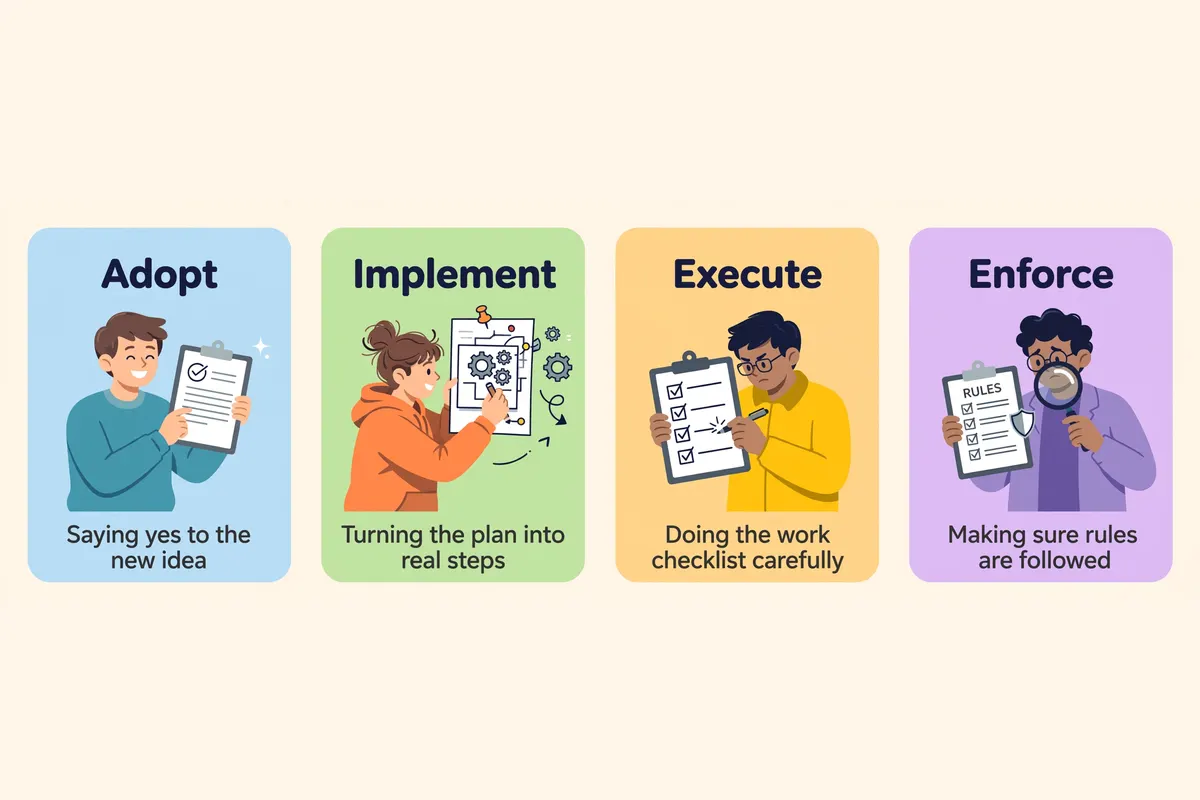
Implement, execute, enforce and adopt are often used in the same discussions, but they describe different parts of the process. The table below shows the difference in one view.
| Word | Core idea | What it stresses | Best for | Example |
|---|---|---|---|---|
| Implement | Put a decided plan, policy or system into effect | The whole move from decision to real use | Plans, policies, systems, programs | The school will implement the new timetable next term. |
| Execute | Carry out a plan or operation carefully and fully | Precision and completion | Plans, strategies, operations | The team executed the launch plan without missing a step. |
| Enforce | Make sure a rule is followed, with consequences if it is not | Compliance after the rule exists | Rules, laws, policies already in force | The council enforces the new parking rules with fines. |
| Adopt | Choose and accept a policy, method or system | Acceptance, not action | Policies, frameworks, approved methods | The board adopted the new safety policy in March. |
Implement vs Apply: Apply is broader than implement because an established method can be applied again and again.
Implement vs Deploy: Deploy is technical only. It fits software, systems and staff moved into position.
Adopt it first, implement it second, enforce it third. If you only adopted it, the work has not started yet. If you only enforced it, someone else already implemented it.
Other Ways to Say “We Will Implement …”
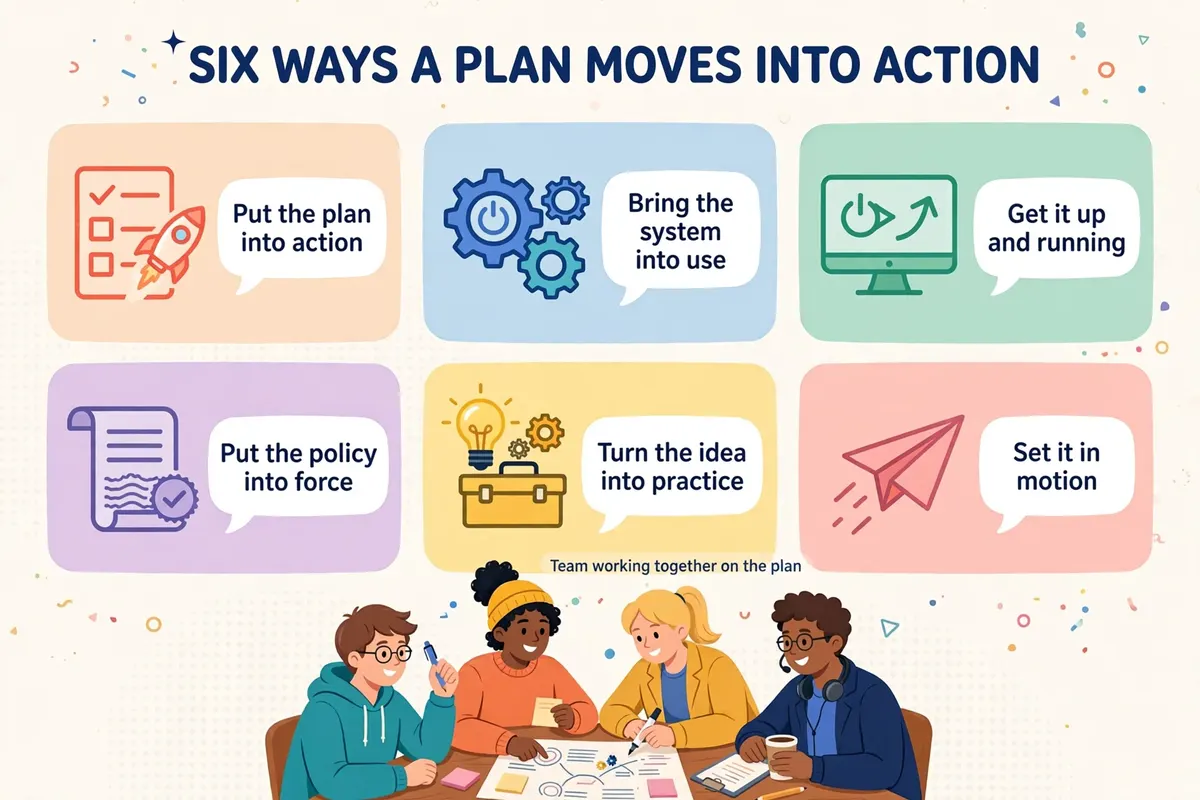
1. Put the plan into action
Tone: Neutral, plain
Meaning: The plainest phrase form of implement.
Example: We will put the plan into action after the budget receives approval.
2. Bring the new system into use
Tone: Neutral
Meaning: For systems and services starting for the first time.
Example: We will bring the new system into use at the start of the next quarter.
3. Get the new process up and running
Tone: Everyday
Meaning: For a process that must actually work, not just be announced.
Example: We will get the new process up and running before the busy season.
4. Put the policy into force
Tone: Formal
Meaning: For laws and rules.
Example: We will put the policy into force on the first day of July.
5. Turn the idea into practice
Tone: Neutral, everyday
Meaning: For lessons, training and ideas becoming real behavior.
Example: We will turn the idea into practice through a series of small changes.
6. Set the new system in motion
Tone: Formal
Meaning: For starting a process that will then run.
Example: We will set the new system in motion after the final review.
Antonyms of Implement
Abandon is the clearest verb opposite.
Opposites That Mean Stop or Cancel
- Abandon: To stop working on a plan or project.
- Cancel: To decide that a planned activity will not happen.
- Repeal: To officially remove a law or regulation.
- Discontinue: To stop providing or carrying out something.
- Withdraw: To remove a proposal, decision or offer.
- Halt: To bring an activity or process to a stop.
- Cease: To stop an action or activity.
Opposites That Mean Fail to Follow Through
- Neglect: To fail to give something the attention or action it needs.
- Ignore: To choose not to consider or act on something.
- Disregard: To treat a rule, instruction or recommendation as unimportant.
- Delay: To put off an action until a later time.
These words do not always mean that a plan has been canceled. A delayed project may still be implemented later.
Opposites That Mean Undo
- Undo: To reverse an action or change.
- Dismantle: To take a system or structure apart.
- Revoke: To officially withdraw permission, authority or a decision.
- Remove: To take something away from its place or use.
Does the Noun Implement Have an Antonym?
There is no direct single-word opposite for implement when it means a physical tool. A tool is an object, so its opposite depends on the context. You might describe something as a non-tool, but that is not a standard dictionary antonym.
FAQs
Frequently Asked Questions
1. What is another word for implement?
Carry out and execute are common alternatives when implement refers to a plan or task. For a policy, consider enact or institute. For software, deploy or roll out may be more precise, depending on the work.
2. What is the difference between implement and execute?
Implement means putting a plan, policy or system into practical use. Execute stresses carrying out a defined plan or operation, often with precision and completion. The words overlap, but their emphasis can differ.
3. What is the difference between implement and enforce?
Implement means putting a rule, policy or system into effect. Enforce means making sure people follow it, often through monitoring or consequences. An organization normally implements a policy before it enforces compliance.
4. Can I use deploy as a synonym for implement?
Yes, deploy can replace implement in suitable technical contexts, especially when placing software, systems or resources into active use. It is narrower than implement, so it may not fit general policies or everyday tasks.
5. Is implement a verb or a noun?
Implement can be both. As a verb, it means putting a plan or system into effect. As a noun, it means a physical tool or instrument. The sentence determines which meaning applies.
6. What is a formal synonym for implement?
Enact, institute, effectuate and give effect to are formal alternatives. Enact suits laws, while institute suits official practices. Effectuate and give effect to appear more often in legal or institutional writing than everyday conversation.
Avoid confusing implement with earlier or later stages. Adopt means accept a choice. Implement means put a choice into effect. Also avoid the false form “implementate.” It is not a standard English word. Employ and utilize are not direct synonyms for implement because they are too general.