Excellent Synonyms: 28 Words That Sound Truly Great
The word excellent works in almost any situation, but using it repeatedly can make your writing sound dull. These 28 excellent synonyms help you praise work, people, food, experiences, and achievements with the right tone.
Quick Answer
For everyday praise, use great, terrific or fantastic. For essays, reports and formal writing, use outstanding, exceptional or superb. For work and achievements, use outstanding, exemplary or first-rate. For food, trips and enjoyable experiences, use superb, wonderful or fabulous.
Excellent means “extremely good”, stronger than good and weaker than perfect, so pick the synonym that matches how strong the praise really is.
What Does Excellent Mean?
Excellent means extremely good. It describes something with a very high level of quality, skill, performance, or enjoyment.
Oxford gives the word two main uses. The first describes something extremely good, such as an excellent book, excellent results, or excellent work. The second use expresses approval or pleasure. For example, someone might hear good news and reply, “Excellent!”
Merriam-Webster connects excellent with something of the very best kind. Cambridge also gives two useful senses: better than anyone or anything else, and extremely pleasant, enjoyable, or likable.
Here are a few examples of the word in natural sentences:
- The meal looked and tasted excellent.
- Both the food and the service were truly excellent.
- She did an excellent job adapting the novel for the screen.
- He was an excellent singer.
- The food was excellent, thank you.
The two jobs of excellent
1. Describing quality
Use excellent before a noun or after a linking verb when you want to describe something.
- She received excellent reviews.
- The car is in excellent condition.
- They delivered excellent service.
2. Expressing approval
Use excellent on its own when you want to show that you like an idea, plan, or piece of news.
- “You can all come?” “Excellent!”
- “We finished the project early.” “Excellent!”
The word family includes excellence, the noun, and excellently, the adverb.
The word comes from late Middle English, through Old French, from the Latin excellent-, meaning “being pre-eminent.” Its root, excellere, means “surpass.”
One distinction matters: excellent is stronger than good, but it does not mean perfect. Perfect suggests that nothing could be better. Excellent allows for a very high standard without making that claim.
When to Use Excellent Synonyms
The best replacement depends on what you are praising and who will read your words. A synonym that sounds natural in a text message may feel out of place in a school essay.
Essays and school writing
Choose words that sound clear and measured. Outstanding, exceptional, and remarkable work well when you discuss strong results, research, or achievements.
For example:
- The student delivered an outstanding analysis of the novel.
- The study produced remarkable results.
Resumes and job applications
A resume needs specific praise that supports your skills and results. Exceptional, outstanding, stellar, and first-rate can describe strong performance.
For example:
- Delivered outstanding customer service across a busy support team.
- Earned recognition for exceptional project management.
Use these words only when your experience supports the claim. A clear result often says more than a string of praise words.
Business emails and reports
For a professional tone, consider superior, first-class, and exemplary.
For example:
- The team provided first-class support during the rollout.
- The report shows exemplary attention to detail.
Choose the word that matches the point you want to make. Superior suggests a comparison, while exemplary describes work others could follow as a model.
Everyday talk and messages
For friendly conversations, great, terrific, fantastic, and awesome sound natural.
For example:
- Your new apartment looks fantastic.
- That was a terrific idea.
- We had a great time at the concert.
Awesome is more casual, so save it for relaxed conversations and informal messages.
Food and experiences
Food, travel, entertainment, and special occasions often call for superb, wonderful, or fabulous.
For example:
- The restaurant served a superb dinner.
- We had a wonderful weekend by the lake.
- The band gave a fabulous performance.
You do not need to replace excellent every time. If the word expresses your praise simply and sincerely, keep it.
Benefits of Using Excellent Synonyms
A wider vocabulary gives you more control over your praise. The goal is not to make every sentence sound grand. It is to choose a word that says exactly what you mean.
1. You avoid repeating the same word
Using excellent several times in one paragraph can make your writing feel repetitive.
Compare these sentences:
The hotel was excellent. The staff were excellent, too. The breakfast was excellent.
Now try:
The hotel was wonderful. The staff were outstanding, and breakfast was superb.
The second version gives each detail its own character.
2. You match the situation
Some words suit a formal report. Others belong in everyday conversation.
For example, exemplary fits a report about workplace conduct. Fantastic sounds more natural when you praise a friend’s new home.
3. You explain what makes something stand out
Different synonyms point to different kinds of quality.
Outstanding says something stands out from the rest.
Exceptional suggests quality far above the usual level.
Superb gives a sense of memorable quality.
Magnificent suggests something grand or impressive.
The right choice adds useful detail instead of simply making the praise louder.
4. You avoid words that praise too little
Words such as average or mediocre do not carry the same force as excellent. They describe a much lower level of quality.
Weak-word and perfect traps: Perfect is stronger than excellent. Oxford defines perfect as “so good that it could not be better,” and perfect is not one of the 28 synonyms. Good, fine, decent, adequate, satisfactory, acceptable, passable, OK, all right, tolerable, and standard mean “good enough”, not “extremely good”, so they are not synonyms of excellent.
Before choosing a replacement, ask what you want the reader to understand. Is the work unusually good, highly polished, memorable, or simply enjoyable? Your answer will guide you toward a more accurate word.

28 Best Excellent Synonyms at a Glance
This list contains 28 choices in four groups. The first group has eight formal words, while the work-and-writing group adds seven professional choices. Seven everyday words offer a more relaxed tone, and six strong words add a sense of grandeur or intensity.
| Synonym | Tone | Best for |
|---|---|---|
| Outstanding | Formal, professional | Work, achievements, reports, essays |
| Exceptional | Formal, academic | Essays, reports, academic and technical writing |
| Superb | Formal, elegant | Food, service, performances, formal praise |
| Superlative | Very formal, literary | Formal writing, reviews, speeches |
| Unparalleled | Formal, literary | Formal writing, speeches, skill, bravery |
| Peerless | Formal, literary | Formal writing, literary praise, skill |
| Unmatched | Formal | Reports, formal praise, skills |
| Matchless | Formal, literary | Formal writing, literary praise |
| Wonderful | Warm, everyday | Everyday talk, messages, experiences, trips |
| Terrific | Warm, enthusiastic | Everyday talk, good news, casual writing |
| Fantastic | Enthusiastic, everyday | Everyday talk, ideas, casual praise |
| Fabulous | Warm, enthusiastic | Everyday talk, clothes, parties, experiences |
| Great | Casual, everyday | Everyday talk, messages, casual settings |
| Awesome | Casual, informal | Everyday talk, casual writing, young speakers |
| Amazing | Casual, informal | Everyday talk, performances, experiences |
| First-rate | Formal, professional | Services, work, reviews, professional writing |
| First-class | Formal, professional | Services, facilities, products, professional writing |
| Top-notch | Neutral, professional | Work, services, professional and everyday writing |
| Stellar | Modern, professional | Work, performances, reviews, modern business writing |
| Remarkable | Neutral, formal | Essays, reports, progress, results |
| Exemplary | Formal, academic | Reports, safety records, behavior, academic writing |
| Superior | Formal, professional | Reports, products, accuracy, professional writing |
| Splendid | Formal, warm | Formal writing, views, occasions, praise |
| Magnificent | Formal, grand | Buildings, views, performances, grand occasions |
| Brilliant | Informal (UK), enthusiastic | Everyday talk, ideas, UK English |
| Sensational | Enthusiastic, media | Reviews, media, performances, headlines |
| Exquisite | Formal, refined | Craft, food, design, art |
| Sublime | Formal, literary | Nature, art, music, literary writing |
Formal Synonyms for Excellent
These eight words suit careful writing, professional praise, and formal descriptions. Some are stronger or more literary than others, so choose them with the audience in mind.
1. Outstanding
Tone: Formal, professional
Uses: Work, achievements, reports, essays
Meaning: Extremely good; stands out clearly from the rest.
Outstanding describes work or performance that rises above the usual standard. It is a strong choice for achievements, results, and people who do something especially well. Oxford often uses it to describe how well someone does something, as in an outstanding achievement.
Examples:
- Maya received an outstanding review for her research project.
- The team delivered an outstanding performance during the final presentation.
2. Exceptional
Tone: Formal, academic
Uses: Essays, reports, academic and technical writing
Meaning: Unusually good; far above the usual standard.
Exceptional suggests that something is rare in its quality, not merely strong. Use it when the result genuinely goes beyond what people normally expect. It can describe talent, leadership, service, or a major achievement.
Examples:
- The researcher made an exceptional contribution to the study.
- Her exceptional leadership helped the group finish a difficult project.
3. Superb
Tone: Formal, elegant
Uses: Food, service, performances, formal praise
Meaning: Extremely good and impressive; of the highest quality.
Oxford calls superb informal in its Learner’s entry and formal in its American entry. The corpus study finds it the least formal of the big three, with outstanding most formal and excellent in the middle.
Examples:
- The chef prepared a superb meal for the guests.
- The orchestra gave a superb performance at the concert.
4. Superlative
Tone: Very formal, literary
Uses: Formal writing, reviews, speeches
Meaning: Of the very highest quality; better than all others.
Superlative is a strong word for praise at the highest level. It often appears in formal reviews, speeches, and polished writing. In everyday conversation, it can sound too grand for an ordinary compliment.
Examples:
- The critic praised the novel for its superlative writing.
- The museum received superlative reviews for its new exhibition.
5. Unparalleled
Tone: Formal, literary
Uses: Formal writing, speeches, praise of skill or bravery
Meaning: With no equal; nothing else reaches the same level.
Unparalleled describes something that has no real comparison. It often suits skill, bravery, service, or a record of achievement. Cambridge uses it in the phrase “unparalleled bravery,” which shows how strongly the word can praise an action.
Examples:
- The rescue team showed unparalleled bravery during the storm.
- Her knowledge of classical music is unparalleled in the department.
6. Peerless
Tone: Formal, literary
Uses: Formal writing, literary praise
Meaning: With no equal; nobody else is as good.
Peerless is a formal word for someone or something without an equal. It often describes a person’s skill, judgment, or taste. It is less common in everyday speech, so use it when a literary tone fits.
Examples:
- The reviewer called the pianist’s technique peerless.
- Her peerless eye for detail made the collection stand out.
7. Unmatched
Tone: Formal
Uses: Reports, formal praise, skills
Meaning: With no equal; not beaten by anything else.
Unmatched describes a quality or skill that no competitor can equal. It works well in reports and professional praise. The word has a comparative feel, so it helps when the reader knows what standard or competition is being discussed.
Examples:
- Her skill at the piano is unmatched among the students.
- The company built an unmatched record of customer support.
8. Matchless
Tone: Formal, literary
Uses: Formal writing, literary praise
Meaning: With no equal; impossible to match.
Matchless is close in meaning to peerless and unmatched. It has an older, literary flavor and appears less often in modern everyday writing. Use it when you want a formal or poetic note.
Examples:
- The travel writer described the valley’s matchless beauty.
- His matchless skill as a craftsman earned him lasting respect.
Everyday Synonyms for Excellent
These seven words sound natural in conversation, texts, reviews, and friendly praise. Some are more enthusiastic than others, so think about how strong you want the compliment to sound.
9. Wonderful
Tone: Warm, everyday
Uses: Everyday talk, messages, experiences, trips
Meaning: Extremely good and pleasing; a delight.
Wonderful is Merriam-Webster’s lead synonym (“as in wonderful”) and the safest everyday swap for excellent. It can describe a person, experience, meal, trip, or piece of news, with a warm tone that suits speech and friendly writing.
Examples:
- We had a wonderful time at the beach.
- Your garden looks wonderful in the morning light.
10. Terrific
Tone: Warm, enthusiastic
Uses: Everyday talk, good news, casual writing
Meaning: Extremely good; exciting and pleasing.
Terrific adds energy to a compliment. It works well when you want to sound happy or enthusiastic about a result, idea, or experience. It is less suited to formal reports and academic writing.
Examples:
- You did a terrific job organizing the event.
- The children had a terrific time at the science museum.
11. Fantastic
Tone: Enthusiastic, everyday
Uses: Everyday talk, ideas, casual praise
Meaning: Extremely good; exciting and hard to believe.
Fantastic is a lively word that can express strong approval. It suits ideas, performances, plans, and enjoyable experiences. Its enthusiastic tone can feel too strong for a measured business report.
Examples:
- Your suggestion for the fundraiser is fantastic.
- The band gave a fantastic show last night.
12. Fabulous
Tone: Warm, enthusiastic
Uses: Everyday talk, clothes, parties, experiences
Meaning: Extremely good and enjoyable; delightful.
Fabulous often describes something enjoyable, attractive, or fun. It is a natural choice for parties, outfits, trips, and social experiences. It can also praise work, but its warm, lively tone makes it less suited to formal writing.
Examples:
- She wore a fabulous blue dress to the wedding.
- We had a fabulous evening with our friends.
13. Great
Tone: Casual, everyday
Uses: Everyday talk, messages, any casual setting
Meaning: Very good; a simple, flexible praise word.
Great is one of the most common words for everyday praise. It works in short replies, friendly messages, and casual conversations. It is weaker than excellent, so choose it when you want a simpler compliment.
Examples:
- That was a great idea for the school fundraiser.
- We had a great view of the city from the balcony.
14. Awesome
Tone: Casual, informal
Uses: Everyday talk, casual writing, young speakers
Meaning: Extremely good; impressive and exciting.
Awesome is a relaxed way to show strong approval. It works well in conversation and informal messages, especially when something feels exciting. Cambridge marks it as informal, so choose another word for essays and formal reports.
Examples:
- Your new bike looks awesome.
- The fireworks display was awesome from our rooftop.
15. Amazing
Tone: Casual, informal
Uses: Everyday talk, performances, experiences
Meaning: Extremely good; surprising and hard to believe.
Amazing expresses strong praise with a sense of surprise. It works for performances, experiences, achievements, and unexpected results. Because it can describe something surprising as well as something good, the surrounding sentence should make your meaning clear.
Examples:
- The singer gave an amazing performance at the festival.
- We saw an amazing view from the mountain trail.
Synonyms for Work and Writing
These seven words can help you describe professional results, services, skills, and written work. Some sound formal, while others bring a modern or more conversational tone.
16. First-rate
Tone: Formal, professional
Uses: Services, work, reviews, professional writing
Meaning: Of the highest quality; top standard.
First-rate describes work or service that meets a very high standard. It often appears before a noun, as in first-rate service or first-rate equipment. It is a useful professional choice, but it is not normally used to describe a person directly.
Examples:
- The company provided first-rate support throughout the project.
- We received first-rate service from the hotel staff.
17. First-class
Tone: Formal, professional
Uses: Services, facilities, products, professional writing
Meaning: Of the highest quality or standard.
First-class describes a high grade of service, facilities, or products. It can also refer to a travel class, so context matters. The phrase is common in business and customer reviews.
Examples:
- The hotel offers first-class facilities for business travelers.
- The repair shop delivered first-class service at a fair price.
18. Top-notch
Tone: Neutral, professional
Uses: Work, services, professional and everyday writing
Meaning: Excellent; of the very best quality.
Top-notch is a clear, punchy way to praise work or service. It has an informal flavor, but it can fit many business settings. For academic essays or very formal reports, a more formal choice may work better.
Examples:
- The design team produced top-notch work for the launch.
- Our new supplier provides top-notch customer support.
19. Stellar
Tone: Modern, professional
Uses: Work, performances, reviews, modern business writing
Meaning: Exceptionally good; outstanding, like a star performance.
Stellar is a modern word for a strong result or performance. It works well in reviews, resumes, and business writing. Its punchy style may feel less natural in older or very formal prose.
Examples:
- Jordan earned a stellar review from the project director.
- The team delivered stellar results during its first quarter.
20. Remarkable
Tone: Neutral, formal
Uses: Essays, reports, progress and results
Meaning: Worth noticing; unusually good and worthy of attention.
Remarkable describes something that deserves attention because it is unusual or impressive. It is especially useful for progress, results, changes, and achievements. It does not always mean simply very good; the idea of being worth noticing is part of its meaning.
Examples:
- The students made remarkable progress during the semester.
- Her report contains a remarkable account of the town’s history.
21. Exemplary
Tone: Formal, academic
Uses: Reports, safety records, behavior, academic writing
Meaning: So good it is a model others should follow.
Exemplary means that something sets a strong example for others. It suits conduct, safety records, leadership, and professional standards. It is not a natural choice for an ordinary meal or a casual experience.
Examples:
- The school praised his exemplary conduct throughout the year.
- The audit found exemplary safety practices at the factory.
22. Superior
Tone: Formal, professional
Uses: Reports, products, accuracy, professional writing
Meaning: Higher in quality than others; better than the rest.
Superior describes something that compares favorably with another option. It is common in reports, product reviews, and professional writing. Since it suggests a comparison, make sure the reader knows what standard or alternative you have in mind.
Examples:
- The new material offers superior protection against heat.
- The report found superior accuracy in the updated system.
Strong Synonyms for Excellent
These six words give praise a stronger or more striking feel. They can describe grand sights, beautiful objects, memorable performances, and work that deserves special attention.
23. Splendid
Tone: Formal, warm
Uses: Formal writing, views, occasions, praise
Meaning: Extremely good; magnificent and pleasing.
Splendid is a warm word that can describe quality, beauty, or an enjoyable occasion. It has a slightly old-fashioned feel, but it still works in formal writing and personal praise.
Examples:
- The guests enjoyed a splendid dinner in the garden.
- We had a splendid view of the lake from the balcony.
24. Magnificent
Tone: Formal, grand
Uses: Buildings, views, performances, grand occasions
Meaning: Extremely good and impressive on a grand scale.
Magnificent suggests something impressive in size, beauty, or effect. It suits grand buildings, sweeping views, major performances, and special events. It can sound excessive for a small, everyday detail.
Examples:
- The palace has a magnificent entrance hall.
- The dancers gave a magnificent performance at the theater.
25. Brilliant
Tone: Informal (UK), enthusiastic
Uses: Everyday talk, ideas, UK English
Meaning: Extremely good; clever and shining.
In UK English, brilliant is a common informal word for something very good. It can praise a clever idea, a strong result, or an enjoyable event. In US English, it more often describes intelligence or a bright quality, so context helps.
Examples:
- That was a brilliant solution to the scheduling problem.
- The students came up with a brilliant idea for their project.
26. Sensational
Tone: Enthusiastic, media
Uses: Reviews, media, performances, headlines
Meaning: Extremely good; causing excitement and admiration.
Sensational is a high-energy word that often appears in reviews and media coverage. It can also mean shocking or likely to attract attention. Make the positive meaning clear when you use it as praise.
Examples:
- The lead actor gave a sensational performance.
- The restaurant received a sensational review after its opening night.
27. Exquisite
Tone: Formal, refined
Uses: Craft, food, design, art
Meaning: Extremely good and beautifully made; delicate perfection.
Exquisite describes fine beauty, careful detail, or delicate craftsmanship. It suits art, design, jewelry, food, and skilled work. It is less natural for a rough, large-scale achievement or a routine business result.
Examples:
- The artist created an exquisite painting of the coastline.
- The chef served an exquisite dessert with fresh berries.
28. Sublime
Tone: Formal, literary
Uses: Nature, art, music, literary writing
Meaning: Extremely good; so beautiful or grand it lifts the spirit.
Sublime is one of the strongest and most literary words in this list. It often describes nature, art, music, or an experience that feels almost beyond ordinary praise. Use it sparingly so its force remains clear.
Examples:
- The sunrise over the mountains was simply sublime.
- The pianist gave a sublime reading of the final movement.
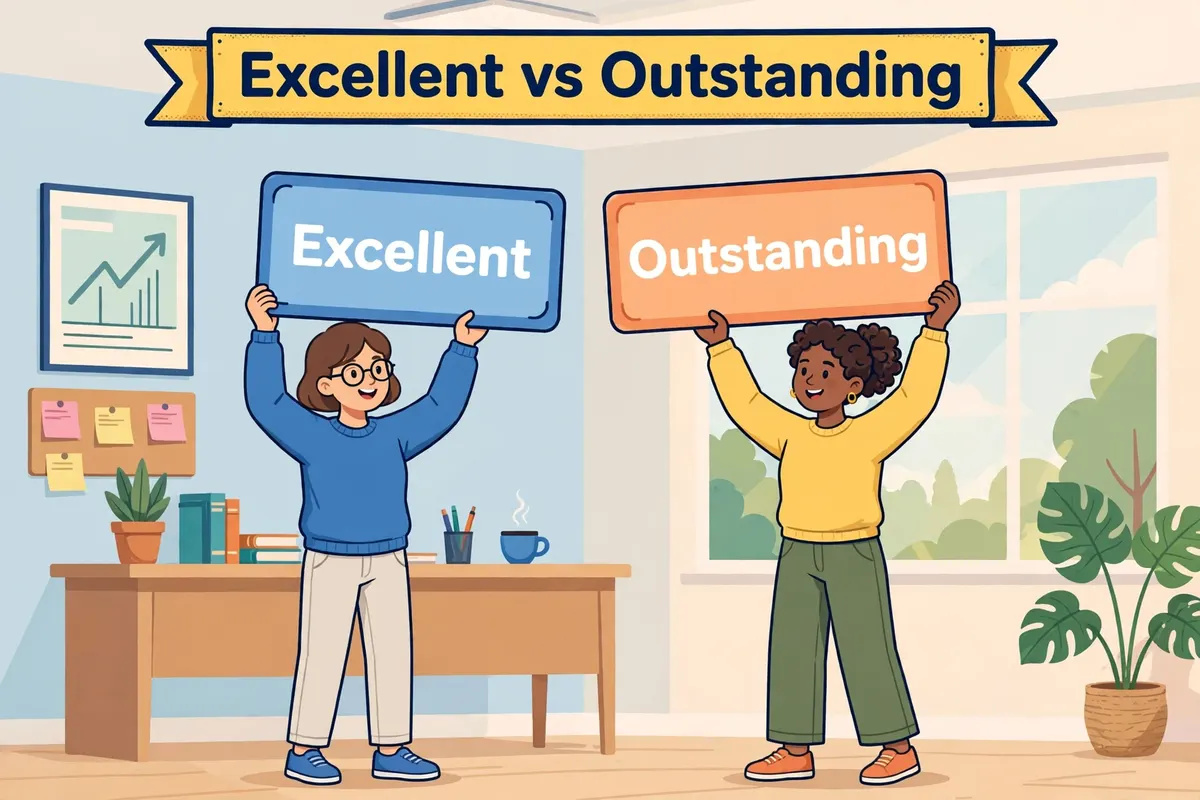
Excellent vs Outstanding vs Superb vs Exceptional
Excellent, outstanding, superb, and exceptional all express strong praise. Their meanings overlap, but each word points to a different kind of quality.
| Word | Core idea | Formality | Best for | Example |
|---|---|---|---|---|
| Excellent | Extremely good, in general | Neutral to formal | Quality of anything: food, service, work, results | The hotel offers excellent service. |
| Outstanding | Stands out from the rest; exceeds expectations | Most formal of the four | Achievements, performance, people | She gave an outstanding presentation. |
| Superb | Extremely good and impressive; memorable quality | Least formal of the three in the corpus study; elegant in tone | Food, experiences, skills, work | The chef prepared a superb meal. |
| Exceptional | Unusually good; far above the normal standard | Formal, academic | Talent, leadership, service, reputation | He showed exceptional leadership. |
How the four words differ
Excellent is the broadest choice. It describes very high quality without adding a special claim about rarity or comparison.
Outstanding means the result stands out from other results. Use it when someone has done something that rises above the usual standard.
Superb often gives praise a memorable or polished feel. It is a natural choice for a meal, performance, service, or experience.
Exceptional suggests that something is unusual because its quality is far above the normal level. It is a strong choice for rare talent or remarkable leadership.
Excellent vs perfect
Perfect is stronger than excellent. It means that nothing could be better or that something has no faults for its intended purpose. Use perfect only when that stronger claim is what you mean.
Excellent vs great
Great is a common everyday word, but it is weaker than excellent. Choose great when you want a relaxed compliment and do not need to claim the highest level of quality.
If It Stands Out, Choose Outstanding; If It Is Memorable, Choose Superb; If It Is Rare, Choose Exceptional; Otherwise, Excellent Is Enough

Other Ways to Say “Excellent!” or “Excellent work”
These phrases offer ready-made alternatives when a single word does not capture your praise. Some sound formal, while others are relaxed or playful.
1. Of the highest quality
This is the most formal, plain option in this set. It describes something made, delivered, or produced at a very high standard.
She created work of the highest quality for the client.
2. Second to none
This phrase means that nothing else is better. It often praises a skill, a service, or a product, and it works well in formal or confident writing.
Her cooking is second to none in our town.
3. In a class of its own
This phrase means that nothing else is similar or close enough to compare with it. It can praise a product, a design, a book, or a person’s skill, and it suits formal and everyday writing.
The museum’s new gallery is in a class of its own.
4. As good as it gets
This is a casual way to say that something is at the highest level. It works well in friendly writing and spoken praise.
The view from the top of the hill is as good as it gets.
5. Top of the line
This phrase means the best quality or the most advanced model of something. Use it when you talk about equipment, vehicles, appliances, or services.
The company sells top-of-the-line equipment for serious photographers.
When the phrase comes before a noun, hyphenate it: top-of-the-line equipment.
6. Out of this world
This is a casual and enthusiastic expression that means extremely good or impressive. It suits food, performances, travel, and experiences, but it is too informal for a formal report.
The dessert at the new bakery was out of this world.
Antonyms of Excellent
Direct opposites
These five words describe something that falls well below the standard of excellent. They signal a poor result or a clear failure, not just an ordinary one.
- Terrible
- Horrible
- Awful
- Poor
- Bad
For example: The service was terrible, and the room was in poor condition.
The middle ground is not the opposite
These words describe a middle level. They mean that something is not excellent, but they do not mean that it is bad.
- Mediocre
- Average
- Ordinary
- Subpar
- Substandard
- Unsatisfactory
- Inferior
- Lackluster
For example: The presentation was average, though the final slide showed a lackluster design.
A note on worst
Worst is the opposite of the best of all sense of excellent, not of the everyday quality sense. It describes the least good option in a group, while excellent describes the quality of one thing.
FAQs
Frequently Asked Questions
1. What is another word for excellent?
Outstanding works well for achievements, while superb often suits food and memorable experiences. Exceptional suggests rare quality. For everyday conversation, great or terrific may sound more natural than a formal replacement.
2. What is a good synonym for excellent on a resume?
Outstanding, exceptional, stellar, first-rate, and exemplary can describe strong work. Choose a word that fits your actual result, then support it with a clear example, such as sales growth or project success.
3. What is the difference between excellent and outstanding?
Excellent means extremely good in general. Outstanding means something stands out from the rest or exceeds expectations. Outstanding often suits achievements, performance, and people, while excellent can describe almost any kind of quality.
4. What is the difference between excellent and superb?
Both words describe very high quality. Superb often adds a sense of memorable or polished quality, especially for food, service, and performances. Excellent is broader and works in more everyday and professional settings.
5. What is the opposite of excellent?
Terrible, awful, horrible, poor, and bad are direct opposites when you mean very poor quality. Mediocre, average, and subpar describe a middle level instead. They mean not excellent, but they do not always mean bad.
6. Is excellent formal or informal?
Excellent is neutral to formal, so it works in essays, reports, business writing, and everyday conversation. For especially formal praise of an achievement, outstanding may be a more precise choice.