
Appreciate Synonyms: 43 Words for Thanks, Value and More
Appreciate has four different meanings: thanking someone, recognizing worth, understanding something fully, and increasing in financial value. The right synonym depends on which meaning you intend, because a word that works for gratitude may sound wrong when you mean admiration or financial growth.
Quick Answer
To thank someone: Be grateful for, thank.
To show worth: Value, treasure.
To show understanding: Understand, recognize.
To describe financial growth: Rise, increase in value.
Remember that these are four separate jobs. Don’t use a financial word in a thank-you sentence or mistake admiration for gratitude.
What Does Appreciate Mean?
According to the Oxford Learner’s Dictionary, appreciate has four main meanings:
- Recognize good qualities: To see and value the good qualities of someone or something.
- Feel grateful: To be thankful for something someone has done.
- Understand: To recognize that something is true or important.
- Increase in value: To become worth more over time.
These meanings explain why appreciate has several different groups of synonyms. For example, thank fits the gratitude meaning, value fits the worth meaning, and understand fits the awareness meaning. Rise belongs to the financial meaning.
Merriam-Webster also describes appreciate through ideas such as grasping worth, admiring, recognizing gratitude and increasing value. Its usage note explains that the gratitude and financial meanings are both standard English.
Cambridge also separates appreciation of worth, gratitude, understanding and financial growth. Collins lists similar groups in its thesaurus entry.
Appreciate is a verb. It is transitive in its first three meanings. In its financial meaning, it is intransitive. Its related forms include: Appreciation: A noun describing gratitude, recognition or an increase in worth. Appreciative: An adjective describing someone who feels or shows appreciation. Appreciator: A noun for someone who recognizes or enjoys the qualities of something. Appreciatory: An adjective describing an expression of appreciation.
The word comes from Latin appretiat-, meaning “set at a price” or “appraised.” Its roots include ad- (to) and pretium (price).
Oxford records common combinations such as really appreciate, truly appreciate, fully appreciate, deeply appreciate, genuinely appreciate and greatly appreciate.
The main lesson is simple: appreciation can involve thanks, worth, understanding or financial growth, so choose the synonym that matches the job in your sentence.
Words that are not appreciate synonyms
A few related words may appear in thesauruses, but they aren’t direct synonyms in the four meanings above.
- Like is much weaker than appreciate. “I like your help” doesn’t clearly thank anyone.
- Know, see and get describe knowing or noticing something. They don’t necessarily mean understanding its importance. Get is slang for understand.
- Sympathize with means feeling for someone experiencing trouble, not expressing appreciation.
- Commend and applaud describe public acts of praise, not the feeling of appreciation itself.
- Be glad of and take pleasure in relate to enjoyment, but they aren’t direct replacements for gratitude.
- Enhance means to improve something, not for a price to rise on its own. It isn’t a financial synonym for appreciate.
- Apprize and apprise relate to informing someone or setting a value, not expressing thanks.
- Thank you belongs among alternative expressions, not as a separate entry in the 43-word synonym count.
When to Use Appreciate Synonyms
The best replacement depends on your audience, purpose and sentence.
For thank-you notes and emails: Use gratitude words when someone has helped you, given you something or completed a task. Good choices include: Be grateful for, Thank, Be appreciative of, Your support is greatly appreciated. Example: “I’m grateful for your help with the presentation.”
For reports and essays: Use understanding and recognition words when discussing facts, decisions or contributions. Good choices include: Recognize, Comprehend, Take into account, Perceive. Example: “The committee recognizes the difficulties facing local businesses.”
For everyday conversations: Choose natural words that sound comfortable in ordinary speech. Good choices include: Thank, Value, Enjoy, Be thankful for. Example: “I really value your advice.”
For stories and personal writing: Use words that express affection, admiration or enjoyment. Good choices include: Treasure, Cherish, Love, Relish. Example: “She cherishes the memories of her childhood.”
For finance and business reports: Use financial words when an asset, investment, currency or property becomes worth more. Good choices include: Rise, Increase in value, Gain in value, Climb, Soar. Example: “The property increased in value over five years.” These words describe financial movement. They don’t express gratitude.
The missing “it” is a common grammar mistake. The phrase “I’d appreciate if you could confirm by Friday” is incorrect in standard usage. The correct sentence is: “I’d appreciate it if you could confirm by Friday.” You can also write: “I’d be grateful if you could confirm by Friday.” The word it is required in the first construction. Don’t leave it out.
Sometimes, appreciate is better than any replacement. Keep it when the sentence expresses more than one idea at once. For example: “I appreciate the time you spent helping me understand the problem.” This sentence expresses both recognition and gratitude.
Don’t use appreciate in progressive tenses. Oxford marks the worth and understanding senses as not used in progressive tenses. It marks the gratitude sense as not usually used in progressive tenses. Incorrect: “I am appreciating your help.” Correct: “I appreciate your help.”
Use “I appreciate you” mainly in casual speech. This expression is acceptable in conversation. It can thank or value the person directly. In formal writing, name the thing instead: “I appreciate your help.” Or: “I am grateful for your help.”
Remember the difference between thank and appreciate. Thank takes a person as its object. Appreciate normally takes the thing or action. Correct: “Thank you for your help.” Correct: “I appreciate your help.” In formal writing, “I thank your help” and “I appreciate you for your help” sound wrong.
Use appreciate with a verb ending in -ing. These sentences are correct: “I appreciate your making the effort to come.” “I appreciate you letting us know.” This construction is incorrect: “I appreciate you to let us know.”
Acknowledge and recognize aren’t complete thank-yous. Both words can credit a contribution or admit a fact. Neither necessarily expresses personal gratitude, so pair them with a direct thank-you when personal gratitude matters.
Keep gratitude and finance separate. “I am grateful for your advice” expresses thanks. “The investment increased in value” describes financial growth. Never put a financial synonym into a thank-you sentence.
Don’t confuse apprize and apprise with gratitude. These words relate to informing someone or setting a value on something. They aren’t thank-you expressions.
Benefits of Using Appreciate Synonyms
Using different words can make your writing clearer and more natural. Here are four practical benefits.
Avoid repeating the same word. Repeating appreciate several times in one email can make the writing sound dull.
Match the tone to the situation. A formal letter may need be indebted to. A message to a friend may sound better with be thankful for.
Make your intended meaning clear. Appreciate can describe gratitude, worth, understanding or financial growth. A more precise word helps readers see which job you mean.
Avoid awkward professional expressions. Instead of writing “I appreciate you” in a formal email, write “I appreciate your support.” Naming the thing you appreciate sounds more professional.
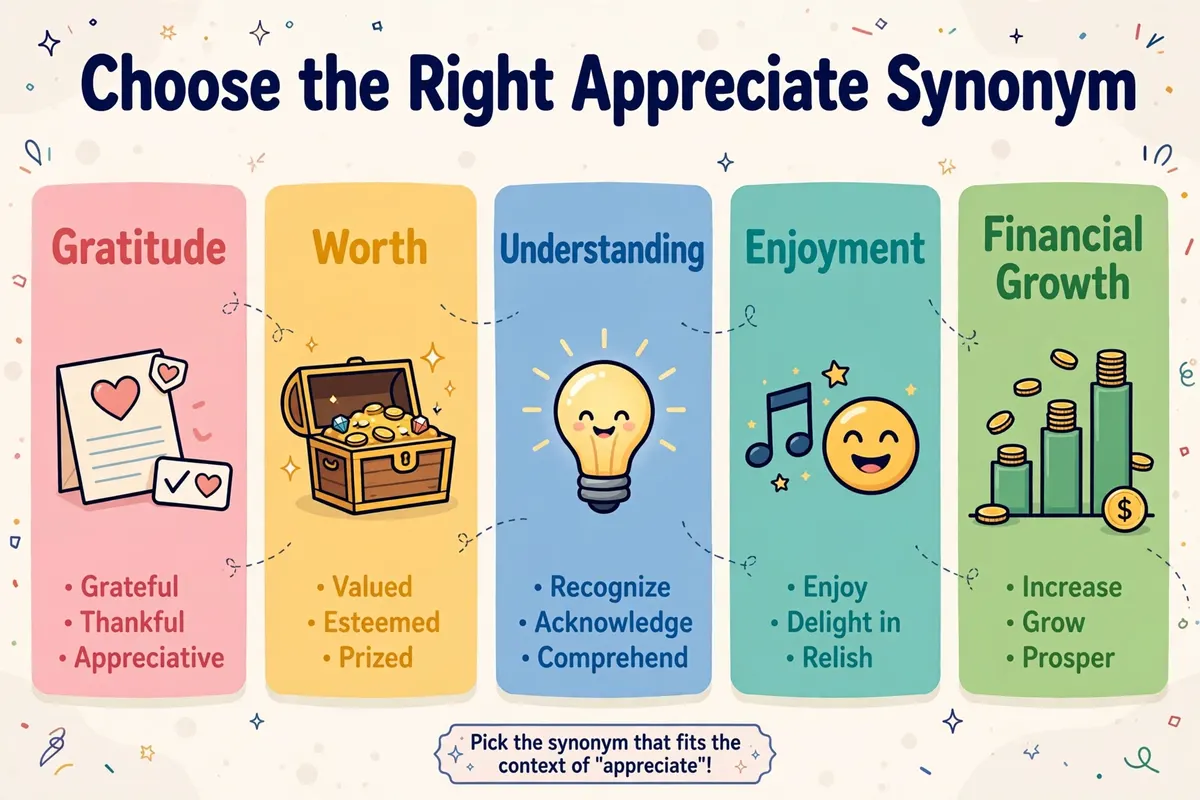
43 Best Appreciate Synonyms at a Glance
The 43 alternatives below fall into five groups. Ten express gratitude, twelve describe worth and admiration, nine describe understanding, six describe enjoyment and holding dear, and the final six are financial terms only. They are not replacements for thank-you expressions.
| Synonym | Tone | Best for |
|---|---|---|
| Be grateful for | Neutral, warm | Thank-you notes, emails, speeches |
| Be thankful for | Warm, everyday | Personal thanks, messages, everyday talk |
| Thank | Direct, everyday | Everyday talk, emails, notes |
| Be indebted to | Formal, strong | Formal letters, speeches, major favors |
| Give thanks for | Formal, written | Formal notes, speeches, public thanks |
| Be appreciative of | Formal, polite | Business emails, formal notes |
| Be obliged (to) | Formal, old-fashioned | Formal British writing, polite letters |
| Feel obliged | Formal | Formal writing, polite requests |
| Acknowledge | Formal, business | Reports, meetings, award remarks |
| Welcome | Polite, business | Business emails, invitations for feedback |
| Value | Neutral | Everyday talk, work, relationships |
| Treasure | Warm, deep | Memories, relationships, keepsakes |
| Cherish | Warm, affectionate | Family, memories, traditions, personal writing |
| Prize | Formal, strong | Qualities, freedom, opportunities, collections |
| Esteem | Formal, literary | Tributes, recommendations, formal writing |
| Admire | Neutral | Skill, character, work, art |
| Respect | Neutral | Work, disagreements, decisions |
| Revere | Formal, deep | Leaders, traditions, sacred things, art |
| Venerate | Very formal | Formal writing, religion, history, tributes |
| Hold in high regard | Formal | Recommendations, tributes, professional writing |
| Think highly of | Neutral, everyday | Everyday talk, recommendations |
| Rate highly | Neutral | Reviews, reports, surveys |
| Understand | Neutral, plain | Everyday talk, emails, explanations |
| Recognize | Formal | Formal statements, reports, public thanks |
| Realize | Neutral | Everyday talk, apologies, stories |
| Grasp | Neutral, emphatic | Difficult ideas, problems, explanations |
| Comprehend | Formal | Academic writing, reports, formal analysis |
| Perceive | Formal | Formal writing, analysis, psychology |
| Be aware of | Neutral | Everyday talk, warnings, instructions |
| Be mindful of | Formal | Formal writing, planning, polite requests |
| Take into account | Formal, practical | Plans, reports, decisions |
| Enjoy | Everyday, warm | Food, music, experiences, everyday talk |
| Relish | Warm, literary | Food, moments, experiences, stories |
| Savor | Warm, slow | Food, wine, music, quiet moments |
| Love | Strong, everyday | Family, friends, passions, everyday talk |
| Adore | Strong, warm | People, pets, favorite things |
| Delight in | Warm | Hobbies, performances, company |
| Increase in value | Neutral, clear | Property, investments, reports |
| Rise | Neutral | Prices, values, currencies, markets |
| Gain in value | Neutral | Property, collections, investments |
| Climb | Neutral | Prices, markets, house values |
| Soar | Vivid, dramatic | Prices, shares, markets in news writing |
| Mount | Formal | Prices, costs, tension, formal reports |
Synonyms for Thanking Someone
These ten alternatives express gratitude for something someone has done.
1. Be grateful for
Tone: Neutral, warm · Uses: Thank-you notes, emails, speeches
Meaning: To feel and show thanks for something someone did.
Explanation: This is a natural choice for expressing personal or professional gratitude. Use “be grateful to” when you name the person, and “be grateful for” when you name the thing.
Examples:
- I’m grateful for your patience during the move.
- We are grateful for the support our neighbors provided.
2. Be thankful for
Tone: Warm, everyday · Uses: Personal thanks, messages, everyday talk
Meaning: To feel glad and thankful for a benefit received.
Explanation: This phrase often carries a sense of relief, as in being thankful that a difficult situation ended well. It is warmer and more personal than a formal acknowledgment.
Examples:
- I’m thankful for your advice during a difficult week.
- She was thankful for the extra time her manager allowed.
3. Thank
Tone: Direct, everyday · Uses: Everyday talk, emails, notes
Meaning: To say thanks to someone for what they did.
Explanation: Thank is direct and natural in most situations. It takes a person as its object, while appreciate normally takes the thing or action.
Examples:
- I want to thank you for staying late.
- Please thank Maria for organizing the meeting.
4. Be indebted to
Tone: Formal, strong · Uses: Formal letters, speeches, major favors
Meaning: To owe someone deep thanks for significant help.
Explanation: This phrase suggests a strong sense of obligation and can sound ceremonial. It’s far too heavy for a small favor.
Examples:
- The research team is indebted to the volunteers who gave their time.
- I will always be indebted to my mentor for her guidance.
5. Give thanks for
Tone: Formal, written · Uses: Formal notes, speeches, public thanks
Meaning: To express thanks in words, often in writing.
Explanation: Give thanks for sounds more formal than thank. It works well in speeches, written messages and public thanks, not in quick chat.
Examples:
- We give thanks for the generosity of our community.
- The director gave thanks for everyone’s hard work.
6. Be appreciative of
Tone: Formal, polite · Uses: Business emails, formal notes
Meaning: To show that you value what someone did.
Explanation: This phrase sounds polite but a little stiff. “I am appreciative of your help” suits formal writing, and it is formal, not warm.
Examples:
- We are appreciative of your continued cooperation.
- I am appreciative of the time you spent reviewing my application.
7. Be obliged (to)
Tone: Formal, old-fashioned · Uses: Formal British writing, polite letters
Meaning: To feel that you owe thanks for a favor.
Explanation: This phrase can express gratitude for a service or favor. It has an old-fashioned flavor, and “much obliged” sounds dated in everyday American English.
Examples:
- I would be obliged to you for a prompt reply.
- We are obliged to our hosts for their generous welcome.
8. Feel obliged
Tone: Formal · Uses: Formal writing, polite requests
Meaning: To feel a duty to thank someone.
Explanation: Feel obliged can express gratitude when the context makes that meaning clear. However, it can also mean feeling forced to do something, so keep the thanks sense clear from context.
Examples:
- I feel obliged to thank everyone who supported the project.
- She felt obliged to acknowledge the assistance she received.
9. Acknowledge
Tone: Formal, business · Uses: Reports, meetings, award remarks
Meaning: To name and credit a contribution openly.
Explanation: Acknowledge recognizes someone’s effort or contribution without necessarily expressing warmth. It does not say “thank you” by itself.
Examples:
- We acknowledge your contribution to the final report.
- The manager acknowledged the staff’s extra effort during the launch.
10. Welcome
Tone: Polite, business · Uses: Business emails, invitations for feedback
Meaning: To receive an offer or suggestion with approval.
Explanation: Welcome expresses receptiveness rather than thanks for a completed act. It never thanks someone for help already given.
Examples:
- We welcome your suggestions for the next meeting.
- The team welcomes feedback from every department.
Synonyms for Valuing and Admiring
These twelve alternatives describe worth, respect and admiration. They don’t automatically express gratitude.
11. Value
Tone: Neutral · Uses: Everyday talk, work, relationships
Meaning: To regard something as important and worthwhile.
Explanation: Value is the closest all-round synonym when appreciate means recognizing worth. However, it states worth, not thanks, so add thanks separately when you mean it.
Examples:
- I value your honest opinion about the proposal.
- Our company values the time its employees give to customers.
12. Treasure
Tone: Warm, deep · Uses: Memories, relationships, keepsakes
Meaning: To value something deeply and personally.
Explanation: Treasure expresses a stronger feeling than appreciate. It is too sentimental for routine workplace thanks.
Examples:
- I treasure the memories we made during our trip.
- She treasures the letters her grandfather sent her.
13. Cherish
Tone: Warm, affectionate · Uses: Family, memories, traditions, personal writing
Meaning: To hold something dear with love and care.
Explanation: Merriam-Webster connects cherish with special love and care. It suits close relationships, family traditions and memories, not routine workplace acknowledgments.
Examples:
- They cherish the time they spend together as a family.
- I cherish every lesson my grandmother taught me.
14. Prize
Tone: Formal, strong · Uses: Qualities, freedom, opportunities, collections
Meaning: To regard something as especially valuable and worth having.
Explanation: Merriam-Webster explains that prize can suggest deep pride in something a person possesses. It’s stronger than value.
Examples:
- Many Americans prize their freedom.
- She prizes the rare books in her collection.
15. Esteem
Tone: Formal, literary · Uses: Tributes, recommendations, formal writing
Meaning: To regard someone highly, with respect.
Explanation: Esteem is useful when discussing someone’s reputation or standing. As a verb, it can sound literary, and “hold in high esteem” is the more natural phrase.
Examples:
- The community esteems her for years of public service.
- I esteem colleagues who treat others fairly.
16. Admire
Tone: Neutral · Uses: Skill, character, work, art
Meaning: To respect and approve of a person’s qualities or abilities.
Explanation: Admire fits appreciation of skill, character, effort or beauty. It doesn’t mean thanks for help received.
Examples:
- I admire the patience she shows with new employees.
- We admire his dedication to helping young musicians.
17. Respect
Tone: Neutral · Uses: Work, disagreements, decisions
Meaning: To regard a person, judgment or principle with consideration.
Explanation: Respect describes consideration for someone’s views or qualities. Respecting a viewpoint doesn’t mean agreeing with it or thanking the person.
Examples:
- I respect your decision to leave the committee.
- The students respect their teacher’s knowledge and experience.
18. Revere
Tone: Formal, deep · Uses: Leaders, traditions, sacred things, art
Meaning: To respect someone or something deeply, almost with awe.
Explanation: Revere expresses much stronger respect than appreciate or ordinary admiration. It often applies to leaders, traditions and sacred things, not ordinary approval.
Examples:
- Many people revere the writers who shaped American literature.
- The community reveres its longtime civil rights leaders.
19. Venerate
Tone: Very formal · Uses: Formal writing, religion, history, tributes
Meaning: To regard someone or something with deep respect and honor.
Explanation: Venerate is very formal and can sound stiff or old-fashioned in everyday writing. Reserve it for serious, formal subjects.
Examples:
- Historians venerate the leaders who fought for equal rights.
- The community continues to venerate its founding members.
20. Hold in high regard
Tone: Formal · Uses: Recommendations, tributes, professional writing
Meaning: To have lasting respect and admiration for someone.
Explanation: This phrase describes a person’s standing over time. It doesn’t express thanks for one completed favor.
Examples:
- I hold my former supervisor in high regard.
- The board holds the organization’s founding members in high regard.
21. Think highly of
Tone: Neutral, everyday · Uses: Everyday talk, recommendations
Meaning: To have a favorable opinion of a person or their work.
Explanation: Think highly of is less formal than hold in high regard. It expresses approval or admiration rather than gratitude.
Examples:
- I think highly of the new department manager.
- Her teachers think highly of her writing skills.
22. Rate highly
Tone: Neutral · Uses: Reviews, reports, surveys
Meaning: To judge something as very good.
Explanation: Rate highly describes an assessment of quality. It tells readers that someone considers something good, and it says nothing about feeling thankful.
Examples:
- Customers rate the hotel’s service highly.
- The reviewers rate her latest book highly.
Synonyms for Understanding Fully
These nine words describe recognizing facts, understanding situations or taking information into account.
23. Understand
Tone: Neutral, plain · Uses: Everyday talk, emails, explanations
Meaning: To grasp a fact, reason or feeling fully.
Explanation: Understand is the plainest choice when appreciate means knowing what something means or why it matters. It does not express gratitude or approval by itself.
Examples:
- I understand why the schedule needs to change.
- We understand the challenges facing new business owners.
24. Recognize
Tone: Formal · Uses: Formal statements, reports, public thanks
Meaning: To see and admit the worth or importance of something.
Explanation: Recognize can sound cooler than understand. It often appears when someone admits an uncomfortable fact, as in “the board recognizes the schedule was unrealistic.”
Examples:
- The board recognizes that the schedule was unrealistic.
- We recognize the effort required to complete this project.
25. Realize
Tone: Neutral · Uses: Everyday talk, apologies, stories
Meaning: To become aware of a fact or its importance.
Explanation: Realize points to the moment someone becomes aware of something. It often takes a that-clause, as in “I realize how much work this took.”
Examples:
- I realize that the deadline gives you very little time.
- She realized how much effort the project required.
26. Grasp
Tone: Neutral, emphatic · Uses: Difficult ideas, problems, explanations
Meaning: To take in something complex after real effort.
Explanation: Grasp suggests more effort than understand. Use it when a point, problem or idea was difficult to take in.
Examples:
- It took me a while to grasp the full problem.
- The students grasped why the experiment failed.
27. Comprehend
Tone: Formal · Uses: Academic writing, reports, formal analysis
Meaning: To understand the meaning or scale of something fully.
Explanation: Comprehend is more formal than understand and often suits academic or serious writing. Do not use it for a short piece of information just heard.
Examples:
- Few people comprehend the full cost of the project.
- The students comprehended the author’s main argument.
28. Perceive
Tone: Formal · Uses: Formal writing, analysis, psychology
Meaning: To notice and understand something, often through insight.
Explanation: Perceive suggests insight or sensing something beneath the surface. It’s heavier than see or notice.
Examples:
- The manager perceived a change in the team’s attitude.
- Children often perceive tension between adults before anyone discusses it.
29. Be aware of
Tone: Neutral · Uses: Everyday talk, warnings, instructions
Meaning: To know that something exists or matters.
Explanation: Be aware of is the lightest awareness phrase in this group. Knowing a fact exists isn’t the same as appreciating its weight.
Examples:
- Please be aware of the new parking restrictions.
- She is aware of the risks involved in the decision.
30. Be mindful of
Tone: Formal · Uses: Formal writing, planning, polite requests
Meaning: To stay aware of a circumstance while you act.
Explanation: Be mindful of adds caution to ordinary awareness. It describes care and attention rather than gratitude, so it is less direct as a thank-you.
Examples:
- Be mindful of the time available before submitting your application.
- Managers should be mindful of their employees’ workloads.
31. Take into account
Tone: Formal, practical · Uses: Plans, reports, decisions
Meaning: To consider a fact when making a decision.
Explanation: Take into account goes further than simply understanding information. The fact must affect the decision or change the plan, or the phrase is empty.
Examples:
- Please take into account the travel time when planning the visit.
- The committee took the budget limits into account before voting.
Synonyms for Enjoying and Holding Dear
These six choices fit pleasure, affection and personal enjoyment. They can replace appreciate when you mean enjoyment or love, not routine thanks.
32. Enjoy
Tone: Everyday, warm · Uses: Food, music, experiences, everyday talk
Meaning: To take pleasure in something.
Explanation: Enjoy replaces appreciate only when the subject is a pleasant experience or activity. In a thank-you note, add thanks for the person’s effort too.
Examples:
- I enjoy listening to jazz after work.
- They enjoy spending summer weekends near the lake.
33. Relish
Tone: Warm, literary · Uses: Food, moments, experiences, stories
Meaning: To enjoy something with strong pleasure.
Explanation: Relish is more vivid than enjoy and often suits food, memorable experiences or exciting moments. It suits tastes and experiences, not people or favors.
Examples:
- She relishes the chance to perform on stage.
- We relished every moment of our trip through the mountains.
34. Savor
Tone: Warm, slow · Uses: Food, wine, music, quiet moments
Meaning: To enjoy something slowly while noticing its quality.
Explanation: Savor suggests slow, deliberate enjoyment. Use the American spelling “savor,” not the British spelling “savour.”
Examples:
- I savor my morning coffee before opening my emails.
- They savored the final minutes of their vacation.
35. Love
Tone: Strong, everyday · Uses: Family, friends, passions, everyday talk
Meaning: To hold someone or something dear.
Explanation: Merriam-Webster includes a love-related meaning of appreciate. Love is much stronger than mild liking, so do not use it for mild liking.
Examples:
- I love the quiet atmosphere of this neighborhood.
- They love spending time with their grandchildren.
36. Adore
Tone: Strong, warm · Uses: People, pets, favorite things
Meaning: To love someone or something deeply.
Explanation: Adore is even stronger in tone than ordinary liking and often expresses affection or enthusiasm. It’s too much for professional writing.
Examples:
- She adores her rescue dog.
- My parents adore the little house they bought near the coast.
37. Delight in
Tone: Warm · Uses: Hobbies, performances, company
Meaning: To take great pleasure in something.
Explanation: Delight in is a phrase rather than a single word. It needs an activity, experience or thing after “in”, as in “delight in music.”
Examples:
- The children delight in playing outside after school.
- He delights in discovering small independent bookstores.
Synonyms for Rising in Value
These six terms describe financial growth. The asset, property, investment or price is the subject, not a person.
38. Increase in value
Tone: Neutral, clear · Uses: Property, investments, reports
Meaning: To become worth more over time.
Explanation: Increase in value is the clearest financial replacement for appreciate. The asset must be the subject, not a person.
Examples:
- The house increased in value after the neighborhood improved.
- Her investment increased in value over the next three years.
39. Rise
Tone: Neutral · Uses: Prices, values, currencies, markets
Meaning: To go up in price or worth.
Explanation: Rise reports the direction of a financial change but doesn’t explain the size of that change. Name the financial subject so the rise is clear.
Examples:
- The value of the property rose after the renovation.
- The currency rose against the dollar during the month.
40. Gain in value
Tone: Neutral · Uses: Property, collections, investments
Meaning: To become worth more through time or a change.
Explanation: Gain in value belongs to financial contexts only. Never use it to express gratitude, admiration or thanks.
Examples:
- The antique clock gained in value over several decades.
- These shares gained in value after the company announced its results.
41. Climb
Tone: Neutral · Uses: Prices, markets, house values
Meaning: To go up steadily in price or worth.
Explanation: Climb suggests a steady upward movement. It’s suitable for prices, market figures and property values, and it is still financial only.
Examples:
- Housing prices climbed throughout the spring.
- The company’s share price climbed after the earnings report.
42. Soar
Tone: Vivid, dramatic · Uses: Prices, shares, markets in news writing
Meaning: To rise sharply and quickly in value.
Explanation: Soar describes a dramatic increase. Use it only for a large, fast rise, not for a small or steady financial rise.
Examples:
- The company’s shares soared after the announcement.
- Property prices soared in the coastal town during the boom.
43. Mount
Tone: Formal · Uses: Prices, costs, tension, formal reports
Meaning: To rise or grow, usually in amount or price.
Explanation: Mount can describe increasing financial amounts, but it also describes growing tension or pressure, as in “tension mounted.” Keep the financial subject clear.
Examples:
- The costs mounted as construction work continued.
- The value of the collection mounted after several rare pieces were added.
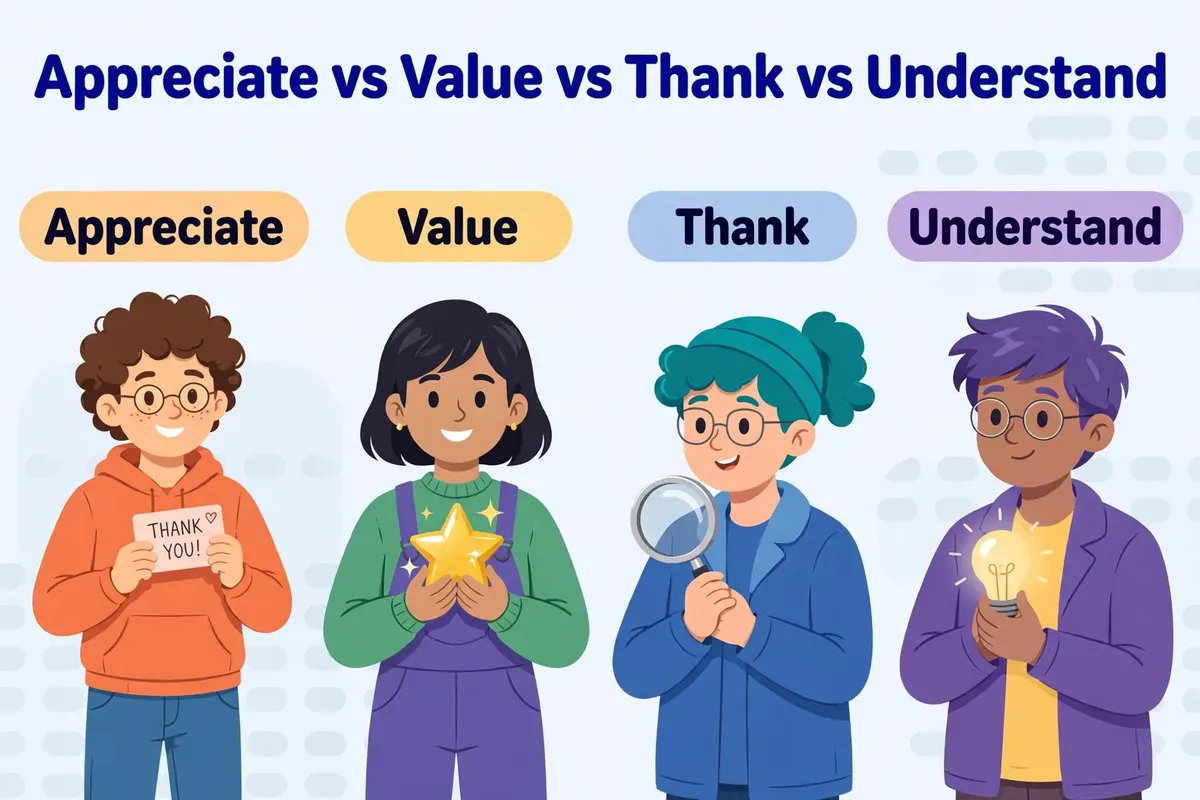
Appreciate vs Value vs Thank vs Understand
These four verbs are related, but they don’t do the same job. Choosing the right one helps readers understand your meaning.
| Word | Core idea | What it expresses | What it takes | Example |
|---|---|---|---|---|
| Appreciate | To see the worth of something or thank for it | Worth, thanks or full understanding, depending on the sentence | A thing, an action, a that/how-clause; a person only in casual speech | I appreciate your help with the move. |
| Value | To rate something highly for its own worth | Worth only, no thanks or understanding | A thing or a person directly | I value your honest feedback on the draft. |
| Thank | To say thanks for what someone did | Thanks only, a direct act of gratitude | A person | Thank you for checking the figures so carefully. |
| Understand | To grasp a fact or feeling fully | Awareness only, no thanks or approval | A fact, a that-clause or a how-clause | I understand why the new timetable is inconvenient. |
Appreciate vs cherish
Cherish adds special love and care. It fits people and memories, not routine work emails.
Appreciate vs prize
Prize adds pride in possessing something. For example, “Americans prize their freedom.”
Appreciate vs treasure
Treasure adds the idea of safeguarding something precious. For example, “a treasured memento.”
If you mean thanks, use “thank” or “be grateful for”; if you mean worth, use “value”; if you mean awareness, use “understand”; use “appreciate” itself when the sentence carries more than one of those ideas at once.

Other Ways to Say “I Appreciate You”
Sometimes you need a more natural way to express gratitude in a message or email. These six phrases are alternatives to “I appreciate you” or “I appreciate it.”
1. I am grateful for your help
Tone: Formal, sincere. This is a clear professional thank-you. It names the help rather than simply stating a feeling.
2. Thank you for your help
Tone: Direct, everyday. This is the safest choice for most emails. It’s polite, clear and natural in both professional and personal writing.
3. Your support is greatly appreciated
Tone: Professional, warm. This works well in workplace messages and formal acknowledgments. It expresses gratitude while keeping a professional tone.
4. It means a lot to me
Tone: Warm, personal. Use this when someone’s help has had a personal effect on you. It tells the person that their action mattered to you.
5. I really value the effort you put into this
Tone: Warm, sincere. This phrase names the specific effort being appreciated. It’s useful when someone has spent time, energy or care on a task.
6. I can’t thank you enough
Tone: Strong, warm. This is the strongest expression in the group. Use it when someone has provided significant help rather than a routine favor.
Antonyms of Appreciate
There isn’t one single opposite of appreciate. The word has four different meanings, so its opposite depends on the sense.
Opposites in the gratitude sense
When appreciate means feeling grateful for someone’s help, the opposites include:
- Be ungrateful for: Fail to show thanks for something received.
- Take for granted: Treat someone’s help as if it were expected.
- Disregard: Pay little attention to someone’s effort.
- Neglect: Fail to give someone or something proper attention.
- Overlook: Fail to notice or acknowledge a contribution.
Example: “He took his colleagues’ support for granted instead of thanking them.”
Opposites in the worth sense
When appreciate means recognizing the value of something, these expressions can work as opposites:
- Undervalue: Regard something as worth less than it really is.
- Disparage: Speak about someone or something in an unfairly negative way.
- Minimize: Make the importance of something seem smaller.
- Find fault with: Focus on someone’s or something’s weaknesses.
- Look down on: Regard someone or something as inferior.
Example: “The manager undervalued the experience her team brought to the project.”
Opposites in the understanding sense
When appreciate means understanding a fact or situation, the opposites include:
- Ignore: Refuse to pay attention to something.
- Misunderstand: Understand something incorrectly.
- Overlook: Fail to notice an important detail.
- Fail to notice: Remain unaware of something that matters.
Example: “The committee overlooked the effect the new schedule would have on families.”
Opposites in the financial sense
When appreciate means increasing in value, the opposites include:
- Depreciate: The direct opposite, a fall in value over time.
- Lose value: Become worth less over time.
- Fall: Move downward in price or worth.
- Decrease: Become smaller in value or amount.
Example: “The vehicle depreciated after several years of use.”
Opposite of the hold-dear sense
When appreciate means loving or holding something dear, hate and dislike can express the opposite feeling. These words oppose the affection sense only. They aren’t general opposites of appreciate.
FAQs
Frequently Asked Questions
1. What is another word for appreciate?
It depends on your meaning. Use thank or be grateful for when expressing thanks, value or treasure when describing worth, understand or recognize for awareness, and rise when discussing an asset that becomes more valuable.
2. What is a formal synonym for appreciate?
Be grateful for suits formal thank-you messages, while be indebted to expresses deep gratitude for major help. Acknowledge credits a contribution, and hold in high regard describes lasting professional respect rather than personal thanks.
3. What is the difference between appreciate and value?
Value means rating something highly for its intrinsic worth. Appreciate can also express gratitude or understanding. You value a friendship for its importance, while you appreciate fine wine by recognizing its qualities.
4. Can you say “I appreciate you”?
Yes. “I appreciate you” is acceptable in casual American speech and can express thanks or affection. In formal writing, name the specific thing instead, as in “I appreciate your help.”
5. Does appreciate mean understand?
Yes. In “I appreciate how difficult this is,” appreciate means understand the difficulty. In “I appreciate your help,” it usually expresses gratitude. The surrounding words tell readers which meaning you intend.
6. What is the opposite of appreciate?
There is no one opposite for every meaning of appreciate. Use be ungrateful for for the thanks sense, undervalue for worth, ignore for understanding, and depreciate when something loses financial value over time.