
Similar Synonyms: 31 Words That Say Alike More Clearly
Two things can share a look, quality, purpose or pattern without being exactly the same. These 31 similar synonyms will help you describe that connection with greater accuracy.
Quick Answer
For everyday comparisons, use alike or like. Choose comparable when judging quality, results or standards. Use analogous for different things that share a function. Reserve identical for things that match in every detail.
The main rule is simple: similar means almost the same, not exactly the same.
What Does Similar Mean?
Similar is an adjective that describes two or more things with qualities in common. They share certain features, but they don’t have to match in every detail.
Three major dictionaries explain this idea in slightly different ways.
- Merriam-Webster: Similar means having qualities in common.
- Cambridge Dictionary: Similar means looking or being almost but not exactly the same.
- Oxford Advanced Learner’s Dictionary: Similar means like somebody or something but not exactly the same.
These definitions point to one clear idea. Similarity allows differences.
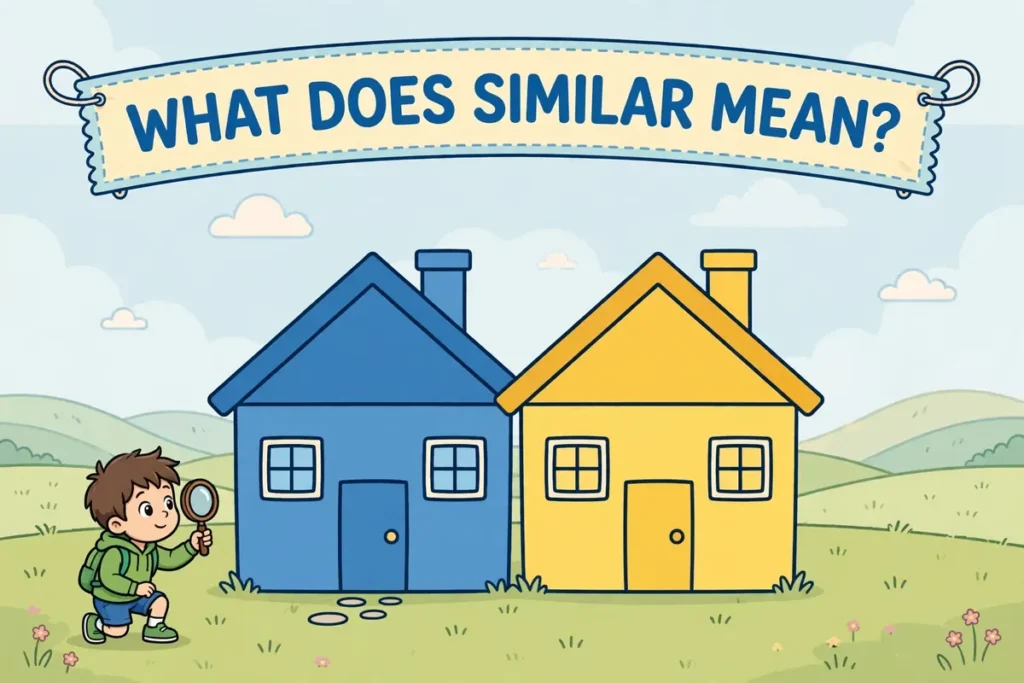
For example, two houses might have the same general layout but different colors, sizes and materials. They’re similar, not identical.
The word also has several related forms:
| Word | Part of speech | Meaning |
|---|---|---|
| Similar | Adjective | Almost the same in certain qualities |
| Similarity | Noun | A quality or feature shared by two or more things |
| Similarly | Adverb | In a way that is almost the same |
| Dissimilar | Adjective | Not alike or not similar |
Grammar matters when you use this word.
- Use similar to before a noun or pronoun. For example, “This design is similar to the original.”
- Use similar in when naming a shared feature. For example, “The two rooms are similar in size.”
- You can also place similar directly before a noun, as in “a similar problem.”
- Don’t confuse similar with alike. Alike normally follows a linking verb. You can say, “The two houses look alike,” but not “alike houses.”
When to Use Similar Synonyms
The best alternative depends on what you’re comparing. A word that works for two people might sound wrong in a product review or research paper.
Here are four common situations where a more precise word can help.
1. Everyday comparisons
Use alike or like when two people or things share familiar features.
For example, two sisters might look alike. Two recipes might taste like each other. These words work well in ordinary conversations.
2. Essays and reports
Comparable and analogous fit more formal writing.
Use comparable when two results, standards or qualities can be judged fairly. Use analogous when different systems or ideas share a function or structure.
For example, two studies might produce comparable results. Two political systems might be analogous despite belonging to different categories.
3. Products and reviews
Comparable and matching can help describe products.
Use comparable when discussing quality, prices, features or performance. Use matching when two products share coordinated features or belong together.
For example, two phones might offer comparable battery life. A matching pair of lamps might have the same design.
4. Stories and descriptions
Alike and resembling can help readers picture people, places and objects.
For example, two characters might look alike. A building might have a shape resembling a palace.
There’s one important point to keep in mind. Don’t replace similar just to sound different. If the likeness is rough and no stronger word is accurate, similar remains the best choice.
Also, choose the right grammar. Write similar to, not similar with, similar as or similar like. Use similar in when describing a shared feature.
Benefits of Using Similar Synonyms
A good synonym does more than prevent repetition. It tells readers what kind of resemblance you mean.
Here are four practical benefits.
1. You can describe the degree of resemblance.
Alike suggests a familiar resemblance. Nearly alike allows small differences. Identical makes a much stronger claim. The right choice tells readers how closely two things match.
2. You can match the tone to your audience.
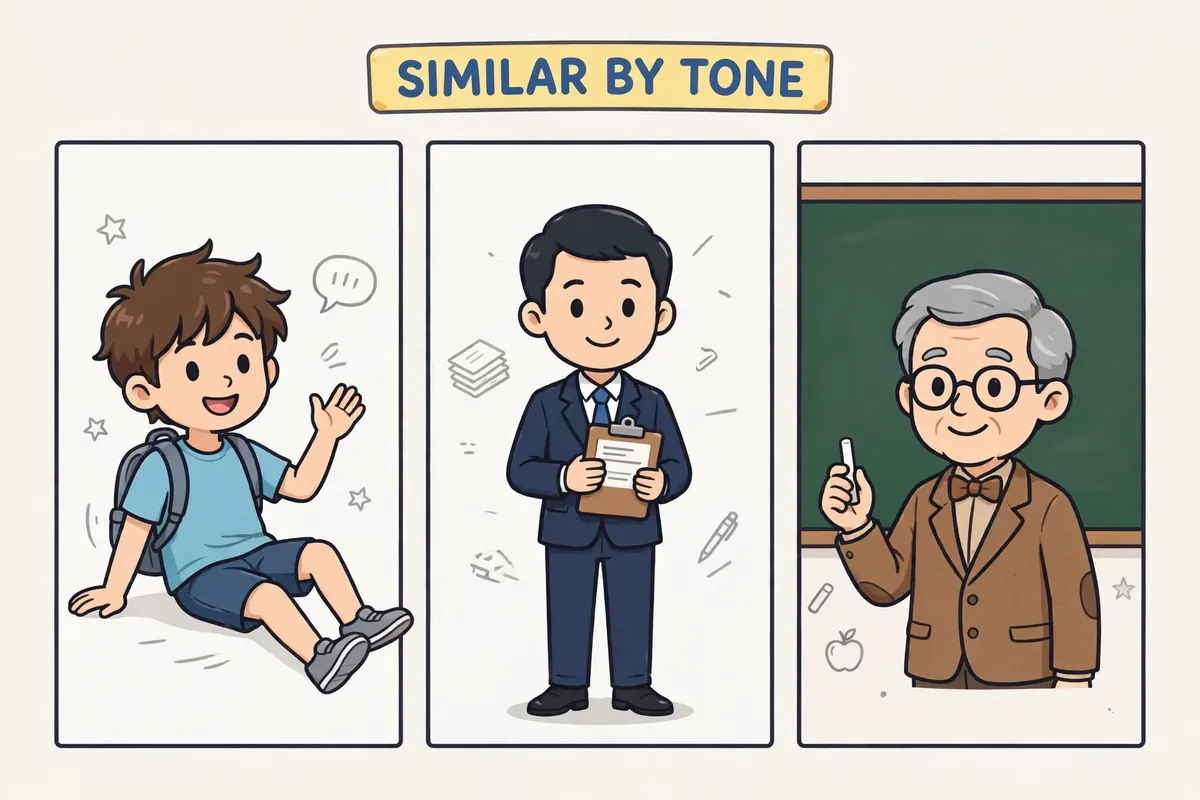
Like and alike suit everyday speech. Comparable works well in business writing. Analogous and congruent fit more specialized discussions.
3. You can avoid repeating similar.
Using different words makes your writing easier to follow. For example, a report can discuss comparable results, parallel trends and related findings without repeating the same adjective.
4. You can avoid overstating a comparison.
Calling two products identical suggests that nothing differs between them. If their features only resemble each other, similar or comparable is more accurate.
The goal isn’t to replace every use of similar. It’s to choose a word that says exactly what you mean.
31 Best Similar Synonyms at a Glance
The list includes everyday expressions, formal terms and specialized words. Some entries make a stronger claim than similar, so check their meanings before using them.
The stronger terms are identical, indistinguishable, almost identical, near-identical, same, equal and equivalent. Each needs a more exact match than ordinary similarity.
| Synonym | Tone | Best for |
|---|---|---|
| Alike | Neutral, everyday | People, twins, everyday comparisons |
| Identical | Neutral, formal | Copies, twins, files, uniforms |
| Indistinguishable | Formal | Looks, copies, products at a distance |
| Much the Same | Neutral, spoken | Schedules, sizes, daily life |
| Nearly Alike | Neutral | Versions, answers, designs |
| Almost Identical | Neutral, formal | Products, results, designs |
| Near-Identical | Neutral, formal | Designs, patterns, copies |
| Same | Neutral | One design bought twice; the same street |
| Like | Casual, everyday | Everyday comparisons, looks, sounds, tastes |
| Resembling | Neutral | Appearance, shape, design, faces |
| Similar-Looking | Neutral | Watches, birds, products, people |
| Matching | Neutral, everyday | Clothes, colors, designs, sets |
| Twin | Neutral | Towers, beds, towns, matching pairs |
| Close | Neutral | Scores, ages, opinions, results |
| Much Alike | Neutral | Paintings, approaches, people |
| Comparable | Formal, business | Products, results, quality, prices, salaries |
| Analogous | Formal, academic | Systems, ideas, processes, situations |
| Parallel | Formal, academic | Careers, projects, themes, histories |
| Equivalent | Formal, business, academic | Qualifications, amounts, measurements |
| Corresponding | Formal, academic | Figures, periods, labels, positions |
| Equal | Neutral, formal | Amounts, scores, shares |
| Interchangeable | Neutral, formal | Parts, words, standard items |
| Congruent | Technical, academic | Geometry, values, ideas, decisions |
| Akin | Formal, literary | Ideas, feelings, experiences |
| Kindred | Warm, literary | People, spirits, themes, interests |
| Related | Neutral | Topics, subjects, events, ideas |
| Allied | Formal, academic | Industries, subjects, fields, organizations |
| Cognate | Technical | Words, languages, word origins |
| Homogeneous | Academic, scientific | Groups, mixtures, populations, materials |
| Along the Same Lines | Neutral, spoken | Plans, suggestions, opinions |
| In the Same Vein | Neutral, literary | Writing, films, creative work, ideas |
Synonyms for Things That Are Nearly the Same
These eight choices describe things with very little difference. Some allow small variations, while others claim an exact match.
1. Alike
Tone: Neutral, everyday · Uses: People, twins, everyday comparisons
Meaning: Resembling each other in appearance or nature.
Explanation: Alike is one of the easiest alternatives to similar in everyday speech. It describes two or more people or things that share noticeable features.
Use it after a linking verb, such as look, seem or be. Don’t place it directly before a noun. Write “similar clothes,” not “alike clothes.”
Examples:
- The two brothers look alike, even though they have different hairstyles.
- Their ideas are alike in several important ways.
2. Identical
Tone: Neutral, formal · Uses: Copies, twins, files, uniforms
Meaning: Exactly the same in every detail.
Explanation: Identical is stronger than similar. It describes things that match completely, with no meaningful differences.
Use it for exact matches, such as two copies of a file or two products with the same details. Don’t use it when the items only share a few features.
Examples:
- The two keys are identical in shape and size.
- Both employees received identical uniforms for the event.
3. Indistinguishable
Tone: Formal · Uses: Looks, copies, products at a distance
Meaning: So alike that you cannot tell two things apart.
Explanation: Indistinguishable describes an extremely close resemblance. Two things may appear identical when viewed together, even if small differences exist.
It’s stronger than similar because it suggests that people cannot tell the items apart. The usual pattern is indistinguishable from.
Examples:
- From across the room, the two paintings were indistinguishable from each other.
- The replacement part looked indistinguishable from the original.
4. Much the Same
Tone: Neutral, spoken · Uses: Schedules, sizes, daily life
Meaning: Almost the same, with only small differences.
Explanation: Much the same is a phrase rather than a single word. It works well when two situations or things share most of their features.
It’s common in everyday speech. Use it when the differences are minor and don’t change the general comparison.
Examples:
- Our daily schedules are much the same during the school year.
- The two rooms are much the same in size and layout.
5. Nearly Alike
Tone: Neutral · Uses: Versions, answers, designs
Meaning: Almost the same, but not completely identical.
Explanation: Nearly alike describes two things that share most of their features. Small differences still exist, so the phrase doesn’t promise an exact match.
It’s useful for comparing versions, designs or answers. It makes a stronger claim than plain similar, so use it when the resemblance is very close.
Examples:
- The two versions of the report are nearly alike.
- Their answers were nearly alike, although the wording differed.
6. Almost Identical
Tone: Neutral, formal · Uses: Products, results, designs
Meaning: Nearly exactly the same in every way.
Explanation: Almost identical describes a very close match with only minor differences. The word identical makes a strong claim, while almost leaves room for small variations.
Use this phrase when two things match in nearly every detail. Avoid it when the differences affect their purpose or quality.
Examples:
- The two phones have almost identical screens and camera layouts.
- Their final test results were almost identical.
7. Near-Identical
Tone: Neutral, formal · Uses: Designs, patterns, copies
Meaning: Almost exactly the same, with only very small differences.
Explanation: Near-identical works as a compact adjective for things that differ in only a few details. It’s stronger than similar and suggests a very close match.
Use it for designs, patterns and copies. The hyphen keeps the two parts together as one descriptive term.
Examples:
- The company released two near-identical versions of the same product.
- The houses have near-identical floor plans.
8. Same
Tone: Neutral · Uses: One design bought twice; the same street
Meaning: Not different; the very thing, rather than something that only looks alike.
Explanation: Same is not a simple replacement for similar. It claims one identity or an exact match, while similar allows differences.
Use the with same when making a comparison. For example, say “the same street.” Don’t use same when two separate things merely share a few features.
Examples:
- We bought the same design of chair for both offices.
- They live on the same street, just a few houses apart.
Synonyms for Things That Look or Feel Alike
The next seven choices focus on appearance, sound, taste and other noticeable qualities. Some describe visual resemblance, while others cover a wider range of shared features.
9. Like
Tone: Casual, everyday · Uses: Everyday comparisons, looks, sounds, tastes
Meaning: Resembling something else or having qualities in common.
Explanation: Like is a common preposition used to compare people and things. It works naturally in everyday speech and simple descriptions.
Use it before a noun or pronoun. For example, “This fabric feels like silk.” Don’t use like as an adjective before a noun in the sense of similar.
Examples:
- Her new jacket looks like the one I bought last month.
- This tea tastes like the blend we tried in London.
10. Resembling
Tone: Neutral · Uses: Appearance, shape, design, faces
Meaning: Looking or seeming like another person or thing.
Explanation: Resembling describes a noticeable likeness in appearance or form. It works well when explaining what something looks or seems like.
The grammar is important. Resembling takes a direct object. Write “resembling a palace,” not “resembling to a palace.”
Examples:
- The new building has a roof resembling a large glass dome.
- She found a flower resembling the one in her grandmother’s garden.
11. Similar-Looking
Tone: Neutral · Uses: Watches, birds, products, people
Meaning: Having an appearance that resembles something else.
Explanation: Similar-looking focuses on visual resemblance. It works for people, animals, products and objects that share visible features.
Don’t use it to describe shared ideas or functions. Two plans might be similar, but they aren’t similar-looking because plans don’t have a physical appearance.
Examples:
- The shop sells several similar-looking watches with different features.
- We spotted two similar-looking birds near the lake.
12. Matching
Tone: Neutral, everyday · Uses: Clothes, colors, designs, sets
Meaning: Having the same or coordinated features, or being made to go together.
Explanation: Matching often suggests a deliberate pair or set. It’s a natural choice when describing coordinated clothes, colors, designs or objects.
It can suggest more than a general resemblance. Two items may look matching because someone selected them to work together.
Examples:
- The children wore matching blue shirts for the school event.
- She bought matching curtains and cushions for the living room.
13. Twin
Tone: Neutral · Uses: Towers, beds, towns, matching pairs
Meaning: One of two things that closely resemble each other.
Explanation: Twin can describe one of two closely related or similar things. It often works as a noun used before another noun.
Use it for pairs such as twin towers or twin beds. It doesn’t work as a general replacement for similar when comparing ideas or abstract qualities.
Examples:
- The hotel has two twin towers beside the main entrance.
- We stayed in a room with twin beds.
14. Close
Tone: Neutral · Uses: Scores, ages, opinions, results
Meaning: Having very little difference in a particular respect.
Explanation: Close works when two things differ only slightly in one area. It can describe scores, ages, opinions and results.
The word can be vague without more detail. Explain what makes the items close, such as close in age or close in value.
Examples:
- The two candidates received close scores in the final round.
- My brother and I are close in age.
15. Much Alike
Tone: Neutral · Uses: Paintings, approaches, people
Meaning: Sharing many qualities or characteristics.
Explanation: Much alike describes two or more things that have several features in common. It works well when the resemblance covers more than one quality.
Like alike, this phrase normally follows a linking verb. Say “the paintings are much alike,” not “much alike paintings.”
Examples:
- The two paintings are much alike in color and composition.
- Their approaches to the project were much alike.
Synonyms for Things That Compare Fairly
These eight terms help compare quality, value, function and structure. Several are formal or technical, so they need the right setting.
16. Comparable
Tone: Formal, business · Uses: Products, results, quality, prices, salaries
Meaning: Similar enough to be compared fairly.
Explanation: Comparable is useful when two things share a standard that allows a fair comparison. It often appears in business writing, product reviews and reports.
Unlike alike, it doesn’t focus mainly on appearance. Two products can have comparable quality or prices even when their designs look different.
Examples:
- Both phones offer comparable battery life and storage.
- The two employees receive comparable salaries for their work.
17. Analogous
Tone: Formal, academic · Uses: Systems, ideas, processes, situations
Meaning: Similar in function, structure or relationship, though different in form.
Explanation: Analogous describes things from different categories that share a function or structure. It’s useful for explaining a connection between ideas, systems or processes.
Merriam-Webster discusses this distinction in its synonym guidance. Two political systems may be analogous even though they belong to different categories. Don’t use it as a casual replacement for similar when comparing ordinary objects such as shoes or pizzas.
Examples:
- The two political systems are analogous in how they distribute power.
- The process is analogous to the way a computer sorts information.
18. Parallel
Tone: Formal, academic · Uses: Careers, projects, themes, histories
Meaning: Similar in structure, development or direction.
Explanation: Parallel suggests that two things develop alongside each other or follow a similar pattern. It often describes careers, projects, themes and historical events.
It’s different from analogous. Parallel focuses on shared development or direction, while analogous focuses on a shared function or relationship.
Examples:
- The two writers had parallel careers in the publishing industry.
- Their projects followed parallel paths over several years.
19. Equivalent
Tone: Formal, business, academic · Uses: Qualifications, amounts, measurements
Meaning: Equal in value, meaning, importance or function.
Explanation: Equivalent makes a stronger claim than similar. It suggests that two things have equal value, meaning or function in a particular context.
Don’t use it for a rough resemblance. Two qualifications may be equivalent if they carry the same value, but two qualifications that merely share some features aren’t necessarily equivalent.
Examples:
- The certificate is equivalent to the qualification required for the role.
- These measurements represent equivalent amounts in different units.
20. Corresponding
Tone: Formal, academic · Uses: Figures, periods, labels, positions
Meaning: Matching or relating directly to another item or position.
Explanation: Corresponding describes items that have a direct relationship or match in position. It works well for figures, labels, periods and entries in a report.
The word suggests an organized connection rather than general resemblance. Use it when one item relates directly to another.
Examples:
- The table shows sales figures and their corresponding expenses.
- Each student received a corresponding number on the class list.
21. Equal
Tone: Neutral, formal · Uses: Amounts, scores, shares
Meaning: The same in value or amount.
Explanation: Equal describes things that match in value, quantity or amount. It doesn’t simply mean that two things share a few features.
This is an important distinction. Two products may be similar in design but have unequal prices. Don’t use equal when you mean general resemblance.
Examples:
- Both teams received equal shares of the prize money.
- The two players finished with equal scores.
22. Interchangeable
Tone: Neutral, formal · Uses: Parts, words, standard items
Meaning: Able to be swapped without losing function or suitability.
Explanation: Interchangeable describes things that can replace one another without causing a meaningful problem. It often applies to parts, words and standard items.
Resemblance alone isn’t enough. Two parts might look similar but still have different functions. Call them interchangeable only when either one can take the other’s place.
Examples:
- These two printer cartridges are interchangeable with the same model.
- In this sentence, the two terms are interchangeable.
23. Congruent
Tone: Technical, academic · Uses: Geometry, values, ideas, decisions
Meaning: Matching or agreeing in shape, position or characteristics.
Explanation: Congruent is a specialized word used in technical and academic settings. It can describe matching shapes, positions or characteristics.
It’s not a natural everyday replacement for similar. Use it when the context calls for a precise description of agreement or a match.
Examples:
- The geometry lesson covered congruent triangles.
- Their decisions were congruent with the goals they had set.
Synonyms for Things That Are Related or of the Same Kind
The final eight choices describe connections between ideas, people, subjects and creative work. Some express resemblance, while others describe a shared purpose or relationship.
24. Akin
Tone: Formal, literary · Uses: Ideas, feelings, experiences
Meaning: Closely related or similar in nature.
Explanation: Akin describes a close relationship between ideas, feelings or experiences. It has a formal or literary tone and isn’t common in casual conversation.
The usual pattern is akin to. Use it when two things share a quality or nature without claiming that they’re identical.
Examples:
- Her sense of relief was akin to pure happiness.
- The two ideas are akin in their basic approach.
25. Kindred
Tone: Warm, literary · Uses: People, spirits, themes, interests
Meaning: Sharing similar qualities, interests or feelings.
Explanation: Kindred has a warm, literary feel. It often describes people who share interests, values or ways of thinking.
The phrase kindred spirits is a familiar example. This word suits people and shared qualities better than products or measurements.
Examples:
- The two artists felt like kindred spirits after their first meeting.
- Their stories explore kindred themes of family and belonging.
26. Related
Tone: Neutral · Uses: Topics, subjects, events, ideas
Meaning: Connected through a shared subject, feature or relationship.
Explanation: Related describes things that have a connection. They might share a topic, origin or other relationship.
However, connection doesn’t always mean resemblance. Two subjects can be related without looking or functioning alike. Use similar when you mean that they share noticeable qualities.
Examples:
- The two articles discuss related topics in different ways.
- These events are related through their shared history.
27. Allied
Tone: Formal, academic · Uses: Industries, subjects, fields, organizations
Meaning: Connected or joined through a shared purpose or interest.
Explanation: Allied describes fields, groups or subjects connected through a shared purpose. It often appears in formal or academic writing.
It doesn’t mainly describe appearance. Two industries might be allied because they share interests, even when their products and methods differ.
Examples:
- The university offers courses in business and allied subjects.
- The two organizations work in allied fields.
28. Cognate
Tone: Technical · Uses: Words, languages, word origins
Meaning: Related by origin, most often used for words and languages.
Explanation: Cognate is a specialized term used mainly in language discussions. It describes words that share an origin.
It isn’t a general substitute for similar. Use it when discussing words, languages or word histories rather than everyday objects.
Examples:
- The two words are cognate because they share a common origin.
- Students studied cognate terms across the two languages.
29. Homogeneous
Tone: Academic, scientific · Uses: Groups, mixtures, populations, materials
Meaning: Made up of similar parts or members, or the same throughout a group.
Explanation: Homogeneous describes a group or mixture whose parts are similar throughout. It’s common in scientific and academic writing.
This term usually applies to a group rather than just two objects. It has a more specialized meaning than similar, so don’t use it as an everyday swap.
Examples:
- The researchers prepared a homogeneous mixture for the experiment.
- The sample came from a homogeneous group of materials.
30. Along the Same Lines
Tone: Neutral, spoken · Uses: Plans, suggestions, opinions
Meaning: Following a similar idea, approach or pattern.
Explanation: Along the same lines is a spoken phrase for comparing ideas or approaches. It works when two suggestions follow a similar direction.
It doesn’t describe physical appearance. Use it for plans, opinions and ways of thinking. The phrase has a conversational tone.
Examples:
- Her suggestion was along the same lines as mine.
- We developed a second plan along the same lines.
31. In the Same Vein
Tone: Neutral, literary · Uses: Writing, films, creative work, ideas
Meaning: Similar in style, subject or general approach.
Explanation: In the same vein describes creative work or ideas that share a style or direction. It often appears in discussions about books, films and writing.
It isn’t meant for measurements or physical resemblance. Use it when two works have a similar subject, tone or creative approach.
Examples:
- Her latest novel is in the same vein as her earlier work.
- The director made another film in the same vein.
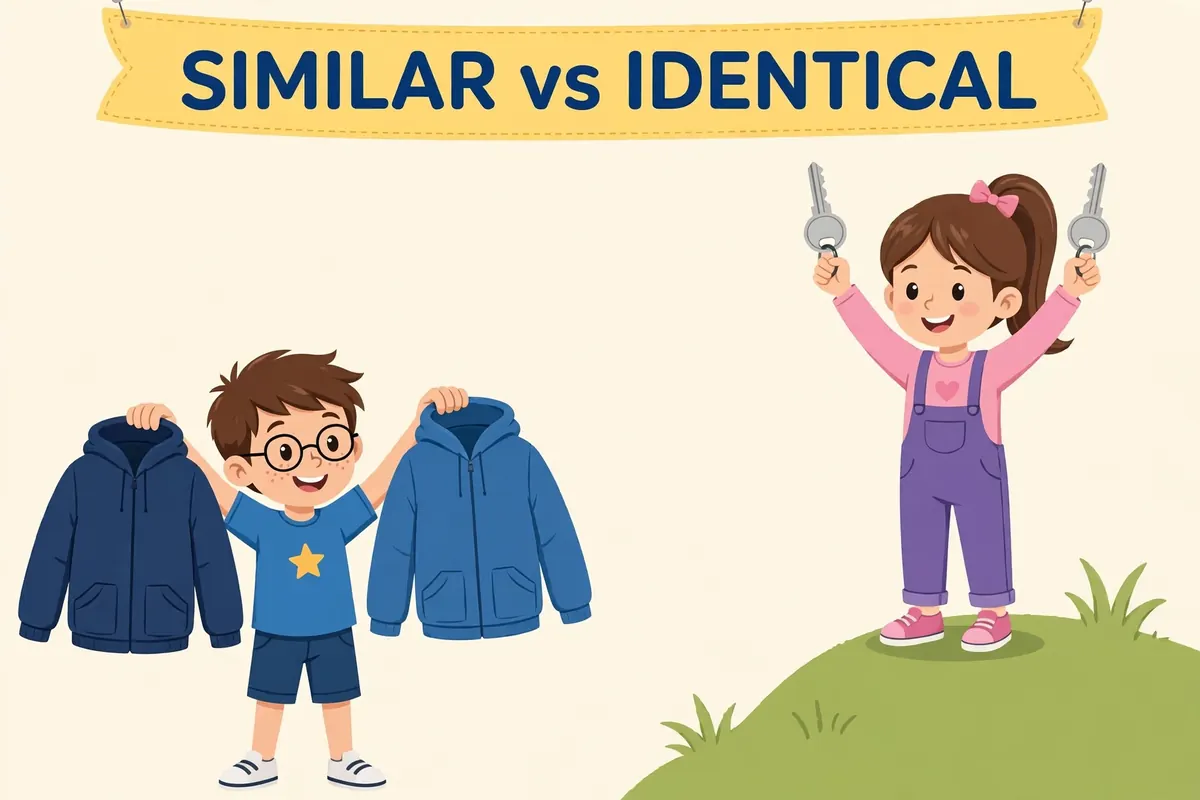
Similar vs Alike vs Identical vs Comparable
These four words can appear in similar sentences, but they don’t mean exactly the same thing. The main difference is the kind of match each word describes.
| Word | Core idea | Can it mean identical? | Example |
|---|---|---|---|
| Similar | Shares some qualities, but differs in others | No | The two jackets are similar in color. |
| Alike | Resembles each other; the closest everyday swap | No | The two sisters look alike. |
| Identical | Exactly the same in every detail | Yes, that is its whole meaning | The two keys are identical. |
| Comparable | Fair to compare; similar in quality or value | No | The two phones offer comparable battery life. |
Similar vs Same
Similar allows differences between two things. Same claims one identity or an exact match.
For example, two houses can have similar designs without being the same house. Use the same when you mean one shared identity.
Analogous vs Parallel
Analogous describes different categories that share a function or relationship. Parallel describes things that share a pattern or develop in a similar direction.
For example, two systems can be analogous in function. Two careers can follow parallel paths.
Closing rule
If the difference is real, say similar. If there’s no difference that matters, say identical. If you’re judging quality or value, say comparable.
Other Ways to Say “This Is Similar to That”
Some expressions communicate resemblance in a more relaxed or colorful way. These six phrases are informal or idiomatic. They work better in conversations and casual writing than in formal reports.
1. Cut from the same cloth
This phrase describes people who share character, values or ways of thinking. It suggests that their personalities have much in common.
Example: The two teachers are cut from the same cloth. Both care deeply about their students.
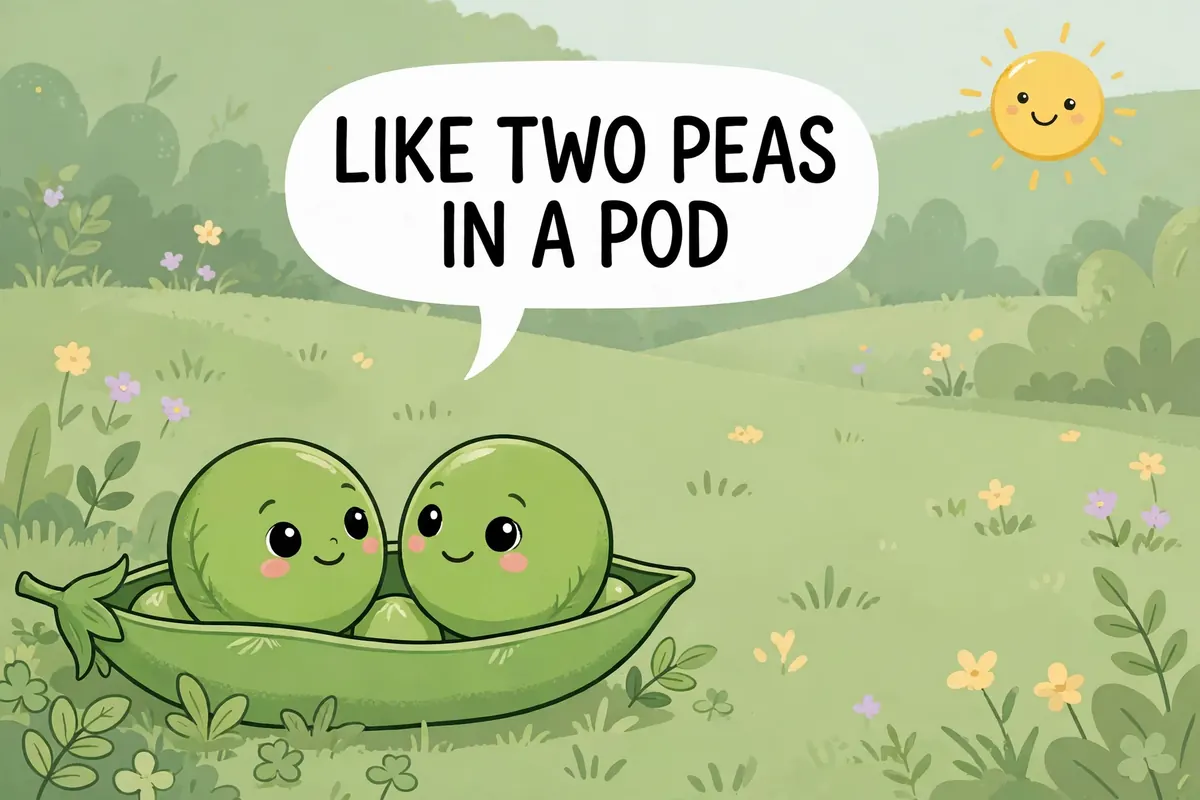
2. Like Two Peas in a Pod
This expression describes two people or things that look or act extremely alike. It often refers to close friends, family members or matching pairs.
Example: The sisters are like two peas in a pod. They even enjoy the same hobbies.
3. On the Same Wavelength
Use this phrase for people who think, understand or communicate in similar ways. It suggests that they understand each other without much explanation.
Example: My colleague and I are on the same wavelength when planning new projects.
4. In the Same League
This expression compares people or things that share a similar standard or level. It’s often used when discussing ability, quality or performance.
Example: Both restaurants are in the same league for food quality and service.
5. Much of a Muchness
This informal expression describes two things that are almost the same. It suggests that the differences are small or don’t matter much.
Example: The two designs are much of a muchness, so either one will work.
6. Like Two Drops of Water
This phrase describes two people or things that look extremely alike. It’s often used for people who share a striking physical resemblance.
Example: The twins look like two drops of water in their school photographs.
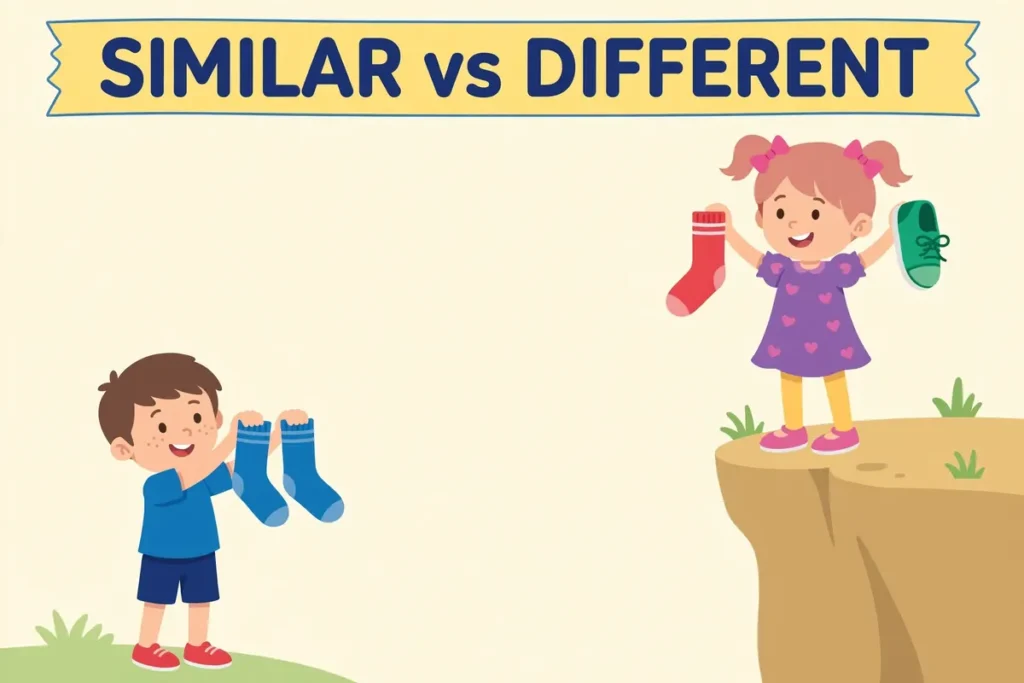
Antonyms of Similar
An antonym describes the opposite meaning. For similar, the main idea is a lack of resemblance or a clear difference.
Here are the main alternatives.
| Antonym | Meaning | Best use |
|---|---|---|
| Different | Not the same | General differences between things |
| Dissimilar | Not alike | Direct contrast in qualities or appearance |
| Unlike | Not similar to something | Comparing two things in contrast |
| Distinct | Clearly separate | Things with clear differences |
| Diverse | Showing variety | Groups with different members or features |
| Disparate | Very different, often from different backgrounds | Strong differences between things |
Two related terms also deserve attention.
Heterogeneous means made up of different kinds of parts or members. It’s the opposite of homogeneous and often appears in academic or scientific writing.
Unrelated means having no direct connection. It describes a lack of relationship rather than simply a lack of resemblance.
These words aren’t all interchangeable. Different is the broadest choice, while dissimilar directly describes a lack of likeness. Choose the term that matches the kind of difference you’re discussing.
FAQs
Frequently Asked Questions
1. What is another word for similar?
Alike is a good everyday alternative, while comparable works in formal writing about quality or value. Use analogous for different things with shared functions. Choose identical only when there’s an exact match.
2. What is the difference between similar and identical?
Similar means two things share qualities but still have differences. Identical means they’re exactly the same in every relevant detail. Calling two products identical makes a much stronger claim than saying they’re similar.
3. Is “like” a synonym for “similar”?
Yes, like can express resemblance as a preposition, as in “a car like mine.” However, don’t use it as an adjective before a noun. Write “a similar car,” not “a like car.”
4. What is a formal synonym for similar?
Comparable suits formal discussions of quality, results and value. Analogous describes different systems with shared functions. Equivalent means equal in value or function, while corresponding describes a direct match between related items.
5. What is the opposite of similar?
Different and dissimilar are the most direct opposites of similar. Unlike and distinct also express contrast. Disparate is useful when two things differ greatly in nature, background or characteristics in a clear and noticeable way.
6. Do I say “similar to” or “similar with”?
Use similar to before a noun or pronoun. Similar with and similar as aren’t standard patterns. Use similar in when describing a shared feature, such as size, shape, style or meaning.