
Agreement Synonyms: 41 Words for Deals and Shared Views
Agreement can mean a shared opinion, a deal between people, or a match between things. These 41 agreement synonyms cover all three meanings, with tone notes and examples to help you choose the right word.
Quick Answer
Use consensus for a shared group opinion.
Use contract for a legally binding deal.
Use arrangement for an everyday plan.
Use accord for a formal agreement.
Use correspondence or compatibility when things match.
What Does Agreement Mean?
Agreement is a noun with three main uses:
- A shared opinion: Two or more people have the same view or support the same decision.
- A deal or arrangement: Two or more people accept a plan, set of terms, or promise.
- A match between things: Words, figures, facts, or other things correspond or follow the same rule.
The meaning depends on the sentence. For example, a committee can reach an agreement, two companies can sign an agreement, and a verb can show agreement with its subject.
Agreement, agree, agreeable, and disagreement
These related words have different grammatical jobs:
Agreement is a noun. It names a shared view, deal, or match.
Agree is a verb. It describes the act of sharing a view or accepting a proposal.
Agreeable is an adjective. It describes someone or something pleasant or acceptable.
Disagreement is a noun. It means a difference of opinion or a lack of agreement.
Agreement can also describe grammar. In subject-verb agreement, the verb must match its subject in number. For example, write “she walks,” not “she walk.”
Agreement does not always mean permission. Consent is permission given by someone. Agreement is not the same as a decision imposed by an authority, either. A ruling is a decision made by a court or other authority. An oath is a promise made by one person.
Oxford lists four uses of agreement: an arrangement, promise or contract made with somebody; the state of sharing the same opinion or feeling; approval of something and allowing it to happen; and, in grammar, words having the same number, gender or person. Merriam-Webster describes it as harmony of opinion and as an arrangement about a course of action. American Heritage adds the law sense: a properly executed and legally binding contract, and the writing or document that embodies it.
Some words look like agreement synonyms but are not. Collusion is a secret agreement to do something wrong. A cartel is a business agreement between firms to fix prices, and it is illegal in many places. Sanction can mean official approval, but it can also mean a punishment, so it is too confusing to use as a plain synonym. Compliance is one-sided obedience, not a mutual agreement. Rapprochement describes restoring friendly relations after a break, not an agreement itself. Entente is a friendly understanding between nations. A bond can be a written promise or a close tie. A stipulation is one clause inside an agreement, not the whole agreement. An oath is a solemn promise by one person. A lease is one specific kind of contract. Negotiation, mediation and arbitration are processes that lead to an agreement, not the agreement itself.
When to Use Agreement Synonyms
Choose a synonym based on what the agreement means in your sentence.
For a shared opinion: Use consensus, concurrence, or common ground.
For a formal deal: Use contract, pact, treaty, or accord when the context fits.
For an everyday plan: Use arrangement, deal, or understanding.
For a decision that needs approval: Use assent, consent, or acceptance.
For things that match: Use correspondence, compatibility, consistency, or accordance.
Pay attention to the number of people involved and the kind of agreement they have. Some words describe a group opinion. Others describe a legal document or a one-sided response.
The phrase also changes the meaning. Reach agreement usually refers to sharing an opinion or settling a group decision. Reach an agreement usually refers to making a deal or settling terms.
Use in agreement with somebody when you share that person’s view. Use in agreement on or in agreement about something when you share a view about a topic.
Benefits of Using Agreement Synonyms
The right synonym makes your meaning easier to understand.
Give readers context
It gives readers context. Consensus points to a group opinion, while contract points to a deal.
Set the right tone
It sets the right tone. Pact and covenant sound more formal than deal or arrangement.
Avoid false claims
It avoids false claims. Consent means permission, while agreement can involve a shared decision.
Make technical writing clearer
It makes technical writing clearer. Correspondence and consistency can describe how facts, figures, or rules match.
Reduce repetition
It reduces repetition. You can choose a word that fits each sentence instead of repeating agreement.
A synonym is useful only when it keeps the intended meaning. A legal document, a group vote, and a shared view are not the same thing.

41 Best Agreement Synonyms at a Glance
The list has four groups: 10 words for shared opinion, 10 for formal deals and documents, 9 for everyday arrangements, and 12 for harmony and matching.
The final group includes words that describe things matching, not people agreeing. This distinction matters when you write about data, rules, facts, or grammar.
| Synonym | Tone | Best for |
|---|---|---|
| Consensus | Neutral, professional | Meetings, committees, group decisions |
| Unanimity | Formal, academic | Votes, boards, formal decisions |
| Concurrence | Formal | Legal, official, executive writing |
| Assent | Formal | Formal meetings, law, official votes |
| Consent | Neutral, formal | Law, medicine, official forms |
| Approval | Neutral | Work, school, official requests |
| Acceptance | Neutral | Business, everyday writing |
| Acquiescence | Formal, literary | Formal writing, stories |
| Shared view | Neutral, plain | Everyday talk, essays, reports |
| Common ground | Neutral | Negotiations, discussions, essays |
| Contract | Formal, business | Business, law, jobs, services |
| Pact | Formal | Politics, history, formal writing |
| Treaty | Formal, diplomatic | Politics, history, international law |
| Covenant | Very formal, solemn | Law, religion, formal pledges |
| Compact | Formal | Law, history, government |
| Protocol | Formal, official | Diplomacy, science, official meetings |
| Convention | Formal, diplomatic | International law, politics |
| Settlement | Formal, legal | Law, divorces, disputes |
| Terms | Neutral, business | Business, contracts, everyday deals |
| Memorandum of understanding | Formal, business | Business, government, negotiations |
| Deal | Casual, everyday | Everyday talk, business, shopping |
| Bargain | Neutral, everyday | Shopping, business, everyday talk |
| Arrangement | Neutral | Everyday plans, travel, events |
| Understanding | Neutral | Everyday talk, business, relationships |
| Compromise | Neutral | Negotiations, relationships, politics |
| Commitment | Neutral, professional | Work, relationships, plans |
| Partnership | Neutral, business | Business, projects, teams |
| Alliance | Formal, political | Politics, nations, groups |
| Gentleman’s agreement | Neutral, old-fashioned | Stories, business history, everyday talk |
| Accord | Formal | Diplomacy, formal writing, business |
| Harmony | Neutral, warm | Everyday talk, music, relationships |
| Concord | Formal, literary | Formal writing, diplomacy, history |
| Unity | Neutral, warm | Speeches, teams, communities |
| Alignment | Neutral, business | Business, strategy, teams |
| Correspondence | Formal, neutral | Reports, science, data |
| Compatibility | Neutral | Technology, relationships, reports |
| Consistency | Neutral | Reports, science, policy |
| Accordance | Formal | Formal writing, law, reports |
| Concordance | Formal, academic | Academic writing, research |
| Unison | Neutral, literary | Music, speeches, groups |
| Solidarity | Neutral, political | Politics, workers, communities |
Synonyms for Shared Opinion
These words describe people who share a view, accept a proposal, or support a decision. They do not all mean that every person agrees completely.
1. Consensus
Tone: Neutral, professional · Uses: Meetings, committees, group decisions
Meaning: Consensus means a general agreement reached by a group after discussion.
Explanation: It suggests broad support for a decision, but it does not always mean every person agrees with every detail. Use unanimity when nobody disagrees.
Examples:
- The committee reached a consensus after hearing each member’s concerns.
- We need a consensus before the team can move forward.
2. Unanimity
Tone: Formal, academic · Uses: Votes, boards, formal decisions
Meaning: Unanimity means every person in a group agrees.
Explanation: It is stronger than consensus and should be used only when nobody disagrees. A decision can have consensus without having complete unanimity.
Examples:
- The board approved the proposal with complete unanimity.
- The vote showed unanimity among all twelve members.
3. Concurrence
Tone: Formal · Uses: Legal, official, executive writing
Meaning: Concurrence means agreement with an opinion, decision, or action.
Explanation: It often appears in legal, official, or workplace writing. It can describe support from another person or authority, rather than a negotiated deal.
Examples:
- The director gave her concurrence before the project began.
- The report was released with the concurrence of the review panel.
4. Assent
Tone: Formal · Uses: Formal meetings, law, official votes
Meaning: Assent means a clear expression of agreement or approval.
Explanation: It often appears in legal and formal settings. It can describe one person’s response to a proposal, so it is not always a mutual agreement.
Examples:
- The members gave their assent to the revised rules.
- His written assent allowed the process to continue.
5. Consent
Tone: Neutral, formal · Uses: Law, medicine, official forms
Meaning: Consent means permission or approval given by a person.
Explanation: It is ONE-SIDED because one person gives permission to another. It does not always mean both sides have made an agreement.
Examples:
- The clinic asked for written consent before the procedure.
- Parents must give their consent before the school trip.
6. Approval
Tone: Neutral · Uses: Work, school, official requests
Meaning: Approval means that someone accepts or supports a plan, request, or action.
Explanation: It is ONE-SIDED when one person or authority approves something. It does not necessarily mean two parties have reached an agreement.
Examples:
- The manager gave approval for the new schedule.
- We cannot begin the project without the client’s approval.
7. Acceptance
Tone: Neutral · Uses: Business, everyday writing
Meaning: Acceptance means receiving or agreeing to a proposal, offer, or condition.
Explanation: It is ONE-SIDED when one person accepts an offer made by someone else. The word can also describe being welcomed into a group.
Examples:
- Her acceptance of the offer arrived by email.
- The company confirmed its acceptance of the revised terms.
8. Acquiescence
Tone: Formal, literary · Uses: Formal writing, stories
Meaning: Acquiescence means accepting something without openly objecting.
Explanation: It often suggests quiet or reluctant agreement, not strong support. Do not use it when you mean enthusiastic approval or a freely negotiated deal.
Examples:
- His acquiescence allowed the meeting to end without an argument.
- The plan moved forward with little more than her acquiescence.
9. Shared view
Tone: Neutral, plain · Uses: Everyday talk, essays, reports
Meaning: A shared view is an opinion held by two or more people.
Explanation: The phrase is direct and easy to understand. It describes a common belief, not necessarily a formal decision or written deal.
Examples:
- The team has a shared view of what needs to change.
- Their shared view helped them agree on the next step.
10. Common ground
Tone: Neutral · Uses: Negotiations, discussions, essays
Meaning: Common ground means points of agreement between people who may hold different opinions.
Explanation: It often helps people find a way forward during a discussion. It does not mean they agree about everything.
Examples:
- The two groups found common ground on the budget.
- We have enough common ground to continue the discussion.
Formal Synonyms for Agreement
These words often describe official deals, legal documents, diplomatic arrangements, or written terms. Some have narrow uses, so check what kind of agreement you mean.
11. Contract
Tone: Formal, business · Uses: Business, law, jobs, services
Meaning: A contract is a formal agreement that creates legal duties when it meets the requirements of the law.
Explanation: It is the strongest word in this group for a binding deal. Every contract is an agreement, but not every agreement is a contract.
Examples:
- Both companies signed a contract for the new service.
- The contract explains each party’s duties and payment terms.
12. Pact
Tone: Formal · Uses: Politics, history, formal writing
Meaning: A pact is a formal agreement between people, groups, or nations.
Explanation: It often suggests a serious promise or shared goal. It is more formal than deal, but it does not always have the legal force of a contract.
Examples:
- The two groups formed a pact to protect the shared site.
- Their pact set out the steps they would take together.
13. Treaty
Tone: Formal, diplomatic · Uses: Politics, history, international law
Meaning: A treaty is a formal agreement between nations or states.
Explanation: It can set rules about borders, trade, peace, or other international matters. Do not use treaty for an ordinary business deal between companies or individuals.
Examples:
- The nations signed a treaty to end the conflict.
- The treaty set new rules for cross-border trade.
14. Covenant
Tone: Very formal, solemn · Uses: Law, religion, formal pledges
Meaning: A covenant is a serious and often lasting promise or agreement.
Explanation: It appears in legal and religious writing, including the Bible. The word sounds solemn and old-fashioned, so it rarely fits a casual plan.
Examples:
- The covenant set out the duties shared by both families.
- The document described a covenant between the two communities.
15. Compact
Tone: Formal · Uses: Law, history, government
Meaning: A compact is a formal agreement between people, groups, or governments.
Explanation: It often describes a mutual commitment or arrangement. The word also has other meanings, so make sure the surrounding sentence makes the agreement clear.
Examples:
- The states signed a compact to manage the river.
- Their compact established shared rules for the project.
16. Protocol
Tone: Formal, official · Uses: Diplomacy, science, official meetings
Meaning: A protocol is an official procedure or set of rules that guides how people or organizations act.
Explanation: In diplomacy, it can also refer to a formal agreement or record. It often describes the rules around a deal, not the deal itself.
Examples:
- The two offices followed the protocol for sharing records.
- The meeting ended with a protocol that listed the agreed steps.
17. Convention
Tone: Formal, diplomatic · Uses: International law, politics
Meaning: A convention is a formal agreement or set of rules accepted by countries or groups.
Explanation: It often appears in international law and diplomacy. The word can also mean a large conference, so the sentence must make the intended meaning clear.
Examples:
- The countries adopted a convention on the treatment of refugees.
- The convention set shared standards for the member states.
18. Settlement
Tone: Formal, legal · Uses: Law, divorces, disputes
Meaning: A settlement is an agreement that resolves a dispute or legal claim.
Explanation: It often ends a disagreement through accepted terms. Unlike a general agreement, it usually suggests that a conflict or claim existed first.
Examples:
- The two sides reached a settlement after months of talks.
- Their settlement ended the dispute without a trial.
19. Terms
Tone: Neutral, business · Uses: Business, contracts, everyday deals
Meaning: Terms are the conditions that people accept when they make an agreement.
Explanation: The word is plural in this use. It describes what the parties must do, pay, or accept, rather than the whole deal by itself.
Examples:
- We reviewed the terms before signing the document.
- The buyer accepted the terms of the sale.
20. Memorandum of understanding
Tone: Formal, business · Uses: Business, government, negotiations
Meaning: A memorandum of understanding is a document that records what two or more parties intend to do together.
Explanation: It is often shortened to MOU. An MOU usually is not legally binding, though its effect depends on its wording and the law that applies.
Examples:
- The universities signed a memorandum of understanding to support student exchanges.
- The memorandum of understanding described the shared goals of the two organizations.
Everyday Synonyms for Agreement
These words fit ordinary conversations, work plans, relationships, and business arrangements. They can sound less formal than legal terms, but they do not all carry the same meaning.
21. Deal
Tone: Casual, everyday · Uses: Everyday talk, business, shopping
Meaning: A deal is an agreement about what people will do, give, or receive.
Explanation: It is common in everyday speech and business. It usually sounds less formal than a contract or treaty.
Examples:
- We made a deal to share the travel costs.
- The seller agreed to the deal before the store closed.
22. Bargain
Tone: Neutral, everyday · Uses: Shopping, business, everyday talk
Meaning: A bargain can mean an agreement reached through discussion or negotiation, often about a price.
Explanation: It can also mean something bought at a low price. Use the context to show which meaning you intend.
Examples:
- They struck a bargain after discussing the final price.
- The bargain gave both shops a fair share of the market.
23. Arrangement
Tone: Neutral · Uses: Everyday plans, travel, events
Meaning: An arrangement is a plan or agreement about how something will happen.
Explanation: It often covers practical details such as time, place, duties, or payment. It can be informal and does not always create legal duties.
Examples:
- We made an arrangement to meet outside the station.
- Their childcare arrangement works for both families.
24. Understanding
Tone: Neutral · Uses: Everyday talk, business, relationships
Meaning: An understanding is an agreement or shared view between people.
Explanation: It can be spoken or informal, without a signed document. It can also mean that people know each other’s needs or expectations.
Examples:
- We have an understanding about how to divide the work.
- Their understanding helped them avoid another argument.
25. Compromise
Tone: Neutral · Uses: Negotiations, relationships, politics
Meaning: A compromise is an agreement in which each side gives up something to reach a result.
Explanation: It requires concessions from both sides. Do not use it for every agreement, because some deals involve no one giving anything up.
Examples:
- The neighbors reached a compromise about the shared driveway.
- Their compromise gave each team part of what it wanted.
26. Commitment
Tone: Neutral, professional · Uses: Work, relationships, plans
Meaning: A commitment is a promise or firm decision to do something.
Explanation: It can form part of an agreement, but it can also be a one-person promise. Check whether you mean a shared deal or an individual duty.
Examples:
- The partners made a commitment to finish the work by June.
- Her commitment to the plan helped the team stay focused.
27. Partnership
Tone: Neutral, business · Uses: Business, projects, teams
Meaning: A partnership is a relationship in which people or organizations work together toward shared goals.
Explanation: It may include a formal agreement, but the word describes the working relationship more than the deal itself.
Examples:
- The two firms formed a partnership to serve new customers.
- Their partnership began with a written agreement.
28. Alliance
Tone: Formal, political · Uses: Politics, nations, groups
Meaning: An alliance is an agreement to work together or support one another.
Explanation: It often involves nations, political groups, or organizations with shared interests. It usually suggests a lasting relationship, not just a one-time deal.
Examples:
- The groups formed an alliance to protect local resources.
- The alliance gave the smaller nations a stronger voice.
29. Gentleman’s agreement
Tone: Neutral, old-fashioned · Uses: Stories, business history, everyday talk
Meaning: A gentleman’s agreement is an informal promise based on trust rather than a legal document.
Explanation: It is usually not legally binding. The phrase is old-fashioned and gendered, so use it with care in modern writing.
Examples:
- They made a gentleman’s agreement to keep the arrangement private.
- The deal rested on a gentleman’s agreement rather than a signed contract.
Synonyms for Harmony and Matching
These words describe harmony, shared direction, or a match between things. The final five entries focus on things matching or following a standard, not people sharing an opinion.
30. Accord
Tone: Formal · Uses: Diplomacy, formal writing, business
Meaning: Accord means agreement or harmony between people, groups, or nations.
Explanation: It often appears in formal or diplomatic writing. It can also describe things that fit together, depending on the context.
Examples:
- The two nations reached an accord on trade.
- The board acted in accord with the group’s stated goals.
31. Harmony
Tone: Neutral, warm · Uses: Everyday talk, music, relationships
Meaning: Harmony means a peaceful or pleasing relationship between people or things.
Explanation: It can describe people who get along, ideas that fit together, or musical sounds that work well together. It does not always mean a formal agreement.
Examples:
- The neighbors lived in harmony after settling their dispute.
- The design brings color and shape together in harmony.
32. Concord
Tone: Formal, literary · Uses: Formal writing, diplomacy, history
Meaning: Concord means agreement, peace, or harmony between people or groups.
Explanation: It has a formal and sometimes literary tone. It is less common in everyday conversation than agreement or harmony.
Examples:
- The leaders hoped to restore concord between the two communities.
- Their years of concord helped the region remain peaceful.
33. Unity
Tone: Neutral, warm · Uses: Speeches, teams, communities
Meaning: Unity means a state of being joined or working together.
Explanation: It can describe shared purpose, support, or a common identity. It does not always mean that every member has the same opinion.
Examples:
- The team showed unity during a difficult season.
- The speech called for unity across the community.
34. Alignment
Tone: Neutral, business · Uses: Business, strategy, teams
Meaning: Alignment means that people, plans, or goals support the same direction.
Explanation: In business, it often describes shared priorities or coordinated work. It can describe a match between plans, rather than a negotiated agreement.
Examples:
- The managers reached alignment on the new sales goals.
- The project needs better alignment between its budget and schedule.
35. Correspondence
Tone: Formal, neutral · Uses: Reports, science, data
Meaning: Correspondence means a close match or relationship between things, such as facts, figures, records, or ideas.
Explanation: In this sense, it is about things matching, not people agreeing. It can also mean written communication, such as letters or emails.
Examples:
- The researchers found a correspondence between the two sets of results.
- The figures showed a close correspondence with the earlier report.
36. Compatibility
Tone: Neutral · Uses: Technology, relationships, reports
Meaning: Compatibility means that two or more things can work together or fit well together.
Explanation: It is about things matching, not people agreeing, and it does not mean making a deal. The word often appears in technology, science, and product descriptions.
Examples:
- The report tested the compatibility of the two software systems.
- We checked the parts for compatibility before installing them.
37. Consistency
Tone: Neutral · Uses: Reports, science, policy
Meaning: Consistency means that things remain the same or agree with one another across different examples.
Explanation: It can describe matching facts, results, or rules. It is about a reliable match, not necessarily a shared opinion between people.
Examples:
- The review found consistency between the records and the final report.
- The policy requires consistency across all departments.
38. Accordance
Tone: Formal · Uses: Formal writing, law, reports
Meaning: Accordance means conformity with a rule, standard, or requirement.
Explanation: It is about things matching a rule or standard, not people agreeing. The word almost always appears in the phrase “in accordance with,” so do not use it alone as a substitute for agreement.
Examples:
- The work was completed in accordance with the safety rules.
- The report was prepared in accordance with the stated guidelines.
39. Concordance
Tone: Formal, academic · Uses: Academic writing, research
Meaning: Concordance means agreement or correspondence between things, such as records, statements, or research results.
Explanation: It is about things matching, not people agreeing. The word is very formal and often appears in academic or technical writing.
Examples:
- The study found concordance between the two measurement methods.
- Researchers checked the concordance of the records before publishing the results.
40. Unison
Tone: Neutral, literary · Uses: Music, speeches, groups
Meaning: Unison means doing or saying something together at the same time.
Explanation: It often describes voices, music, or group action. It can suggest unity, but it is not a direct substitute for every kind of agreement.
Examples:
- The audience spoke the final line in unison.
- The singers performed the chorus in unison.
41. Solidarity
Tone: Neutral, political · Uses: Politics, workers, communities
Meaning: Solidarity means unity and mutual support among people with a shared interest or purpose.
Explanation: It often appears in political, community, or workplace writing. It describes support between people, not necessarily a specific deal or shared opinion.
Examples:
- The workers showed solidarity during the negotiations.
- The community stood in solidarity with the families affected by the closure.
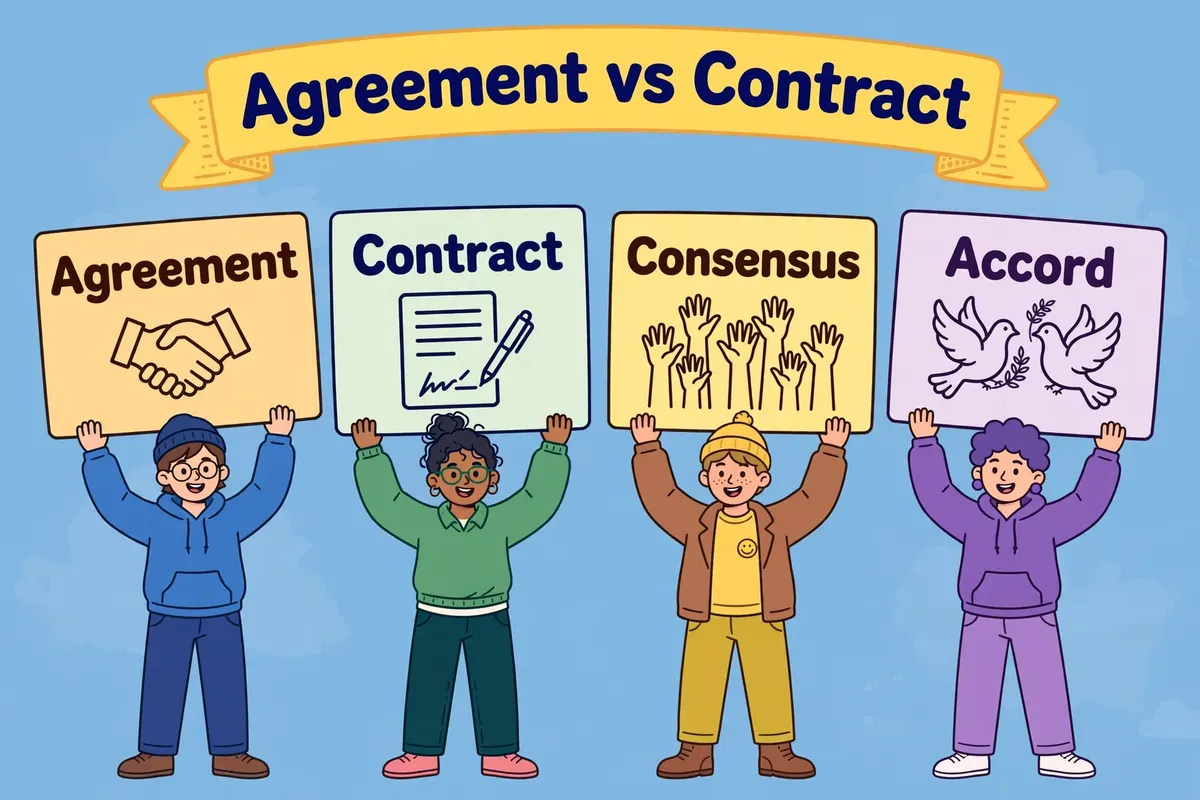
Agreement vs Contract vs Consensus vs Accord
These four words overlap, but they do not mean the same thing. The main difference is whether you mean a shared opinion, a general deal, or a formal arrangement.
| Word | Core idea | Binding? | Example |
|---|---|---|---|
| Agreement | General shared opinion or deal | Sometimes, if legal tests are met | We reached an agreement on the price. |
| Contract | Binding agreement usually written and enforceable | Yes, when legally valid | We signed a contract before the work began. |
| Consensus | Broad group view supported after discussion | No, it is a decision, not a document | The committee reached a consensus on the new policy. |
| Accord | Formal, often diplomatic agreement or harmony | Usually, when it is a formal arrangement | The two nations signed an accord on trade. |
Agreement vs pact
An agreement is a broad term for a shared view or deal. A pact is more formal and often describes a serious arrangement between nations, groups, or people. A pact may carry a sense of a solemn promise, while agreement can describe an ordinary plan.
Consensus vs unanimity
Consensus means a group broadly supports a decision after discussion. Unanimity means every member agrees, with no one opposed. A group can reach consensus even when a few members still have reservations.
If everyone simply thinks the same, it is a consensus; if two sides shake on a plan, it is an agreement; if a court can enforce it, it is a contract; if nations sign it, it is an accord or a treaty.

Other Ways to Say “We Reached an Agreement”
Use these phrases when you want a natural alternative to “We reached an agreement.” The best choice depends on whether you mean a shared view, a deal, or a formal decision.
1. We came to an understanding
This suggests that both sides accepted the same plan or expectations.
2. We struck a deal
This is casual and works well for a business or personal arrangement.
3. We reached a consensus
Use this when a group agreed on a shared decision after discussion.
4. We signed the contract
Use this when the agreement is a formal, signed document.
5. We are on the same page
Tone: Idiom
This means that everyone understands or supports the same plan.
6. We shook on it
Tone: Idiom
This means that people made a deal, often with a handshake.
Antonyms of Agreement
The opposite of agreement is disagreement. Other antonyms depend on whether you mean a difference of opinion, a dispute, or a lack of matching between things.
Opposites for shared opinion
- Disagreement: A difference in opinion or a failure to reach the same view.
- Dissent: An open expression of disagreement with a decision or group opinion.
- Dissension: Formal disagreement or conflict within a group.
- Disunity: A lack of unity among people who should be working together.
Opposites for a deal or peaceful relationship
- Dispute: A serious disagreement, often about rights, duties, or terms.
- Conflict: A clash between people, groups, interests, or goals.
- Discord: A lack of harmony or friendly relations.
- Clash: A direct conflict between opposing views or interests.
- Quarrel: An angry argument between people.
Opposites for matching
- Incompatibility: A state in which two or more things do not work or fit together.
- Variance: A difference between things that might be expected to match.
- Discrepancy: A difference between facts, figures, or records that should agree.
- Opposition: A state of being against or in conflict with something.
FAQs
Frequently Asked Questions
1. What is another word for agreement?
Consensus, accord, understanding, and arrangement can all mean agreement, but each fits a different situation. Use consensus for a group opinion, accord for a formal agreement, and arrangement for an everyday plan between people.
2. Are agreement and contract the same thing?
No. Every contract is an agreement, but not every agreement is a contract. A contract generally needs an offer, acceptance, consideration, and legal capacity. An informal spoken plan may be an agreement without being enforceable.
3. What is a formal synonym for agreement?
Contract, pact, covenant, and accord can all work in formal settings. Use contract for a legally binding deal, pact for a solemn arrangement, covenant for a serious pledge, and accord for a formal agreement.
4. What does agreement mean in grammar?
In grammar, agreement means words match in number, gender, or person. In “They live in the country,” live is plural to match they. A singular subject usually takes a singular verb, as in “she walks.”
5. What is the difference between agreement and consensus?
Agreement is the broad word for a shared view or arrangement. Consensus is a group view reached through discussion. Members can support that view even when it isn’t everyone’s first choice.
6. What is the opposite of agreement?
Disagreement is the direct opposite of agreement. Dissent describes an open objection to a view, while discord means a lack of harmony. For mismatched facts or figures, use discrepancy or variance.