
Courage Synonyms: 35 Words for Brave and Bold Writing
Courage describes the strength to face danger, difficulty, or opposition, even when fear makes the situation uncomfortable. The right synonym can show whether someone faces physical danger, endures hardship, or stands up for a belief.
Quick Answer
For everyday use, say bravery, the most direct and widely understood synonym.
For formal or military praise, say valor (the UK spelling is valour).
For enduring hardship over time, say fortitude.
For casual conversation, say guts or nerve.
Core rule: courage is not the absence of fear, it is acting in spite of fear. Fearlessness means no fear at all, and that is a different word.
- What Does Courage Mean?
- When to Use Courage Synonyms
- Benefits of Using Courage Synonyms
- 35 Best Courage Synonyms at a Glance
- Direct Synonyms for Courage
- Formal Synonyms for Courage
- Everyday Synonyms for Courage
- Synonyms for Moral Courage
- Courage vs Bravery vs Valor vs Fearlessness
- Other Ways to Say “Courage”
- Antonyms of Courage
- Frequently Asked Questions
What Does Courage Mean?
Oxford Advanced Learner’s Dictionary defines courage as “the ability to do something dangerous, or to face pain or opposition, without showing fear.” Merriam-Webster defines courage as “mental or moral strength to venture, persevere, and withstand danger, fear, or difficulty.” Cambridge defines courage, in Cambridge’s own search-result text, as “the ability to control your fear in a dangerous or difficult situation.” Dictionary.com defines courage, from search-result text, as “the quality of mind or spirit that enables a person to face difficulty, danger, pain, etc., without fear; bravery.” Bravery is the most direct synonym for courage. These definitions share one idea: courage helps people face situations that might otherwise stop them.
Merriam-Webster’s Synonym Chooser on its dictionary page distinguishes four close words. Mettle suggests an ingrained capacity for meeting strain or difficulty with fortitude and resilience. Spirit suggests a quality of temperament enabling one to hold one’s own or keep up one’s morale when opposed or threatened. Resolution stresses firm determination to achieve one’s ends. Tenacity adds to resolution implications of stubborn persistence and unwillingness to admit defeat.
Courage can appear in two different forms. Physical courage means facing physical danger, pain, or personal risk. Moral courage means standing up for what is right despite criticism, pressure, or possible consequences. These forms overlap, but they are not interchangeable in every sentence. Valor and heroism often describe physical courage, while conviction describes moral courage.
Courage is an uncountable noun. You normally say “great courage”, not “a courage”. Courage is a noun, not an adjective. Wrong: “a courage man.” Right: “a courageous man” or “a man of great courage.” Its word forms are courage (noun), courageous (adjective) and courageously (adverb). There is no verb form. You do not “courage” something, you “show courage” or “take courage.”
The word comes from Middle English, from Old French corage, from Latin cor, meaning “heart.”
Oxford lists these idioms: have or lack the courage of your convictions, screw up your courage, take courage (from something), take your courage in both hands, and pluck up the courage.
Trap: “Dutch courage” means courage from drinking alcohol, and it is not real courage. Recklessness and rashness mean acting without thought, and bravado is a boastful pretense of courage, called “empty bravado.” Courage requires intention and judgment. None of the three is a synonym for courage.
When to Use Courage Synonyms
The best synonym depends on the situation, the kind of courage involved, and the impression you want to create.
Here are four useful contexts.
1. Essays and School Writing
Choose words that explain inner strength, determination, or moral choices.
Fortitude: When someone endures a difficult experience.
Resolution: When someone remains committed to a goal.
Conviction: When someone acts according to a strong belief.
Example: Her fortitude helped her continue studying during a difficult period.
2. Formal Praise and Speeches
Use words that communicate admiration and recognize significant actions.
Valor: For heroic or military courage.
Heroism: For brave actions that protect or help others.
Gallantry: For noble and courageous conduct.
Example: The ceremony honored the valor of the rescue workers.
3. Everyday Conversation
Simple, familiar words usually sound more natural in ordinary conversations.
Bravery: For general acts of courage.
Guts: For informal descriptions of facing something frightening.
Nerve: For confidence when doing something difficult.
Example: It took real guts to admit the mistake in front of everyone.
4. Stories and Creative Writing
Choose descriptive words that help readers understand a character’s personality or actions.
Pluck: For spirited courage.
Daring: For adventurous or risky actions.
Gallantry: For noble, traditional bravery.
Example: The young explorer showed remarkable daring during the journey.
Sometimes courage itself is the strongest choice. Keep the original word when another expression would add a meaning that does not fit.
Benefits of Using Courage Synonyms
Using different words for courage makes your writing clearer and more expressive.
1. Avoid Repetition
Repeating courage several times can make a paragraph sound monotonous. Words such as bravery, fortitude, and mettle provide useful variety.
2. Match the Right Tone
A formal essay may need fortitude or conviction. A casual conversation may sound more natural with guts or nerve.
Choosing the right register helps your writing feel appropriate.
3. Show the Kind of Courage
Not every brave action involves the same challenge.
Bravery often describes facing immediate danger.
Fortitude describes enduring hardship.
Conviction describes acting according to a belief.
Valor often describes heroic physical courage.
These distinctions help readers understand what a person actually did.
4. Avoid Confusing Related Ideas
Fearlessness, recklessness, and courage have different meanings. Choosing the right word prevents you from describing a thoughtful decision as an absence of fear or an impulsive action.
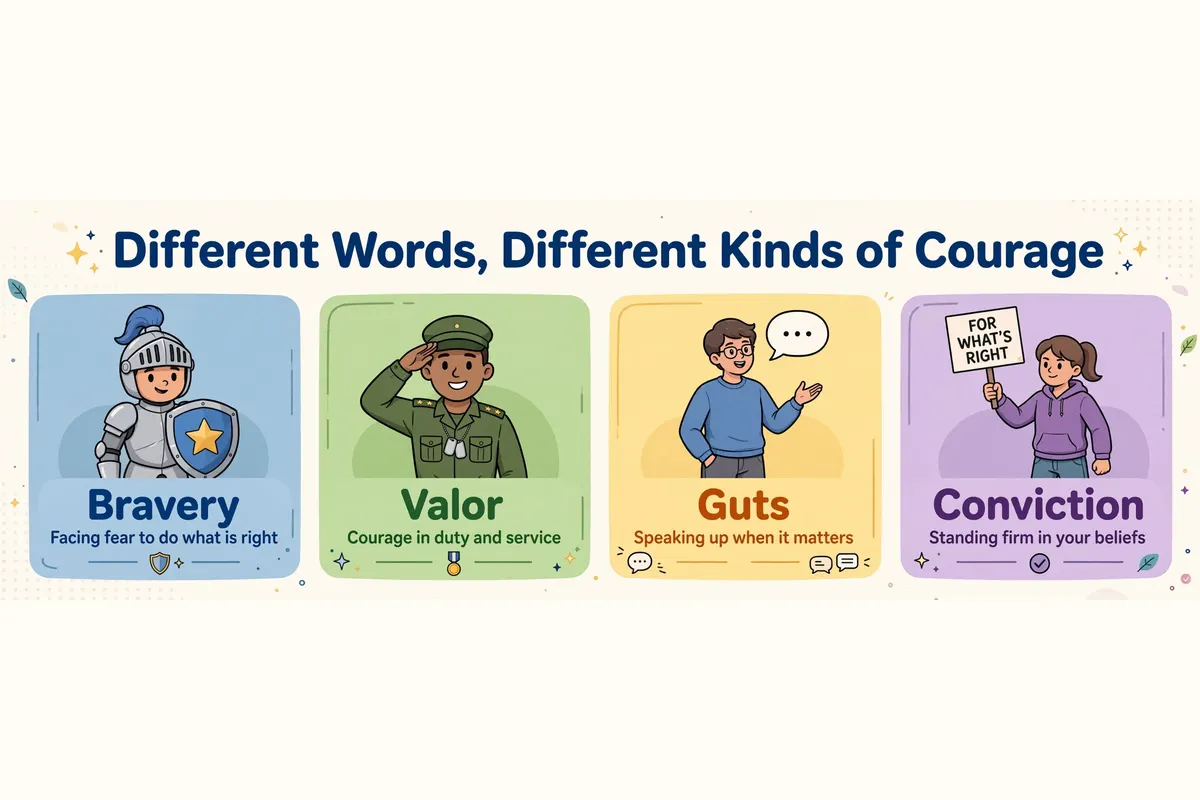
35 Best Courage Synonyms at a Glance
The following table contains 35 words grouped by their main uses. The first eight are direct synonyms for facing danger. The next eight are formal or literary choices for enduring hardship. Nine words suit everyday conversation, while the final ten cover moral courage, determination, and related forms of boldness.
Some entries are uncommon or carry important warnings. Stoutheartedness, doughtiness, derring-do, and lionheartedness are mainly useful for recognizing older or literary language. Courageousness and prowess also require special care.
| Synonym | Tone | Best for |
|---|---|---|
| Bravery | Neutral, positive | Everyday talk, essays, stories, general use |
| Valor | Formal, heroic | Military writing, formal praise, awards, speeches |
| Heroism | Formal, admiring | News, stories, tributes, formal writing |
| Gallantry | Formal, old-fashioned | Military praise, formal writing, historical stories |
| Fearlessness | Admiring, strong | Sports, adventure, personality descriptions |
| Boldness | Confident, neutral | Business, leadership, essays, everyday writing |
| Daring | Exciting, adventurous | Stories, journalism, adventure writing |
| Dauntlessness | Formal, literary | Formal writing, literary stories, speeches |
| Fortitude | Formal, solemn | Essays, obituaries, medical contexts, formal speeches |
| Intrepidity | Academic, literary | Literary writing, historical essays, formal analysis |
| Mettle | Formal, literary | Essays, sports writing, formal praise |
| Resolution | Formal, neutral | Essays, reports, formal writing |
| Tenacity | Formal, admiring | Essays, biographies, formal writing |
| Spirit | Neutral, literary | Stories, essays, speeches |
| Stoutheartedness | Archaic, literary | Literary writing, historical essays |
| Doughtiness | Archaic, formal | Old texts, literary writing |
| Guts | Casual, spoken | Everyday talk, casual writing, stories |
| Nerve | Neutral, casual | Everyday talk, stories, academic debate |
| Pluck | Informal, admiring | Stories, sports writing, everyday talk |
| Spunk | Informal, spirited | Everyday talk, stories, casual writing |
| Backbone | Casual, metaphorical | Everyday talk, leadership writing, stories |
| Grit | Informal, respectful | Sports, stories, everyday talk, essays about effort |
| Moxie | Informal, American | Everyday American talk, casual writing, stories |
| Spine | Informal, direct | Everyday talk, casual writing |
| Heart | Neutral, warm | Stories, speeches, everyday talk |
| Audacity | Intense, bold | Journalism, stories, debate |
| Temerity | Formal, negative-leaning | Formal writing, literary criticism |
| Conviction | Formal, serious | Essays, leadership writing, ethics, speeches |
| Determination | Neutral, positive | Everyday talk, essays, stories, biographies |
| Steadfastness | Formal, positive | Essays, formal writing, stories |
| Hardihood | Formal, literary | Literary writing, formal essays |
| Derring-do | Archaic, literary | Old stories, literary writing, playful formal writing |
| Lionheartedness | Literary, admiring | Stories, literary writing, praise |
| Courageousness | Neutral, awkward | Almost never. Use “courage” instead |
| Prowess | Formal, admiring | Formal writing, sports, military praise |
Direct Synonyms for Courage
These eight words describe bravery, bold action, or the willingness to face danger. They are useful when someone takes a risk, confronts a difficult situation, or acts despite uncertainty.
1. Bravery
Tone: Neutral, positive · Uses: Everyday talk, essays, stories, general use
Meaning: The quality of facing danger or difficulty without being overcome by fear.
Explanation: Bravery is the most direct and widely understood synonym for courage. It often describes an observable act, such as helping someone during an emergency or confronting a serious threat. Use bravery when you need a familiar word that works in most situations.
Examples:
- Her bravery during the emergency inspired everyone in the building.
- The story celebrates the bravery of ordinary people who protect their neighbors.
2. Valor
Tone: Formal, heroic · Uses: Military writing, formal praise, awards, speeches
Meaning: Great courage in the face of danger, especially in battle.
Explanation: Valor describes exceptional bravery and often carries a sense of honor or sacrifice. It is especially fitting when discussing military service, heroic actions, or formal recognition. Use valor when ordinary bravery does not fully express the significance of an action.
Examples:
- The soldier received an award for his valor during the mission.
- The ceremony recognized the valor of those who defended their community.
3. Heroism
Tone: Formal, admiring · Uses: News, stories, tributes, formal writing
Meaning: Courage shown through an act that saves, protects, or helps others.
Explanation: Heroism is stronger than general courage because it usually involves an admirable action. It often describes people who put themselves at risk to protect someone else. Use heroism when the action itself deserves special recognition.
Examples:
- The firefighter’s heroism helped save several families from the building.
- Her heroism during the accident earned widespread admiration.
4. Gallantry
Tone: Formal, old-fashioned · Uses: Military praise, formal writing, historical stories
Meaning: Brave and noble conduct, often associated with duty or chivalry.
Explanation: Gallantry describes courage combined with honor, courtesy, or noble behavior. It appears frequently in historical and military contexts. The word can also refer to polite attention toward women, so make the intended meaning clear.
Examples:
- The captain was praised for his gallantry during the dangerous rescue.
- The historical novel describes the gallantry of the soldiers defending the town.
5. Fearlessness
Tone: Admiring, strong · Uses: Sports, adventure, personality descriptions
Meaning: Having no fear in the face of danger.
Explanation: Fearlessness describes the absence of fear, while courage involves acting despite fear. A person can show courage while feeling anxious, uncertain, or frightened. Do not use fearlessness as an exact replacement for courage when fear is part of the situation.
Examples:
- Her fearlessness on the climbing wall amazed the spectators.
- The documentary showed his fearlessness during dangerous mountain expeditions.
6. Boldness
Tone: Confident, neutral · Uses: Business, leadership, essays, everyday writing
Meaning: A willingness to take risks and speak or act without hesitation.
Explanation: Boldness describes confident action, especially when someone challenges expectations or makes an unusual choice. It can involve courage, but it also applies to confidence and strong opinions. Use boldness when the emphasis is on taking initiative rather than facing physical danger.
Examples:
- Her boldness helped the team consider a completely different approach.
- The manager showed boldness by questioning an outdated company policy.
7. Daring
Tone: Exciting, adventurous · Uses: Stories, journalism, adventure writing
Meaning: A willingness to take thrilling or risky chances.
Explanation: Daring suggests adventure, excitement, and a readiness to face risk. It often describes dramatic actions or ambitious challenges. It is less suitable for quiet endurance or moral decisions that do not involve adventurous risk.
Examples:
- The explorer’s daring made the expedition possible.
- Her daring decision to cross the desert became the subject of a documentary.
8. Dauntlessness
Tone: Formal, literary · Uses: Formal writing, literary stories, speeches
Meaning: Courage that nothing can frighten or discourage.
Explanation: Dauntlessness describes a strong refusal to be intimidated by danger or difficulty. It has a grand, literary sound and appears more naturally in formal descriptions than everyday conversation. Choose a simpler word such as bravery when writing for a general audience.
Examples:
- The story highlights the dauntlessness of a young leader facing powerful enemies.
- His dauntlessness gave the frightened villagers hope during the crisis.
Formal Synonyms for Courage
These words describe inner strength, endurance, and determination. They are especially useful in academic writing, biographies, formal speeches, and descriptions of people who face prolonged hardship.
9. Fortitude
Tone: Formal, solemn · Uses: Essays, obituaries, medical contexts, formal speeches
Meaning: Mental and emotional strength to endure pain or hardship over time.
Explanation: Fortitude emphasizes endurance rather than a single brave action. It describes the ability to keep going through suffering, setbacks, or difficult circumstances. It is one of the strongest formal alternatives when someone faces a long period of hardship.
Examples:
- She showed remarkable fortitude during her lengthy recovery.
- His fortitude helped the family remain hopeful through difficult years.
10. Intrepidity
Tone: Academic, literary · Uses: Literary writing, historical essays, formal analysis
Meaning: Fearless boldness in facing danger or adventure.
Explanation: Intrepidity describes an unusually bold approach to danger. It often appears in historical accounts, literary descriptions, and formal discussions of heroic behavior. The word is elevated and uncommon, so bravery or courage usually sounds more natural in everyday writing.
Examples:
- The biography describes the explorer’s intrepidity during his early expeditions.
- Her intrepidity impressed the people who witnessed the dangerous rescue.
11. Mettle
Tone: Formal, literary · Uses: Essays, sports writing, formal praise
Meaning: An ingrained capacity to meet strain or difficulty with resilience.
Explanation: Mettle describes a person’s ability to handle pressure and prove their character during a challenge. It commonly appears in expressions such as “test your mettle” and “show your mettle.” Use it when you want to show character under pressure.
Examples:
- The final match tested the team’s mettle under intense pressure.
- She proved her mettle by leading the project through several setbacks.
12. Resolution
Tone: Formal, neutral · Uses: Essays, reports, formal writing
Meaning: Firm determination to achieve an end, whatever the difficulty.
Explanation: Resolution focuses on a person’s firm purpose and commitment. It can support courageous behavior, but it does not necessarily involve danger or fear. Use resolution when the main idea is staying committed to a difficult goal.
Examples:
- His resolution remained strong despite repeated criticism.
- The reformer’s resolution helped bring attention to an unfair policy.
13. Tenacity
Tone: Formal, admiring · Uses: Essays, biographies, formal writing
Meaning: Stubborn persistence and an unwillingness to admit defeat.
Explanation: Tenacity adds persistence to determination. It describes someone who continues working toward a goal despite resistance, disappointment, or repeated failure. It is a close relative of courage, but it focuses more on persistence than on facing danger.
Examples:
- Her tenacity helped her complete the demanding research project.
- The athlete’s tenacity kept him competing after several difficult seasons.
14. Spirit
Tone: Neutral, literary · Uses: Stories, essays, speeches
Meaning: The quality of temperament that keeps morale up when opposed or threatened.
Explanation: Spirit can describe the inner attitude that helps someone remain hopeful and determined during difficult circumstances. It also has broader meanings involving morale, personality, and temperament. Make sure the surrounding sentence establishes that you mean courage rather than general enthusiasm.
Examples:
- Her spirit remained strong despite the criticism she received.
- The team’s fighting spirit helped its members finish the difficult season.
15. Stoutheartedness
Tone: Archaic, literary · Uses: Literary writing, historical essays
Meaning: Brave and resolute courage, especially in older or formal stories.
Explanation: Stoutheartedness describes a person with a strong heart and an unwillingness to surrender to fear. It has an old-fashioned literary sound. Modern writers generally choose bravery or fortitude because these words are easier for readers to understand.
Examples:
- The novel praises the stoutheartedness of the villagers during the siege.
- His stoutheartedness became a central theme in the historical account.
16. Doughtiness
Tone: Archaic, formal · Uses: Old texts, literary writing
Meaning: Courage and determination, especially when facing a difficult fight.
Explanation: Doughtiness is an uncommon word associated with traditional descriptions of brave warriors and determined people. It can appear in historical or literary writing, but it rarely sounds natural in modern conversation. Use it mainly when recognizing older vocabulary or discussing historical language.
Examples:
- The poem celebrates the doughtiness of the warriors defending their homeland.
- The historian described the commander’s doughtiness during the final battle.
Everyday Synonyms for Courage
These nine words work well in conversations, stories, and less formal writing. Some are casual expressions, while others are metaphors for standing firm or continuing through hardship.
17. Guts
Tone: Casual, spoken · Uses: Everyday talk, casual writing, stories
Meaning: The nerve to do something frightening or difficult.
Explanation: Guts is a familiar informal word for courage. It often describes someone who takes a difficult step despite pressure, embarrassment, or possible failure. It is natural in conversation but too casual for many formal essays and professional reports.
Examples:
- It took guts to tell the truth when everyone else stayed silent.
- She had the guts to challenge a decision that affected her whole team.
18. Nerve
Tone: Neutral, casual · Uses: Everyday talk, stories, academic debate
Meaning: The courage or confidence necessary to do something difficult, unpleasant, or rude.
Explanation: Nerve can describe admirable boldness when someone faces a frightening challenge. However, it can also suggest disrespect or excessive confidence. The expression “What nerve!” usually communicates criticism rather than praise.
Examples:
- He had the nerve to ask for another chance after the mistake.
- It takes nerve to speak honestly in front of a large audience.
19. Pluck
Tone: Informal, admiring · Uses: Stories, sports writing, everyday talk
Meaning: Spirited, lively courage, often shown by a young person or underdog.
Explanation: Pluck describes a cheerful kind of courage that helps someone face difficulties without giving up. It often carries warmth and admiration. It is informal and especially useful when describing someone who keeps trying despite limited advantages.
Examples:
- The young player showed plenty of pluck during the championship.
- Her pluck helped her face the unfamiliar challenges of starting a new school.
20. Spunk
Tone: Informal, spirited · Uses: Everyday talk, stories, casual writing
Meaning: Lively courage and determination.
Explanation: Spunk describes an energetic attitude that combines confidence, boldness, and determination. It can make a character sound lively and spirited. The word is informal and can also refer to liveliness or energy rather than courage alone.
Examples:
- The new employee showed real spunk during her first presentation.
- His spunk helped him stand up to the more experienced competitors.
21. Backbone
Tone: Casual, metaphorical · Uses: Everyday talk, leadership writing, stories
Meaning: Strength of character and the resolve to stand firm.
Explanation: Backbone uses the image of a strong spine to describe someone who refuses to surrender their principles. It is especially useful for moral courage and speaking up. It is less suitable when describing a single physical rescue or dangerous adventure.
Examples:
- She showed backbone by refusing to support the dishonest proposal.
- The community needed a leader with enough backbone to defend its interests.
22. Grit
Tone: Informal, respectful · Uses: Sports, stories, everyday talk, essays about effort
Meaning: Stubborn persistence and toughness through a long struggle.
Explanation: Grit describes the ability to keep working through repeated setbacks and difficult conditions. It is closely related to courage, but its main focus is persistence over time. Use grit for a long challenge rather than a single brave decision.
Examples:
- His grit helped him finish the race despite the difficult conditions.
- The biography describes the grit she needed to rebuild her business.
23. Moxie
Tone: Informal, American · Uses: Everyday American talk, casual writing, stories
Meaning: Boldness mixed with nerve and resourcefulness.
Explanation: Moxie describes someone who has the confidence and energy to take on a difficult challenge. It often carries a positive, playful tone in American English. It is a casual expression, so choose bravery or determination for formal writing.
Examples:
- The young entrepreneur had the moxie to launch her own company.
- It took real moxie to question the popular opinion during the meeting.
24. Spine
Tone: Informal, direct · Uses: Everyday talk, casual writing
Meaning: The courage to stand up and say or do the hard thing.
Explanation: Spine is a metaphor for strength of character. It commonly appears in expressions such as “have the spine to” and “show some spine.” Use it when describing someone who stands firm instead of avoiding an uncomfortable decision.
Examples:
- He finally had the spine to tell his manager about the problem.
- She showed enough spine to defend her colleague against unfair criticism.
25. Heart
Tone: Neutral, warm · Uses: Stories, speeches, everyday talk
Meaning: Emotional strength that keeps a person going through difficulty.
Explanation: Heart can describe warmth, determination, and the emotional strength to face hardship. It is often used positively when praising someone who continues despite personal challenges. Because heart has several meanings, the surrounding context should make the intended sense clear.
Examples:
- The young volunteer had the heart to help families after the storm.
- Her heart gave her the strength to keep supporting the community.
Synonyms for Moral Courage
Moral courage involves standing by a belief, accepting responsibility, or speaking against something wrong. The following words describe different shades of boldness and determination, but several are not direct replacements for courage.
26. Audacity
Tone: Intense, bold · Uses: Journalism, stories, debate
Meaning: Boldness that surprises or shocks, for good or ill.
Explanation: Audacity describes an unusually bold action or attitude. It can express admiration when someone challenges an unfair system, but it can also suggest arrogance or disrespect. Use it when the context makes the positive meaning clear.
Examples:
- Her audacity helped expose a problem that others were afraid to discuss.
- The journalist admired his audacity in questioning the powerful officials.
27. Temerity
Tone: Formal, negative-leaning · Uses: Formal writing, literary criticism
Meaning: Reckless boldness that goes beyond what is sensible or wise.
Explanation: Temerity usually describes excessive confidence or daring without enough consideration of the consequences. Unlike positive courage, it often suggests poor judgment. Use it carefully when you want to criticize someone’s bold behavior rather than praise it.
Examples:
- He had the temerity to challenge the judge without understanding the rules.
- The critic questioned her temerity in making such a serious accusation without evidence.
28. Conviction
Tone: Formal, serious · Uses: Essays, leadership writing, ethics, speeches
Meaning: A strong belief that gives someone the courage to act on it.
Explanation: Conviction describes a firmly held belief or principle. It can provide the motivation behind moral courage, especially when someone risks criticism by defending what they believe is right. It names the belief behind the action, not the courageous action itself.
Examples:
- Her conviction gave her the strength to oppose the unfair policy.
- He spoke with conviction even when several colleagues disagreed.
29. Determination
Tone: Neutral, positive · Uses: Everyday talk, essays, stories, biographies
Meaning: Firmness of purpose and a refusal to give up.
Explanation: Determination describes a person’s commitment to reaching a goal despite obstacles. It often supports courageous behavior, although someone can be determined without facing danger or fear. Use it when persistence and purpose matter more than the risk involved.
Examples:
- Her determination helped her complete the demanding training program.
- His determination to defend the workers remained strong throughout the dispute.
30. Steadfastness
Tone: Formal, positive · Uses: Essays, formal writing, stories
Meaning: Firm and unchanging loyalty to a belief or course.
Explanation: Steadfastness describes the ability to remain committed when circumstances become difficult. It is especially useful for moral courage, loyalty, and standing by a principle. It emphasizes consistency over time rather than one dramatic act of bravery.
Examples:
- Her steadfastness helped the organization remain committed to its mission.
- The community admired his steadfastness during the long campaign for fairness.
31. Hardihood
Tone: Formal, literary · Uses: Literary writing, formal essays
Meaning: Courage and toughness when facing hardship or danger.
Explanation: Hardihood combines bravery with the ability to withstand difficult conditions. It can describe physical toughness as well as a person’s willingness to face danger. The word is uncommon, so fortitude or bravery will usually sound more natural to modern readers.
Examples:
- The explorers displayed remarkable hardihood during the harsh winter journey.
- The historical account praises the hardihood of the early settlers.
32. Derring-do
Tone: Archaic, literary · Uses: Old stories, literary writing, playful formal writing
Meaning: Daring and heroic action, especially bold deeds.
Explanation: Derring-do is an old-fashioned expression for adventurous bravery. It often appears in stories about knights, warriors, and larger-than-life heroes. Use it for a literary effect or when discussing older writing, not as an ordinary modern synonym.
Examples:
- The adventure novel is filled with tales of derring-do.
- The storyteller described the knight’s derring-do during the rescue.
33. Lionheartedness
Tone: Literary, admiring · Uses: Stories, literary writing, praise
Meaning: The courage of a lion, describing someone who is brave-hearted and fearless.
Explanation: Lionheartedness is a strong, admiring description of bravery. It suggests a person who faces serious challenges with an unusually bold spirit. The word has a literary quality, so bravery or heroism usually works better in everyday writing.
Examples:
- The story celebrates the lionheartedness of the young warrior.
- Her lionheartedness inspired the other volunteers to continue their work.
34. Courageousness
Tone: Neutral, awkward · Uses: Almost never. Use “courage” instead
Meaning: The state of being courageous.
Explanation: Courageousness is a noun form related to the adjective courageous, but it sounds clunky in most modern writing. The simpler noun courage is more standard and natural. This entry is included as a recognition and usage warning, not as a recommended everyday synonym.
Examples:
- The report discusses the courageousness of the volunteers during the emergency.
- His courageousness impressed the audience, although “his courage” would sound more natural.
35. Prowess
Tone: Formal, admiring · Uses: Formal writing, sports, military praise
Meaning: Exceptional skill and bravery, especially in battle or sport.
Explanation: Prowess often describes outstanding ability, expertise, or performance. It can include bravery, but skill and excellence are frequently more important than courage itself. Use it when someone demonstrates exceptional ability alongside bold action, not as a general replacement for courage.
Examples:
- The athlete demonstrated remarkable prowess during the international competition.
- The commander was respected for his military prowess and leadership.
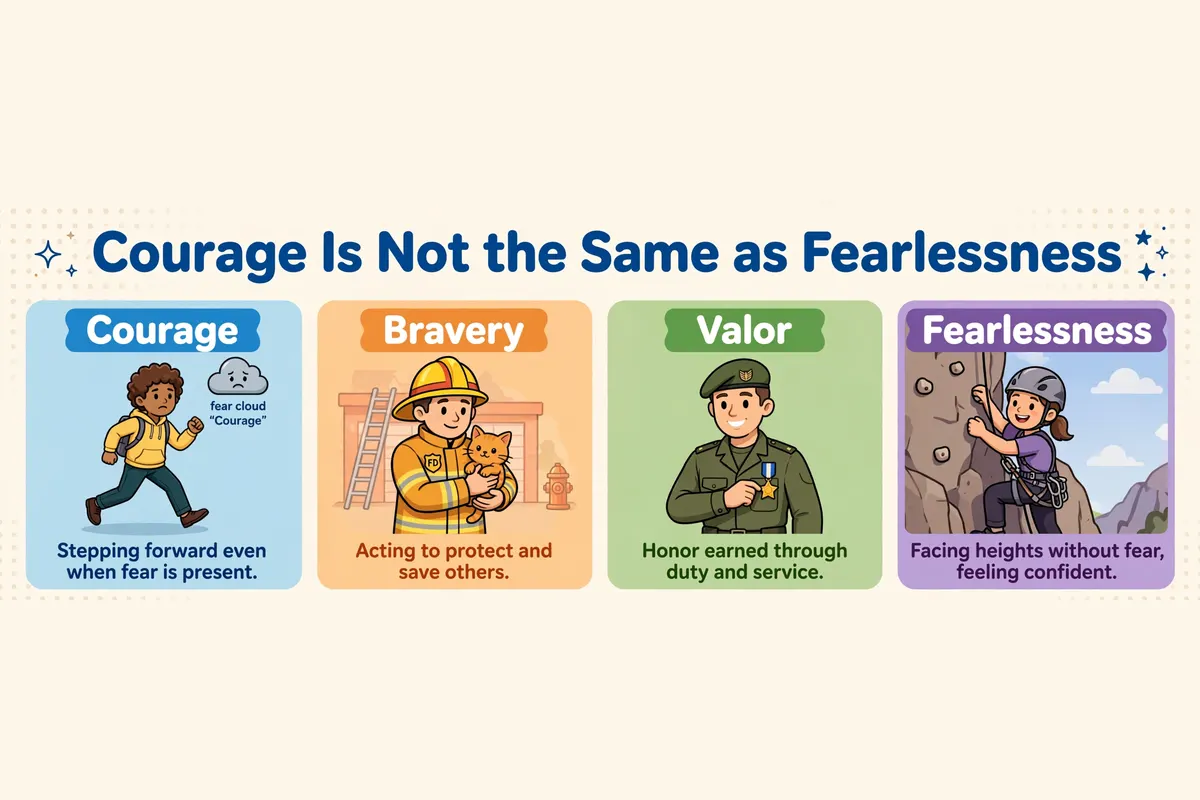
Courage vs Bravery vs Valor vs Fearlessness
Courage, bravery, valor, and fearlessness all relate to facing danger, but they stress different qualities. Understanding these differences helps you choose the right word.
| Word | Core idea | Is fear present? | Best for | Example |
|---|---|---|---|---|
| Courage | Inner strength to act in spite of fear | Yes, the person acts anyway | Moral choices, endurance, standing up for what is right | It took courage to speak up when everyone else stayed silent. |
| Bravery | The visible act of facing danger | Often no, the act can be instinctive or fearless | Physical danger, rescue, immediate action | The firefighter’s bravery saved three children from the blaze. |
| Valor | Heroic courage, especially in battle | Yes, danger is faced knowingly | Military praise, formal awards, heroic acts | He received a medal for his valor in battle. |
| Fearlessness | Having no fear at all | No, fear is absent | Sports, adventure, personality traits | Her fearlessness on the climbing wall amazed the crowd. |
Courage vs fortitude: fortitude is endurance over time, and courage is the act of facing.
Courage vs grit: grit is long struggle, and courage can be a single act.
If the person feels fear and acts anyway, say courage. If the act itself is the story, say bravery. If the act is heroic or military, say valor. If there is no fear at all, say fearlessness, and never call fearlessness courage, because courage needs fear to exist.
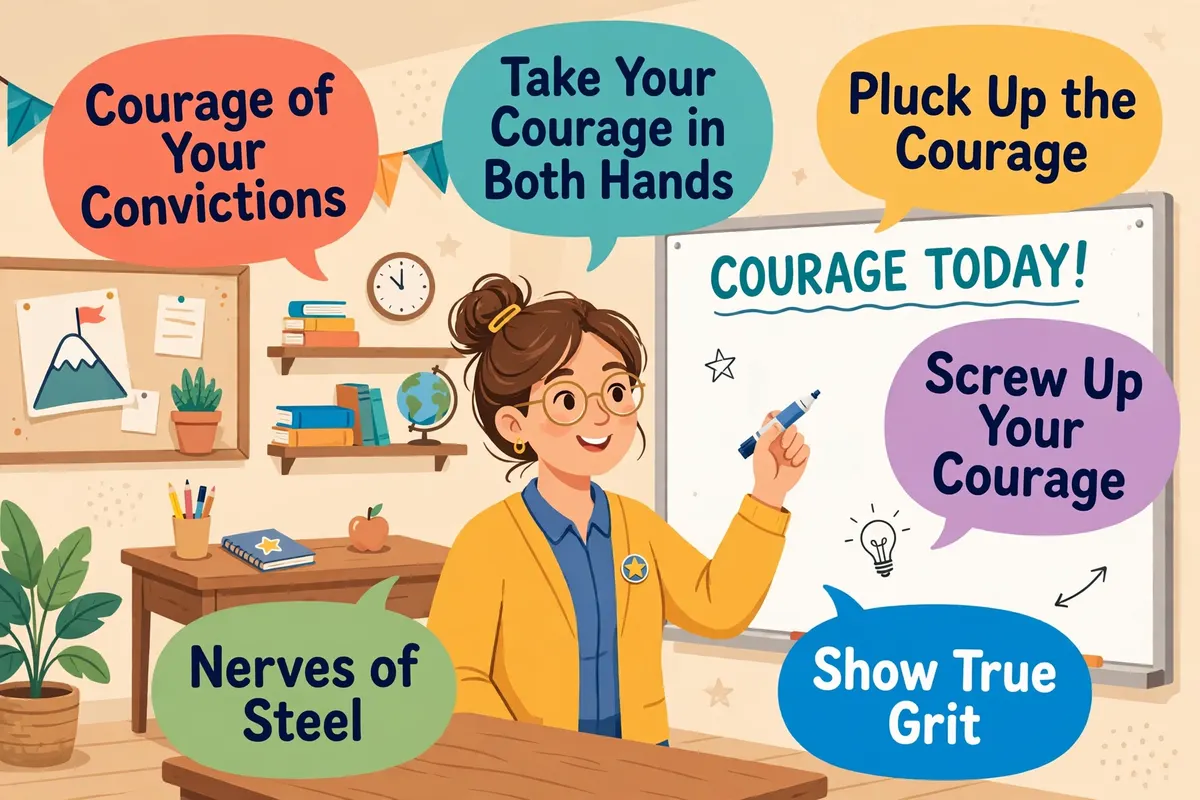
Other Ways to Say “Courage”
Sometimes a phrase communicates courage more naturally than a single word. These six expressions describe gathering confidence, standing by your beliefs, or remaining calm under pressure.
1. Have the Courage of Your Convictions
Meaning: Act according to what you believe is right, even when doing so may bring criticism or personal costs.
Tone: Formal, thoughtful.
Best for: Ethical decisions, speeches, essays, and discussions about personal principles.
Example: She had the courage of her convictions when she refused to approve the dishonest report.
2. Take Your Courage in Both Hands
Meaning: Force yourself to do something frightening or uncomfortable.
Tone: Formal, expressive.
Best for: Describing a difficult conversation, a major decision, or an intimidating first step.
Example: He took his courage in both hands and finally asked for the promotion.
3. Pluck Up the Courage
Meaning: Gather enough confidence to do something that makes you nervous.
Tone: Informal, conversational.
Best for: Personal situations, difficult questions, and everyday challenges.
Example: She finally plucked up the courage to speak to her new neighbors.
4. Screw Up Your Courage
Meaning: Force yourself to become brave enough to face a difficult situation.
Tone: Informal, conversational.
Best for: Describing someone preparing for an uncomfortable or frightening action.
Example: He screwed up his courage before entering the manager’s office.
5. Show True Grit
Meaning: Face a long, difficult struggle with stubborn persistence.
Tone: Informal, admiring.
Best for: Sports, personal challenges, work, and stories about persistence.
Example: The young athlete showed true grit after returning from a serious injury.
6. Have Nerves of Steel
Meaning: Remain calm and brave when facing intense pressure or danger.
Tone: Informal, expressive.
Best for: Emergency situations, stressful jobs, public performances, and demanding challenges.
Example: The emergency surgeon had nerves of steel during the complicated operation.
Antonyms of Courage
Courage has a direct opposite: cowardice. However, several other words describe different degrees of fear, hesitation, and unwillingness to stand firm.
These alternatives are not equally strong. Some sound mild, while others express serious criticism.
- Cowardice
Cowardice is the direct opposite of courage. It describes allowing fear to prevent someone from doing something they should face.
Example: His cowardice prevented him from defending the colleague who needed his support. - Timidity
Timidity is a softer description of being shy, hesitant, or easily frightened. It does not carry the same strong blame as cowardice.
Example: Her timidity made it difficult for her to speak during the meeting. - Fearfulness
Fearfulness describes a state of being full of fear. It focuses on the emotion rather than necessarily judging someone’s character.
Example: His fearfulness increased when he realized how dangerous the journey could become. - Faintheartedness
Faintheartedness describes a lack of confidence or nerve when facing a difficult situation.
Example: The leader’s faintheartedness prevented the team from making an important decision. - Cravenness
Cravenness is a strong, blaming word for shameful or extreme cowardice. It suggests a serious failure to face a situation.
Example: The writer criticized the official’s cravenness during the public crisis. - Spinelessness
Spinelessness describes a lack of backbone or moral strength. It often applies when someone refuses to defend a belief or stand against wrongdoing.
Example: The employees viewed his silence as spinelessness rather than neutrality. - Pusillanimity
Pusillanimity is a formal and uncommon word for a weak or timid spirit. It usually sounds critical and belongs in elevated or literary writing.
Example: The historian described the general’s pusillanimity during the critical negotiations.
Fear and Cowardice Are Not Identical
Fear is the natural emotion that courage works against. Feeling afraid does not automatically make someone a coward.
Cowardice describes allowing fear to prevent necessary action. A person can feel fear and still show courage by choosing to act.
FAQs
Frequently Asked Questions
- What is another word for courage?
Bravery is the most direct synonym for courage and works in everyday writing. Valor suits formal or military praise, fortitude describes enduring hardship, and guts is a natural choice in casual conversation. - What is the best formal synonym for courage?
Fortitude is an excellent formal choice when describing someone enduring hardship over time. Valor is better for heroic or military actions. Choose the word that matches the person’s experience and context. - Is bravery the same as courage?
Bravery and courage are closely related, but they stress different things. Bravery often describes a visible act, while courage highlights the inner decision to face fear and act anyway, even when fear is strong. - What is the opposite of courage?
Cowardice is the direct opposite of courage because it describes allowing fear to prevent necessary action. Timidity is a softer alternative that describes someone who is shy or easily frightened. - What is a casual word for courage?
Guts and nerve are common casual words for courage. Guts often describes facing something frightening, while nerve emphasizes the confidence needed to do something difficult, uncomfortable, or socially challenging for most people. - What is the difference between courage and fearlessness?
Courage means feeling fear but choosing to act anyway. Fearlessness means having no fear at all. The distinction matters because acting without fear does not always involve thoughtful or admirable judgment.