
However Synonyms: 28 Words That Show Contrast Clearly
However helps connect two contrasting ideas, but repeating it can make your writing feel dull. These 28 however synonyms give you clearer choices for essays, emails, conversations, and everyday writing.
Quick Answer
For everyday contrast, use but or yet. For essays and reports, choose nevertheless or nonetheless. Use on the other hand or conversely to introduce another viewpoint.
When however means “in whatever way,” use no matter how or regardless of how instead.
Remember: However is a conjunctive adverb in its contrast sense, not a conjunction. You cannot join two independent clauses with only a comma before it.
What Does However Mean?
However is an adverb with two main jobs. It can introduce a contrasting statement or describe the manner or degree of something.
Oxford Advanced Learner’s Dictionary gives two central meanings. The first introduces a statement that contrasts with something said earlier. The second means “to whatever degree” when it appears with an adjective or adverb.
Merriam-Webster also defines however through the ideas of “in spite of that” and “on the other hand.” Cambridge Dictionary covers the contrast meaning and the sense “in whatever way.”
These meanings look similar on the page, but they work differently in sentences.
1. However as a Contrast Word
In its contrast sense, however introduces an idea that differs from or challenges the point before it.
For example:
The restaurant looked expensive. However, the food was affordable.
The first sentence creates an expectation. The second gives the reader a different result.
You can also place however inside a sentence:
The restaurant, however, offered several affordable meals.
This use connects two related ideas without making the second one an exact opposite.
2. However as a Manner or Degree Word
However can also mean “in whatever way” or “to whatever degree.”
For example:
You can arrange the books however you like.
However hard she tried, the door would not open.
In these sentences, however does not introduce a contrast between two statements. It describes how something happens or the degree to which something is true.
Phrases such as “no matter how” and “regardless of how” can express this meaning.
The Two Meanings Need Different Punctuation
The contrast sense usually takes punctuation around it. When it connects two independent clauses, use a semicolon before however and a comma after it.
Correct: The road was busy; however, we arrived on time.
The manner sense takes no comma.
Correct: You can decorate the room however you like.
There is another important detail. However has no common noun or adjective family. You should not invent forms such as “howeverness” or “howeverable.”
When to Use However Synonyms
The right replacement depends on your audience, sentence structure, and intended contrast. A word that sounds natural in a conversation may feel too casual in an academic paper.
Here are four common situations.
1. Essays and Reports
Formal writing often needs a clear connection between an argument and a contrasting point.
Try these options:
Nevertheless: Use it when the second point remains true despite the first.
The figures were lower than expected. Nevertheless, the project met its main goal.
Nonetheless: Use it when you want a similar formal transition.
The proposal had several weaknesses. Nonetheless, the committee approved it.
Conversely: Choose it when the reverse situation is true.
Some customers prefer online shopping. Conversely, others enjoy visiting physical stores.
These words work well in reports, academic papers, and structured arguments. Make sure the replacement expresses your intended relationship.
2. Business Emails
Business writing needs a professional tone without sounding stiff.
Consider these choices:
That said: Introduces another point after acknowledging the first.
The schedule is tight. That said, we can finish the review by Friday.
Despite this: Shows that something remains true even after the previous fact.
The first delivery arrived late. Despite this, the client approved the order.
Even so: Gives a more conversational transition while keeping a professional tone.
The budget is limited. Even so, we can complete the main tasks.
These expressions work well in emails, meeting notes, and workplace discussions.
3. Everyday Conversations
People usually choose shorter words when speaking or sending messages.
Try:
But: Introduces a direct contrast.
I wanted to call, but I ran out of time.
Yet: Shows an unexpected contrast.
The room was small, yet it felt comfortable.
Still: Keeps the earlier point in view while adding another fact.
It was raining. Still, we went for a walk.
Though: Often sounds natural at the end of a spoken sentence.
I don’t usually watch documentaries. I enjoyed that one, though.
These choices sound less formal than nevertheless or notwithstanding.
4. Stories and Narrative Writing
Stories often need transitions that keep the action moving.
Even so: Shows that an earlier problem did not change the next action.
Mia was nervous. Even so, she stepped onto the stage.
After all: Can introduce a reason or remind readers of an important fact.
We decided to stay home. After all, the weather forecast looked terrible.
On the other hand: Introduces another viewpoint.
The cabin was far from town. On the other hand, it offered complete privacy.
Use the expression that matches the story’s meaning. Don’t replace every however with the same word.
A Common Punctuation Mistake to Avoid
Never use a comma alone to join two independent clauses with however.
Incorrect: I wanted to attend, however I had another appointment.
Correct: I wanted to attend; however, I had another appointment.
You can also write two separate sentences:
I wanted to attend. However, I had another appointment.
This mistake is called a comma splice. It is one of the most common punctuation problems involving however.
Also, keep however when it expresses your meaning better than the alternatives. You don’t need to replace a correct word just to avoid repetition.
Benefits of Using However Synonyms
A good replacement does more than make your vocabulary look varied. It helps readers understand the relationship between your ideas.
Here are four practical benefits.
1. Avoid Repeating the Same Word
Using however in every paragraph can make an essay or report sound repetitive.
You can use still, yet, even so, or that said when their meanings fit.
For example:
The first plan looked promising. However, it was too expensive. However, the second plan also had problems.
A more natural version:
The first plan looked promising. However, it was too expensive. The second plan had problems, too.
You can also use another suitable transition when the sentence needs one.
2. Match Your Writing Tone
Different words create different impressions.
Notwithstanding sounds very formal. But feels direct and conversational. That said works well in many business situations.
Choosing the right tone helps your message sound natural.
A casual text does not need a legal expression. An academic argument may need more than a simple but.
3. Explain the Type of Contrast
Not every contrast works in the same way.
Use nevertheless when the second point stands despite a difficulty. Choose conversely when the reverse is true. Use on the other hand when presenting a different viewpoint.
These choices give readers a better idea of how the two statements relate.
4. Improve Sentence Structure
Learning the difference between conjunctions and conjunctive adverbs helps you avoid punctuation errors.
But and yet can join clauses as conjunctions. However, nevertheless, and nonetheless need different punctuation when they connect independent clauses.
Knowing these differences makes your writing easier to read and edit.
28 Best However Synonyms at a Glance
These 28 alternatives cover four situations: formal contrast, everyday conversation, presenting another viewpoint, and old-fashioned expressions.
The first eight suit formal or balanced writing. The next seven work in everyday situations. Entries 16 through 22 present another side of an argument. The final six include older expressions and literary phrases.
Words 23 through 26 are mainly for recognition, not everyday use.
| Synonym | Tone | Best for |
|---|---|---|
| Nevertheless | Formal, academic | Essays, reports, formal emails |
| Nonetheless | Formal, academic | Essays, reports, formal writing |
| Notwithstanding | Very formal, legal | Legal, academic, official writing |
| Despite this | Formal, business | Reports, emails, business writing |
| In spite of this | Formal | Reports, essays, formal writing |
| Even so | Neutral, formal | Essays, stories, everyday formal writing |
| Be that as it may | Formal, literary | Essays, speeches, formal writing |
| At the same time | Neutral | Essays, discussions, balanced writing |
| But | Casual, everyday | Everyday speech, messages, casual writing |
| Yet | Neutral, literary | Stories, essays, everyday writing |
| Still | Neutral, everyday | Everyday talk, stories, emails |
| Though | Casual, everyday | Everyday speech, casual writing |
| Anyway | Casual, spoken | Everyday talk, casual writing |
| Anyhow | Casual, spoken | Everyday talk, informal writing |
| After all | Neutral, spoken | Everyday talk, stories, explanations |
| On the other hand | Neutral | Discussions, essays, balanced comparisons |
| On the contrary | Formal | Arguments, essays, debates |
| Conversely | Formal, academic | Analysis, reports, academic writing |
| In contrast | Formal, academic | Essays, reports, comparisons |
| By contrast | Formal, academic | Essays, academic writing |
| On the flip side | Casual, spoken | Casual talk, blogs, light writing |
| That said | Neutral, business | Business emails, meetings, essays |
| Howbeit | Archaic, formal | Old texts, formal literary writing |
| Withal | Archaic, formal | Old texts only |
| Per contra | Archaic, formal | Old legal / academic texts |
| Still and all | Old-fashioned, spoken | Old-fashioned speech, stories |
| Just the same | Neutral, spoken | Everyday talk, stories |
| For all that | Neutral, literary | Stories, essays, literary writing |
Formal Synonyms for However
Formal alternatives can make an argument easier to follow. They also help you show whether the next point challenges, balances, or continues the earlier statement.
These eight expressions work in different formal settings.
1. Nevertheless
Tone: Formal, academic
Uses: Essays, reports, formal emails
Meaning: In spite of what has just been said; the point still stands.
Explanation: Nevertheless introduces a point that remains true despite an earlier difficulty or objection. It carries a stronger sense of persistence than a simple contrast. Use it when the second statement deserves emphasis.
Examples:
The research team faced several delays; nevertheless, it completed the study.
Nevertheless, the board approved the revised version.
2. Nonetheless
Tone: Formal, academic
Uses: Essays, reports, formal writing
Meaning: Even so; in spite of that.
Explanation: Nonetheless performs almost the same job as nevertheless. Both expressions show that an earlier problem does not prevent the next point from being true. Choose one when you want a formal transition, then keep your wording consistent.
Examples:
The instructions were difficult to follow; nonetheless, everyone finished the task.
Nonetheless, it kept its main offices open.
3. Notwithstanding
Tone: Very formal, legal
Uses: Legal, academic, official writing
Meaning: In spite of something; despite it.
Explanation: Notwithstanding is a very formal expression that often appears in legal or official writing. It can introduce a noun or noun phrase, as in “notwithstanding the rain.” It sounds stiff in everyday conversations.
Examples:
Notwithstanding the delays, the court reached a final decision.
The building remained open, notwithstanding the ongoing repairs.
4. Despite This
Tone: Formal, business
Uses: Reports, emails, business writing
Meaning: In spite of the fact just stated.
Explanation: Despite this points back to a fact or situation in the previous sentence. The word this needs a clear reference, so readers know which problem or detail you mean. It works well in reports and workplace messages.
Examples:
Despite this, the customer accepted the order.
Despite this, it completed the planned work.
5. In Spite of This
Tone: Formal
Uses: Reports, essays, formal writing
Meaning: In spite of the fact just stated.
Explanation: In spite of this carries the same basic meaning as despite this. It is longer and may sound slightly heavier in a formal sentence. Use it when you want to refer clearly to an earlier fact.
Examples:
In spite of this, the event continued.
In spite of this, the office reviewed the remaining details.
6. Even So
Tone: Neutral, formal
Uses: Essays, stories, everyday formal writing
Meaning: In spite of that; still true.
Explanation: Even so introduces a point that remains true despite the previous information. It sounds more conversational than nevertheless and can work at the beginning or middle of a sentence. It also fits stories and everyday formal writing.
Examples:
Even so, it had enough space for the family.
The first attempt failed; even so, the students kept working.
7. Be That as It May
Tone: Formal, literary
Uses: Essays, speeches, formal writing
Meaning: Even if that is true, the main point still stands.
Explanation: Be that as it may acknowledges an earlier statement before returning to the speaker’s main point. The phrase has an old-fashioned literary flavor. It suits speeches and formal arguments better than casual messages.
Examples:
Be that as it may, the committee must follow the published rules.
Be that as it may, the group reached its destination.
8. At the Same Time
Tone: Neutral
Uses: Essays, discussions, balanced writing
Meaning: While that is true, something else is also true.
Explanation: At the same time can present two ideas that exist together or balance one another. However, it also means that two events happen simultaneously. Use it for contrast only when the relationship between the ideas is clear.
Examples:
At the same time, it requires more staff training.
At the same time, it offers little privacy.
Everyday Synonyms for However
Everyday alternatives usually sound more natural in speech, messages, and informal writing. They are often shorter and easier to fit into ordinary conversations.
Here are seven useful choices.
9. But
Tone: Casual, everyday
Uses: Everyday speech, messages, casual writing
Meaning: Introduces a simple, direct contrast.
Explanation: But is one of the most common ways to show contrast. Unlike however, it is a coordinating conjunction that joins two clauses. When it joins independent clauses in one sentence, place a comma before it.
Examples:
I wanted to buy the jacket, but it was too expensive.
The kitchen is small, but it has plenty of storage.
10. Yet
Tone: Neutral, literary
Uses: Stories, essays, everyday writing
Meaning: But at the same time; in spite of that.
Explanation: Yet can introduce an unexpected or surprising contrast. It also works as a coordinating conjunction when joining two clauses. In that position, use a comma before it rather than the punctuation pattern for however.
Examples:
The road was narrow, yet two cars passed safely.
She felt nervous, yet she answered every question.
11. Still
Tone: Neutral, everyday
Uses: Everyday talk, stories, emails
Meaning: Even so; the fact remains true.
Explanation: Still can introduce a point that remains true after an earlier statement. It sounds natural in conversations and simple workplace messages. When it begins a contrast sentence, place a comma after it.
Examples:
Still, we arrived before the meeting.
Still, everyone enjoyed it.
12. Though
Tone: Casual, everyday
Uses: Everyday speech, casual writing
Meaning: Softens a contrast; in spite of that.
Explanation: Though often creates a softer contrast than but. In spoken English, it frequently appears at the end of a sentence. In that position, it can sound more natural than however.
Examples:
I enjoyed this one, though.
They were surprisingly soft, though.
13. Anyway
Tone: Casual, spoken
Uses: Everyday talk, casual writing
Meaning: In any case; despite what was said.
Explanation: Anyway can return a conversation to its main point or introduce a decision despite an earlier detail. It also means “in any case,” so the surrounding sentence should make the contrast clear. It is usually too casual for formal reports.
Examples:
Anyway, I found what I needed.
Anyway, the rain changed our plans.
14. Anyhow
Tone: Casual, spoken
Uses: Everyday talk, informal writing
Meaning: In any case; in spite of that.
Explanation: Anyhow is a casual alternative that can introduce a point despite an earlier situation. It is more informal than anyway and can also mean “in any way.” Use context to make the intended meaning clear.
Examples:
Anyhow, we decided to attend the show.
Anyhow, we reached the station on time.
15. After All
Tone: Neutral, spoken
Uses: Everyday talk, stories, explanations
Meaning: When everything is considered; in the end.
Explanation: After all can remind readers of a fact that supports the next statement. It also means “in the end” or “as it turned out.” The contrast meaning needs an earlier point that the speaker wants to reconsider.
Examples:
After all, parking near the stadium was difficult.
After all, she had managed the team for three years.
Synonyms for Showing the Other Side
Sometimes you don’t want to show that one idea is wrong. You simply want to present another viewpoint or compare two different situations.
These seven expressions help readers follow that shift.
16. On the Other Hand
Tone: Neutral
Uses: Discussions, essays, balanced comparisons
Meaning: From a second, opposing view.
Explanation: On the other hand introduces a different side of an issue. It works well when a discussion considers two viewpoints or choices. It often follows a sentence that has already presented the first side.
Examples:
On the other hand, the rent is high.
On the other hand, the second offers more practice.
17. On the Contrary
Tone: Formal
Uses: Arguments, essays, debates
Meaning: Actively corrects or rejects what was just said.
Explanation: On the contrary is stronger than however. It says that the earlier statement is wrong or that the opposite is true. Don’t use it for a mild difference between two ideas.
Examples:
On the contrary, it increased spending.
On the contrary, she praised the entire team.
18. Conversely
Tone: Formal, academic
Uses: Analysis, reports, academic writing
Meaning: In the opposite way; the reverse is true.
Explanation: Conversely works when the second situation is the reverse of the first. It is common in comparisons, research discussions, and formal analysis. A small difference or mild disagreement usually needs another expression.
Examples:
Conversely, rural homes may offer larger yards.
Conversely, others choose to pay the full amount upfront.
19. In Contrast
Tone: Formal, academic
Uses: Essays, reports, comparisons
Meaning: When two things are set side by side, they differ.
Explanation: In contrast draws attention to differences between two people, objects, or situations. It works best when the writing clearly identifies both things being compared. It is not the best choice for a single concession.
Examples:
In contrast, the southern region has a dry climate.
In contrast, the second included several detailed examples.
20. By Contrast
Tone: Formal, academic
Uses: Essays, academic writing
Meaning: The same as “in contrast,” with a slightly more formal feel.
Explanation: By contrast introduces a difference between two situations or subjects. Its meaning is very close to in contrast, so using both expressions in the same paragraph can sound repetitive. Choose the one that fits your sentence.
Examples:
By contrast, the second involved more than 1,000.
By contrast, the nearby village stays quiet.
21. On the Flip Side
Tone: Casual, spoken
Uses: Casual talk, blogs, light writing
Meaning: The other, less obvious side of the matter.
Explanation: On the flip side introduces another way to view a situation. It has a casual tone and often appears in conversations or informal articles. Avoid it in academic papers and official reports.
Examples:
On the flip side, it requires frequent travel.
On the flip side, its battery doesn’t last long.
22. That Said
Tone: Neutral, business
Uses: Business emails, meetings, essays
Meaning: Having said that, here is the other side.
Explanation: That said introduces a related point that qualifies or balances the previous statement. It is shorter than having said that and works well in workplace communication. Keep the thought that follows connected to the earlier point.
Examples:
That said, we can still finish the report.
That said, it gives customers everything they need.
Old-Fashioned Synonyms for However
Some expressions appear in older books, formal records, or historical writing. They may help you understand a text, but that doesn’t make them suitable for modern conversation.
The first four entries below are old-fashioned or archaic. Treat them as recognition words rather than everyday replacements.
23. Howbeit
Tone: Archaic, formal
Uses: Old texts, formal literary writing
Meaning: In spite of that; however.
Explanation: Howbeit is an archaic expression that appears in older writing. Merriam-Webster lists it among words related to however, but modern writers rarely use it. Learn to recognize it rather than placing it in an everyday email.
Examples:
The journey was long; howbeit, the travelers reached the village safely.
The task seemed difficult; howbeit, the workers completed it before sunset.
24. Withal
Tone: Archaic, formal
Uses: Old texts only
Meaning: In spite of that; together with that.
Explanation: Withal is an old-fashioned word that can carry more than one related sense. It may express an idea similar to in spite of that, but it does not sound natural in modern writing. Recognize it when reading older books.
Examples:
The old house was small, withal it remained comfortable for its owners.
The journey was tiring, withal the travelers remembered it fondly.
25. Per Contra
Tone: Archaic, formal
Uses: Old legal / academic texts
Meaning: On the contrary; on the other side.
Explanation: Per contra comes from Latin and has an old-fashioned formal flavor. It can express an opposing position or point of view. Modern writers should choose on the contrary or conversely instead.
Examples:
The first record supported the claim; per contra, the second raised doubts.
The earlier account favored one decision; per contra, the later report supported another.
26. Still and All
Tone: Old-fashioned, spoken
Uses: Old-fashioned speech, stories
Meaning: In spite of everything; even so.
Explanation: Still and all is an old-fashioned phrase that expresses a meaning close to even so. It appears in older speech and storytelling. Modern writers generally choose even so because it sounds simpler and more natural.
Examples:
Still and all, the family enjoyed the experience.
Still and all, it felt welcoming.
27. Just the Same
Tone: Neutral, spoken
Uses: Everyday talk, stories
Meaning: In spite of that; all the same.
Explanation: Just the same introduces a point that remains true despite something already mentioned. It sounds natural in everyday conversations and stories. It is a more familiar way to express this idea than the older phrase still and all.
Examples:
Just the same, we enjoyed the scenery.
Just the same, he agreed to help.
28. For All That
Tone: Neutral, literary
Uses: Stories, essays, literary writing
Meaning: In spite of that; despite it all.
Explanation: For all that acknowledges an earlier fact while keeping another point in view. It has a literary feel and often appears in stories or reflective writing. The earlier statement should make the contrast clear.
Examples:
For all that, its residents remained proud of their home.
For all that, her work impressed the entire team.
However vs But vs Nevertheless vs Nonetheless
These four words can introduce contrasting ideas, but their grammar and strength differ. Choosing the right one helps your sentences sound clear and correct.
| Word | Core idea | Part of speech | Punctuation it needs | Example |
|---|---|---|---|---|
| However | A formal pivot to a contrasting point | Conjunctive adverb | Semicolon before and comma after, or a new sentence with a comma | The plan was risky; however, it worked. |
| But | A simple, direct contrast | Coordinating conjunction | Comma before it, inside one sentence | The plan was risky, but it worked. |
| Nevertheless | In spite of that; the point still stands | Conjunctive adverb | Same as however: semicolon before and comma after, or a new sentence with a comma | The plan was risky; nevertheless, it worked. |
| Nonetheless | Even so; the same job as nevertheless | Conjunctive adverb | Same as however: semicolon before and comma after, or a new sentence with a comma | The plan was risky; nonetheless, it worked. |
However vs Although
However can begin a new sentence and introduce a contrasting statement. Although is a subordinating conjunction that needs a clause connected to a main clause.
Correct: Although it rained, we went out.
Incorrect as a standalone replacement: Although, we went out.
On the Other Hand vs On the Contrary
On the other hand presents another viewpoint or balances two ideas. On the contrary actively rejects or corrects the earlier statement. The second expression makes a much stronger claim.
The Closing Rule: Which Word Should You Choose?
Use but when you want to join two clauses with a simple contrast.
Use however when you want to introduce a contrasting point in a new sentence or with correct semicolon punctuation.
Use nevertheless when the second point remains true despite a difficulty or objection.
Use nonetheless when you want the same general meaning as nevertheless.
Don’t choose a word only because it sounds formal. Choose it because its meaning matches the relationship between your ideas.
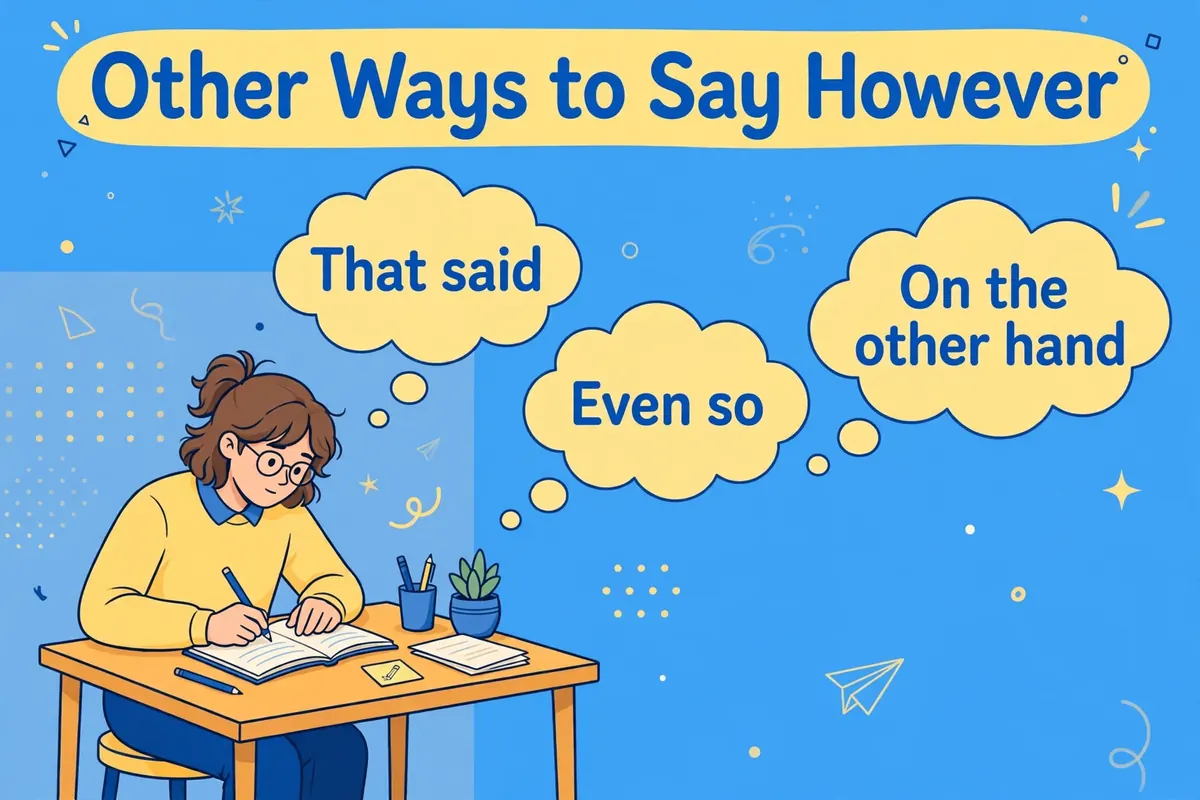
Other Ways to Say “However, …”
Sometimes you need a complete phrase rather than a single synonym. These six expressions can help you change the tone or structure of a sentence.
1. Having Said That
Tone: Neutral, business
This is the fuller form of that said. It acknowledges an earlier point before introducing another consideration.
Example: The first proposal needs more work. Having said that, its main idea is worth keeping.
2. Despite That
Tone: Formal, business
Despite that refers to an earlier situation while showing that the next point remains true.
Example: The delivery arrived later than expected. Despite that, the customer was satisfied.
3. In Spite of That
Tone: Formal
This phrase has the same general meaning as despite that. It gives the sentence a slightly longer form.
Example: The team had limited resources. In spite of that, it finished the project.
4. Then Again
Tone: Casual, spoken
Then again introduces a second thought or a different way of looking at a situation. It is common in everyday speech.
Example: It’s a long commute. Then again, the salary is great.
5. No Matter How
Tone: Neutral
This phrase expresses the manner or degree sense of however. It does not introduce a contrast between two statements.
Example: No matter how late it gets, I always review my notes.
6. Regardless of How
Tone: Neutral, formal
Regardless of how also expresses the manner or degree meaning. It describes how something happens without changing the main result.
Example: Regardless of how they try to cut costs, expenses keep rising.
Important distinction: No matter how and regardless of how are not contrast synonyms. They replace however only when it means “in whatever way” or “to whatever degree.”
Antonyms of However
However does not have a direct opposite word. It is a connector that introduces contrast, rather than a word that describes an object or quality.
You can still find words that perform a different job. Some add information, others show a result, and some confirm or strengthen an earlier point.
1. Moreover
Moreover adds another supporting point instead of introducing a contrast.
Example: The course is affordable. Moreover, it includes free study materials.
2. Furthermore
Furthermore adds information that supports the earlier statement.
Example: The library has extended hours. Furthermore, it offers free computer access.
3. Therefore
Therefore introduces a result or conclusion that follows from an earlier fact.
Example: The roads were covered in ice. Therefore, the school closed for the day.
4. Consequently
Consequently shows that something happened as a result of an earlier situation.
Example: The company missed its sales target. Consequently, it changed its marketing plan.
5. Similarly
Similarly points to a likeness between two people, situations, or ideas instead of a difference.
Example: The first class teaches basic grammar. Similarly, the second class focuses on core writing skills.
6. Likewise
Likewise introduces another point that follows the same pattern or shows a similar quality.
Example: The first team completed its review. Likewise, the second team submitted its report.
7. Indeed
Indeed confirms or strengthens the point that came before it.
Example: The new library is popular. Indeed, visitors often arrive before it opens.
8. In Fact
In fact adds emphasis or corrects an earlier impression rather than presenting an ordinary contrast.
Example: I thought the store had closed. In fact, it had moved to a larger building.
These words are not direct dictionary antonyms of however. They perform different connecting jobs, such as addition, result, similarity, and confirmation.
FAQs
Frequently Asked Questions
1. What is another word for however?
For everyday writing, try but or yet. In formal essays and reports, nevertheless or nonetheless may fit better. Use on the other hand when you want to introduce a second viewpoint.
2. What is the difference between however and nevertheless?
However signals a contrast between ideas. Nevertheless adds the sense that something remains true despite the point just made. Choose nevertheless when you want to stress that the earlier problem does not change your conclusion.
3. What is the difference between however and but?
But is a coordinating conjunction that joins clauses, usually with a comma before it. However is an adverb, so use a semicolon before it or start a new sentence instead.
4. Do you put a comma before or after however?
At the start of a contrast sentence, place a comma after however. Between independent clauses, use a semicolon before it and a comma after it. In the manner sense, such as however you like, use no comma.
5. Can you start a sentence with however?
Yes. You can begin a sentence with however when it introduces a contrast. Put a comma after it, then continue with the contrasting point. The old rule against starting with however is a myth.
6. What is a formal synonym for however?
For formal writing, nevertheless and nonetheless work in many contrast sentences. Notwithstanding is more formal and often takes a noun phrase, while despite this points back to a fact already stated.