
Quiet Synonyms: 25 Words for Calm, Soft and Still
Quiet can describe a room with little noise, a peaceful place, a person who speaks little, or a time when nothing much happens. These 25 quiet synonyms help you choose the right word for each situation.
Quick Answer
- For little or no sound: Silent or hushed.
- For peaceful places and moments: Peaceful or tranquil.
- For people who speak little: Reserved or soft-spoken.
- For low activity: Sleepy or subdued.
Remember the main difference: quiet allows a little sound, while silent means no sound at all. Choose your word based on whether you’re describing sound, a place, a person, or activity.
What Does Quiet Mean?
Quiet is an adjective that describes something with little noise, little activity, or a peaceful quality. It can also describe a person who talks little.
Oxford explains quiet through several common meanings:
- Little noise: Something makes very little sound, such as a quiet voice or engine.
- Little activity: A place has few people or not much happening. A quiet town or street fits this meaning.
- Peaceful: A moment or setting feels undisturbed, such as a quiet evening at home.
- A person who speaks little: Someone tends not to talk very much.
- Quiet authority: A person has a definite but understated presence or influence.
Merriam-Webster also describes quiet as free from noise, calm, or marked by little movement or activity. It covers a person who tends to speak little, and a thing done secretly, such as quiet diplomacy. Cambridge covers the low-noise and low-activity meanings too. It also uses quiet as a noun for silence, as in “Let’s have some quiet in here!” and notes that business can be quiet during the holidays.
Quiet as a noun and verb
Quiet doesn’t only work as an adjective.
- Noun: “The quiet of the garden helped me relax.” Here, quiet means a state of calm or little noise.
- Verb: “Please quiet the baby down.” Here, quiet means to make someone or something less noisy.
- Verb phrase: “The children quieted down after lunch.” Here, quiet means to become less noisy.
Noun alternatives include silence, stillness, hush, peace, and tranquility. Verb alternatives include silence, hush, soothe, pacify, and calm. These are not adjective synonyms, so they do not appear in the 25 entries below.
Quiet and quite aren’t the same word
Quiet means making little noise or having little activity. Quite means very or to a considerable extent.
- “The library is quiet.” This means there’s little noise.
- “The library is quite peaceful.” This means the library is very peaceful.
The spelling difference changes the meaning completely.
Related forms of quiet
- Quietly: The standard adverb. Example: “She spoke quietly.”
- Quietness: The noun describing a quiet state. Example: “I enjoyed the quietness of the countryside.”
- Quieten: A verb meaning to become or make quieter. It’s used mainly in British English.
- Quieter: The comparative form.
- Quietest: The superlative form.
You may also see the phrase “on the quiet.” It means secretly or without telling anyone. It doesn’t mean “in a low voice.” One more distinction matters: a quiet business has little activity. Words such as slow, inactive, and sluggish describe that business sense, not low sound. The main rule is simple: quiet means little noise, not necessarily no noise. Use silent when absolutely no sound is present. Secret and discreet describe privacy, not volume, so they are not quiet synonyms either. Mute, dumb, and speechless are not quiet synonyms: mute can mean physically unable to speak, dumb is offensive in this sense, and speechless means temporarily unable to speak.
When to Use Quiet Synonyms
The best synonym depends on what you’re describing. A word that fits a room might sound strange when used for a person.
When describing sound: Use silent when no sound is present. Hushed works for lowered voices or a room where people are waiting. Muted fits sounds that have been lowered in volume.
Examples: The audience remained silent after the announcement. Everyone spoke in hushed voices. Muted music played in the background.
When describing places: Peaceful and tranquil describe places free from disturbance. Secluded describes a location away from crowds and busy areas.
Examples: We found a peaceful garden behind the library. The lake looked tranquil at sunrise. They stayed in a secluded cottage.
When describing people: Reserved, soft-spoken, and reticent describe different kinds of quiet behavior. A reserved person doesn’t readily share thoughts or feelings. A soft-spoken person uses a gentle, low voice.
Examples: My new colleague is reserved but friendly. The teacher is soft-spoken and patient. He was reticent about his family history.
When describing low activity: Sleepy describes a place where little happens. Subdued describes something less lively or expressive than usual. Low-key fits a small, restrained event.
Examples: The town feels sleepy on Sunday mornings. The crowd gave a subdued response. We planned a low-key birthday dinner.
You don’t always need a synonym. Keep quiet when it expresses the meaning clearly. A stronger word should add something true, not just sound fancy.
Benefits of Using Quiet Synonyms
Using different words for quiet gives your writing more precision. It also helps readers understand exactly what you mean.
- Stop repeating the same word: Repeating quiet in every sentence can make your writing dull. For example: “The quiet street had a quiet park and a quiet café.” A more natural version would be: “The peaceful street had a secluded park and a hushed café.” Each word gives the reader a slightly different picture.
- Match the word to the situation: A room, person, and business don’t become quiet in the same way.Choosing the right word prevents confusion.
- Silent describes the absence of sound.
- Peaceful describes freedom from disturbance.
- Reserved describes a person’s manner.
- Sleepy describes a place with little activity.
- Show how quiet something is: Quiet and silent aren’t interchangeable. A quiet room may have a ticking clock, soft footsteps, or distant traffic. A silent room has no sound at all. This difference matters when you’re describing a library, recording studio, classroom, or empty building.
- Describe people without sounding rude: Some words suggest that a person is unfriendly or unwilling to talk. Reserved is usually a polite choice. Soft-spoken describes a gentle speaking voice. Taciturn is more formal and can sound cold. A quiet person isn’t automatically shy or unfriendly. They may simply prefer listening to speaking.
25 Best Quiet Synonyms at a Glance
The following table divides the 25 words by meaning. Eight describe little or no sound, seven describe peaceful places and moments, six describe quiet people, and four describe low activity and restrained style.
| Synonym | Tone | Best for |
|---|---|---|
| Silent | Neutral | Rooms, audiences, phones, moments of no sound |
| Hushed | Neutral, literary | Libraries, courtrooms, conversations, expectant rooms |
| Noiseless | Neutral, formal | Movement, footsteps, machines, engines |
| Soundless | Neutral, literary | Stories, films, movement, descriptions |
| Muted | Neutral | Applause, traffic, music, responses, microphones |
| Soft | Neutral, gentle | Voices, knocks, music, chimes |
| Muffled | Neutral | Voices through a wall, sounds under a blanket |
| Faint | Neutral | Bells, music, tapping, distant sounds |
| Peaceful | Positive, warm | Gardens, villages, evenings, discussions |
| Tranquil | Positive, literary | Lakes, gardens, mornings, retreats |
| Serene | Positive, literary | Lakes, expressions, mornings, settings |
| Calm | Neutral, positive | People, moods, seas, rooms, situations |
| Placid | Neutral, literary | Water, lakes, expressions, temperaments |
| Restful | Positive, warm | Afternoons, holidays, rooms, breaks |
| Still | Neutral | Air, water, rooms, crowds holding still |
| Reserved | Neutral, polite | Colleagues, new people, formal descriptions |
| Reticent | Formal | People holding back information, formal writing |
| Taciturn | Formal | Characters, formal descriptions, stories |
| Soft-spoken | Positive, gentle | Teachers, guides, colleagues, descriptions |
| Uncommunicative | Neutral to negative | Formal writing, descriptions of closed-off people |
| Withdrawn | Neutral to negative | Descriptions of shy or distant behavior |
| Sleepy | Neutral, warm | Villages, towns, afternoons, streets |
| Secluded | Neutral | Cottages, valleys, tables, courtyards |
| Subdued | Neutral | Moods, responses, colors, celebrations |
| Low-key | Casual | Celebrations, launches, announcements, events |
Synonyms for Little or No Sound
These eight words describe low sound or its complete absence. Some suggest a complete lack of noise, while others describe sound that is weak or lowered.
1. Silent
Tone: Neutral. Uses: Rooms, audiences, phones, moments of no sound.
Meaning: Making no sound at all or saying nothing.
Explanation: Silent is the strongest word in this group. It means there’s no sound, while quiet still allows soft sounds. Don’t use it for a room that still has soft background noise.
Examples:
- The classroom became silent when the principal entered.
- Her phone remained silent throughout the meeting.
2. Hushed
Tone: Neutral, literary. Uses: Libraries, courtrooms, conversations, expectant rooms.
Meaning: Very low in sound, often because people have lowered their voices.
Explanation: Hushed often suggests that people have deliberately lowered their voices. It also suits a room where people are waiting for something to happen. Don’t use it for machines or traffic.
Examples:
- The audience listened in hushed silence before the concert began.
- A hushed conversation took place near the hospital entrance.
3. Noiseless
Tone: Neutral, formal. Uses: Movement, footsteps, machines, engines.
Meaning: Making no sound or producing no noise.
Explanation: Noiseless is more formal and literary than everyday quiet. It often describes movement that produces no sound, like noiseless footsteps. In everyday speech, silent is the simpler choice.
Examples:
- The cat made a noiseless jump onto the sofa.
- The new machine completed a noiseless cycle.
4. Soundless
Tone: Neutral, literary. Uses: Stories, films, movement, descriptions.
Meaning: Without any sound at all.
Explanation: Soundless creates a strong image of complete silence. It’s common in descriptive or literary writing, such as a soundless descent. Silent is the simpler everyday choice.
Examples:
- A soundless shadow moved across the empty hallway.
- The film showed a soundless descent into the deep ocean.
5. Muted
Tone: Neutral. Uses: Applause, traffic, music, responses, microphones.
Meaning: Reduced in volume or intensity.
Explanation: Muted describes sound that’s been lowered rather than removed. It also applies to responses, colors, and music. In a call, muted can mean the microphone is switched off, not just low, so say which you mean.
Examples:
- Muted applause came from the back of the theater.
- Her microphone was muted during the online meeting.
6. Soft
Tone: Neutral, gentle. Uses: Voices, knocks, music, chimes.
Meaning: Gentle and low in volume.
Explanation: Soft describes a sound that isn’t harsh or loud. The word also means gentle to touch or mild in character, so attach it to the sound noun, like a soft voice.
Examples:
- A soft voice came from the next room.
- We heard a soft knock at the front door.
7. Muffled
Tone: Neutral. Uses: Voices through a wall, sounds under a blanket.
Meaning: Quiet because something blocks or covers the sound.
Explanation: Muffled needs a reason for the reduced sound. A wall, blanket, closed door, or distance may block it. A muffled voice is quiet because it is covered or distant, not just low.
Examples:
- We heard a muffled voice through the closed door.
- The blanket made his muffled laughter difficult to hear.
8. Faint
Tone: Neutral. Uses: Bells, music, tapping, distant sounds.
Meaning: So weak or distant that it’s difficult to hear.
Explanation: Faint describes the strength of a sound, not the peacefulness of a place. A faint noise may be hard to hear even in a busy setting. Don’t use it for a peaceful room.
Examples:
- A faint bell rang somewhere across the valley.
- She noticed a faint tapping behind the wall.
Synonyms for Peaceful Places and Moments
These seven words describe calm surroundings, relaxed situations, or places without much disturbance.
9. Peaceful
Tone: Positive, warm. Uses: Gardens, villages, evenings, discussions.
Meaning: Free from disturbance or conflict.
Explanation: Peaceful describes a place or situation without trouble, conflict, or disturbance. It doesn’t mean the place is free of sound. A peaceful place can still have birdsong, talk, or soft music.
Examples:
- We spent a peaceful afternoon beside the lake.
- The small village has a peaceful atmosphere.
10. Tranquil
Tone: Positive, literary. Uses: Lakes, gardens, mornings, retreats.
Meaning: Extremely calm and undisturbed.
Explanation: Tranquil suggests deep calm and freedom from disturbance. It sounds more literary than quiet, so it fits writing and retreats. For an everyday booking request, a quiet room is plainer and safer.
Examples:
- The tranquil lake reflected the mountains at sunrise.
- She enjoyed a tranquil morning in the garden.
11. Serene
Tone: Positive, literary. Uses: Lakes, expressions, mornings, settings.
Meaning: Calm and untroubled, often with a beautiful quality.
Explanation: Serene suggests a beautiful, almost spiritual sense of calm. It carries a stronger and more positive feeling than plain quiet. Use it for lakes, mornings, and expressions.
Examples:
- Her serene expression helped everyone feel at ease.
- The serene coastline looked beautiful in the early morning.
12. Calm
Tone: Neutral, positive. Uses: People, moods, seas, rooms, situations.
Meaning: Free from agitation or strong disturbance.
Explanation: Calm describes a feeling or steady condition, not necessarily a low sound level. A room can remain calm during a loud discussion. A person can be calm while speaking loudly.
Examples:
- She remained calm during the difficult conversation.
- The sea looked calm before the storm arrived.
13. Placid
Tone: Neutral, literary. Uses: Water, lakes, expressions, temperaments.
Meaning: Calm and peaceful, with little movement.
Explanation: Placid often describes water, a face, or someone’s temperament. It can sound stiff when used for a street or a shop. It suggests little movement as well as calm.
Examples:
- The placid lake barely moved in the morning air.
- His placid expression gave no hint of worry.
14. Restful
Tone: Positive, warm. Uses: Afternoons, holidays, rooms, breaks.
Meaning: Giving rest or helping someone feel relaxed.
Explanation: Restful describes the effect of an experience or setting. It suggests that you feel rested after spending time there. It doesn’t describe the sound level itself.
Examples:
- We enjoyed a restful afternoon at home.
- The hotel offered a restful place to recover after a long trip.
15. Still
Tone: Neutral. Uses: Air, water, rooms, crowds holding still.
Meaning: Without movement, often calm and quiet.
Explanation: Still is mainly about movement, not sound. Still water can have birdsong above it, and a still room can still have soft sounds. Use it when nothing is moving.
Examples:
- The still water reflected the trees along the bank.
- Everyone stood still while the photographer adjusted the camera.
Synonyms for Quiet People
These six words describe people who speak little, keep their thoughts private, or use a gentle voice.
16. Reserved
Tone: Neutral, polite. Uses: Colleagues, new people, formal descriptions.
Meaning: Not readily expressing thoughts or feelings.
Explanation: Reserved is a polite way to describe someone who doesn’t share much about themselves. It doesn’t suggest the person is unfriendly. A reserved person can still be confident.
Examples:
- Our new manager is reserved but easy to work with.
- She seemed reserved during her first few days at school.
17. Reticent
Tone: Formal. Uses: People holding back information, formal writing.
Meaning: Reluctant to speak, especially about a particular subject.
Explanation: Reticent usually needs a topic to complete its meaning. Someone may be reticent about family matters or private plans. Don’t use it for every person who speaks little.
Examples:
- He was reticent about his private life.
- The witness remained reticent about the events of that evening.
18. Taciturn
Tone: Formal. Uses: Characters, formal descriptions, stories.
Meaning: Speaking very little by habit.
Explanation: Taciturn is a formal word for someone who rarely speaks. It can sound cold or unfriendly, even when the person means no harm. Use reserved if you want to be kind.
Examples:
- The taciturn farmer rarely joined the village conversations.
- His taciturn manner made the first meeting feel awkward.
19. Soft-spoken
Tone: Positive, gentle. Uses: Teachers, guides, colleagues, descriptions.
Meaning: Usually speaking in a gentle, low voice.
Explanation: Soft-spoken describes how someone talks, not how often they speak. A soft-spoken person may enjoy long conversations. It never means lacking confidence.
Examples:
- Our soft-spoken teacher explained the lesson clearly.
- The soft-spoken guide answered every question patiently.
20. Uncommunicative
Tone: Neutral to negative. Uses: Formal writing, descriptions of closed-off people.
Meaning: Not willing to share thoughts or talk.
Explanation: Uncommunicative has a negative edge. It suggests that someone won’t talk or share information, rather than simply speaking little. Use it carefully in formal writing.
Examples:
- The uncommunicative customer gave only one-word answers.
- His uncommunicative behavior made the group discussion difficult.
21. Withdrawn
Tone: Neutral to negative. Uses: Descriptions of shy or distant behavior.
Meaning: Keeping away from other people or avoiding social involvement.
Explanation: Withdrawn describes social distance, not speaking volume. Someone may be withdrawn in a large group but loud with close friends. It describes keeping away from other people.
Examples:
- He became withdrawn after changing schools.
- The withdrawn student preferred to spend lunch alone.
Synonyms for Low Activity and Restrained Style
These four words describe places with little activity, situations that lack energy, or events kept small on purpose.
22. Sleepy
Tone: Neutral, warm. Uses: Villages, towns, afternoons, streets.
Meaning: Quiet because little is happening; also meaning drowsy.
Explanation: Sleepy can describe a place where very little activity takes place. It also means feeling tired or ready for sleep. A sleepy village is quiet because little happens there, not because people are napping.
Examples:
- The sleepy village had only one open store after sunset.
- A sleepy afternoon passed without much activity in town.
23. Secluded
Tone: Neutral. Uses: Cottages, valleys, tables, courtyards.
Meaning: Separated from busy places and other people.
Explanation: Secluded describes a location that’s away from crowds or busy areas. It doesn’t guarantee low noise. A secluded spot can still be noisy.
Examples:
- They rented a secluded cottage in the mountains.
- We found a secluded table at the back of the restaurant.
24. Subdued
Tone: Neutral. Uses: Moods, responses, colors, celebrations.
Meaning: Less lively, intense, or expressive than usual.
Explanation: Subdued suggests that something has been toned down. It can describe a quiet response, muted colors, or a low-key celebration. It may imply tiredness or disappointment, but don’t assume the reason without more information.
Examples:
- The crowd gave a subdued response to the announcement.
- The room had subdued colors and simple furniture.
25. Low-key
Tone: Casual. Uses: Celebrations, launches, announcements, events.
Meaning: Simple and restrained, with little display or excitement.
Explanation: Low-key is casual and works well in everyday conversation. It’s useful for events or plans that are intentionally small and relaxed. Avoid it in formal essays. A low-key event can still include music and conversation.
Examples:
- We planned a low-key birthday dinner at home.
- The company held a low-key launch for its new product.
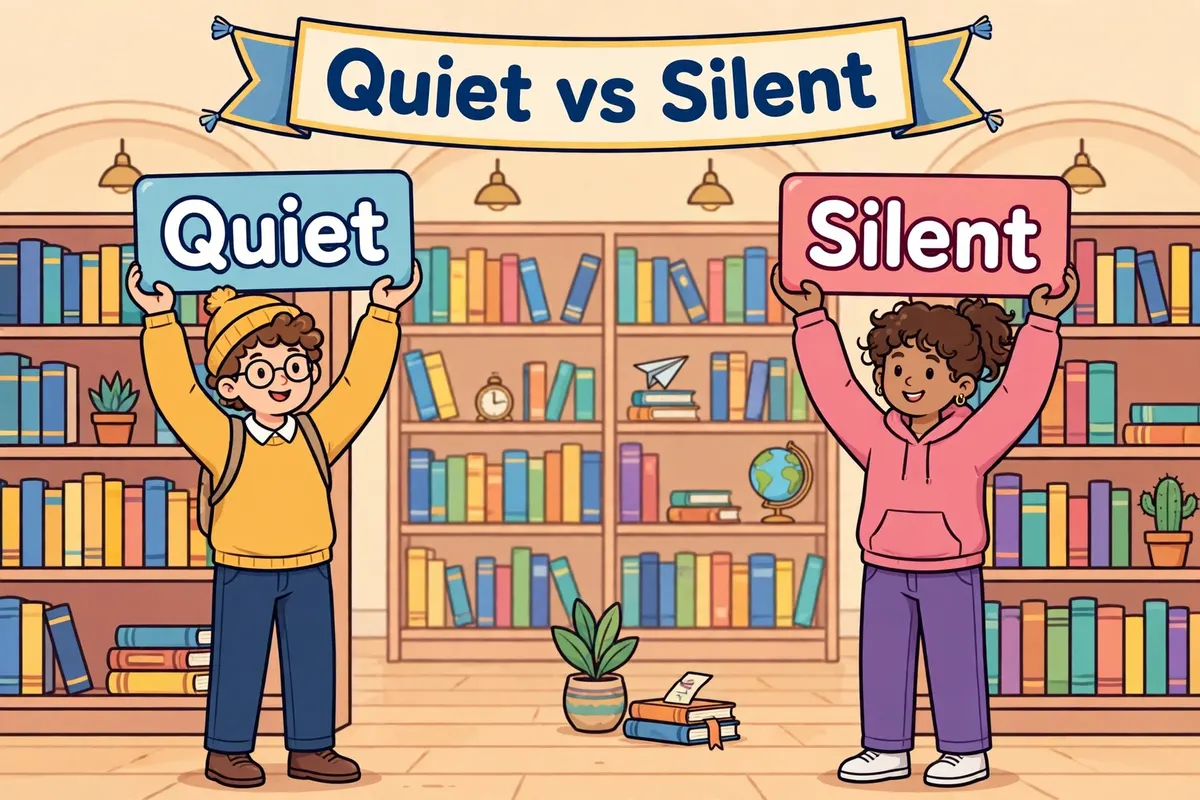
Quiet vs Silent vs Calm vs Still
Quiet, silent, calm, and still can describe similar situations, but they don’t mean the same thing.
| Word | Core idea | What it measures | Example |
|---|---|---|---|
| Quiet | Little noise or little activity | Sound level or activity level, low but not zero | The library was quiet, with only soft footsteps. |
| Silent | No sound at all; saying nothing | Sound, zero | The room fell silent when the speaker began. |
| Calm | Free from agitation or disturbance | Feeling or steadiness, not sound | She kept her voice calm during the interruption. |
| Still | Without movement | Movement, not sound | The air was still inside the empty hall. |
If You Mean No Sound, Use Silent; Low Sound, Use Quiet; a Steady Feeling, Use Calm; No Movement, Use Still
Two other differences are worth keeping clear:
- Quiet vs peaceful: Peaceful means free from disturbance. A peaceful room can still have birdsong, soft music, or people talking.
- Quiet vs reserved: Reserved describes a person who doesn’t readily express thoughts or feelings. Never describe a room as reserved when you mean quiet.

Other Ways to Say “Quiet”
Sometimes a phrase works better than a single adjective. These six expressions describe low volume, silence, or a calm setting.
- In a low voice: This means speaking softly so that only nearby people can hear. Example: She answered in a low voice so the baby wouldn’t wake.
- Keep it down: This is an everyday, fairly polite request for someone to lower their volume. Example: Please keep it down because the baby is asleep.
- Not a sound: This phrase stresses complete silence. It suggests that nobody or nothing made any noise. Example: Not a sound came from the hallway after midnight.
- In a soft voice: This describes a gentle way of speaking, often to avoid disturbing someone. Example: He spoke in a soft voice during the ceremony.
- Without a word: This means leaving or doing something without speaking. Example: She left the room without a word.
- Peace and quiet: This phrase refers to a calm setting or a break from noise and disturbance. Example: I need a little peace and quiet to finish this assignment.
Antonyms of Quiet
Quiet doesn’t have just one opposite. The right antonym depends on whether you’re describing sound, a place, activity, a person, or a mood.
Here are the main opposites by meaning:
- Loud: The opposite of quiet when describing sound. A loud speaker produces strong sound, while a quiet one is hard to hear.
- Noisy: The opposite when describing a room or place. A noisy restaurant has plenty of sound and activity.
- Busy: The opposite of quiet when describing low activity. A busy store has customers, movement, and plenty to do.
- Talkative: The opposite when describing a person who doesn’t speak much. A talkative person enjoys speaking and often has a lot to say.
- Boisterous: The opposite of a quiet mood or crowd. It describes loud, energetic behavior.
- Rowdy: Describes a noisy, disorderly crowd, often with rough or uncontrolled behavior.
- Hectic: The opposite of a calm, unhurried state. A hectic day involves too much activity and pressure.
- Agitated: Describes someone or something disturbed, upset, or unsettled rather than calm.
The word quite isn’t an antonym of quiet. It means very or to a considerable extent, so it’s a different word that only looks like quiet.
FAQs
Frequently Asked Questions
1. What is another word for quiet?
The best alternative depends on your meaning. Use silent when there’s no sound, peaceful or tranquil for a calm place, and reserved or soft-spoken for a person who talks little.
2. Is quiet the same as silent?
No. Quiet means there’s little noise, so soft footsteps or a ticking clock may still be heard. Silent means no sound at all. Use silent only when you mean complete silence.
3. What is a polite word for a quiet person?
Reserved is a polite choice for someone who doesn’t readily share thoughts or feelings. Soft-spoken describes a gentle voice. Taciturn is more formal and can sound cold, so use it carefully.
4. What is the difference between quiet and calm?
Quiet describes sound or activity, while calm describes a lack of agitation. A person can be quiet but nervous, or calm while speaking loudly. The two words describe different qualities.
5. What is the opposite of quiet?
The opposite depends on the meaning. Loud describes sound, noisy describes a place, busy describes activity, and talkative describes a person who speaks often. There’s no single opposite for every situation.
6. How do you ask someone to be quiet politely?
Try saying, “Please keep it down” or “Could you speak more quietly?” Both requests sound more considerate than harsh commands. Choose a gentle tone, especially in shared spaces or conversations.