
Stupid Synonyms: 19 Polite and Clear Alternatives
There are better ways to describe a poor choice than calling someone stupid.
These 19 stupid synonyms help you choose words that fit the situation, from polite feedback to strong criticism.
Quick Answer
- Foolish is the closest polite replacement for stupid when describing poor judgment.
- Unwise and ill-advised work well in essays, reports and professional emails.
- Silly suits light, casual situations where the mistake isn’t serious.
- Absurd and ridiculous describe ideas that make little sense.
The main rule: Describe the action, idea or decision, not the person. Say “a foolish mistake” rather than “a stupid person.”
What Does Stupid Mean?
The word stupid describes a lack of thought, good judgment or intelligence. Its meaning changes slightly depending on what it describes.
The Oxford Advanced Learner’s Dictionary gives three main uses:
Poor judgment: Showing a lack of thought or good judgment. You might describe a mistake, question or idea as stupid. For example, “It was a pretty stupid thing to do.”
A person who isn’t intelligent: Not clever or intelligent, or slow to learn and understand. Oxford marks this use as sometimes offensive. It also warns against using the word to describe someone with a learning disability.
Annoyance: An informal word placed before a noun to show frustration. For example, “I can’t get the stupid thing open!”
Merriam-Webster also gives meanings related to dulled feelings and senseless thinking. Its example of the latter is a stupid decision.
Cambridge defines the main sense as very silly or not clever. It also recognizes the informal annoyance meaning before a noun.
These uses aren’t interchangeable. They serve three different jobs:
- Describing a person: This can sound insulting and should be handled with care.
- Describing an action or idea: This is the most useful sense for choosing a replacement.
- Showing annoyance: In “this stupid machine,” the word means annoying, not unintelligent. Most intelligence-related synonyms won’t fit.
Word family and related forms
Here are the main forms of the word:
| Form | Meaning | Example |
|---|---|---|
| Stupid | Adjective | That was a stupid decision. |
| Stupidly | Adverb | I stupidly left my keys inside. |
| Stupidity | Noun | I couldn’t believe my stupidity. |
| Stupidness | Noun | The discussion focused on the stupidness of the plan. |
| Stupider | Comparative adjective | This mistake is even stupider than the last one. |
| Stupidest | Superlative adjective | That was the stupidest choice available. |
Are stupider and stupidest real words? Yes. Merriam-Webster confirms both forms are correct. More stupid and most stupid are also common.
One more meaning deserves attention. In slang, stupid good means excellent or terrific. It expresses strong praise, not an insult.
The safest general rule is simple: criticize the choice instead of attacking someone’s intelligence. “A foolish mistake” is more respectful than “a stupid person.”
When to Use Stupid Synonyms
The best replacement depends on your audience and the point you’re trying to make. A word that works in a casual conversation may sound rude in a work email.
Essays and reports
Choose words that describe reasoning or judgment without attacking anyone.
- Unwise: A decision that shows poor judgment.
- Ill-advised: A choice made without enough thought or good advice.
- Illogical: An argument that doesn’t follow clear reasoning.
- Irrational: Thinking or reasoning that goes against logic.
For example, “The proposal was ill-advised” sounds more suitable for a report than “The proposal was stupid.”
Business emails and feedback
Professional feedback should explain the problem without embarrassing the person who made the decision.
Try:
- Misguided: When an idea is wrong but may have good intentions.
- Poorly reasoned: When an argument lacks sound reasoning.
- Not well thought out: When a plan needs more careful consideration.
You could write, “The original plan wasn’t well thought out, so we should review the costs.”
That gives the reader something to fix.
Everyday talk
Casual conversations allow lighter words, provided the situation isn’t serious.
- Silly: A harmless or playful mistake.
- Dumb: An informal US word for something lacking sense.
- Daft: A British informal word for something foolish.
Be careful with dumb. Its older meaning, unable to speak, is now offensive when used to describe a person who cannot speak. Never use it that way.
Stories and dialogue
Characters may use stronger words when the scene calls for anger, frustration or sharp criticism.
- Dense: For someone who repeatedly fails to understand a point.
- Idiotic: For extremely foolish behavior, with a harsh-word warning.
These words can make dialogue sound direct, but they’re poor choices for polite feedback. Idiotic is especially harsh.
A useful rule for every situation
Describe the decision, not the person.
Better: “That was an ill-advised decision.”
Harsh: “You’re stupid.”
The first sentence explains what went wrong. The second attacks someone’s intelligence.
You don’t have to replace stupid every time. Keep it when quoting someone’s exact words or when the bluntness is an intentional part of the conversation.
Benefits of Using Stupid Synonyms
A more precise word can make your message clearer and less hurtful.
1. You sound kinder.
Calling a decision foolish doesn’t mean the person who made it lacks intelligence. It leaves room for mistakes and learning.
2. Your language fits the situation.
Unwise works in a formal report. Silly sounds natural in a friendly conversation. Idiotic belongs in strong criticism or fictional dialogue, not a polite workplace message.
3. You explain the actual problem.
Different words point to different faults:
- Judgment: foolish, unwise or imprudent.
- Knowledge: uninformed or ignorant.
- Logic: illogical or irrational.
- Understanding: dense or unintelligent.
Careless and thoughtless also need a distinction. They describe a lack of attention or consideration, not a lack of intelligence. A careful person can still make a foolish mistake.
4. You avoid accidental insults.
A person may know a great deal and still make one poor decision. Choosing a word that describes the decision keeps your criticism fair.

19 Best Stupid Synonyms at a Glance
The following table contains all 19 words, arranged by their main use.
Six are polite or formal choices. Five are everyday alternatives. Four are strong or harsh words that need caution. The final four describe ideas or reasoning that make little sense.
| Synonym | Tone | Best for |
|---|---|---|
| Foolish | Neutral, polite | General use, essays, everyday talk |
| Unwise | Formal, soft | Essays, reports, formal emails |
| Unintelligent | Formal, clinical | Academic, technical, objective writing |
| Ill-advised | Formal, business | Business emails, reports, professional feedback |
| Imprudent | Formal, serious | Legal, financial, high-stakes warnings |
| Misguided | Neutral, sympathetic | Feedback, stories, essays |
| Silly | Casual, gentle | Everyday talk, children, light writing |
| Dumb | Casual, US informal | Everyday US speech, casual writing |
| Daft | Casual, British informal | Everyday UK speech, casual writing |
| Dopey | Casual, teasing | Everyday talk, jokes, light stories |
| Dense | Casual, critical | Everyday talk, stories |
| Idiotic | Harsh, insulting | Stories, dialogue, strong criticism only |
| Brainless | Harsh, insulting | Stories, dialogue, angry speech only |
| Moronic | Harsh, offensive | Old texts, dialogue, strong criticism only |
| Asinine | Formal, insulting | Literary writing, strong written criticism |
| Absurd | Neutral, formal | Essays, debates, criticism of ideas |
| Ridiculous | Neutral, strong | Everyday talk, reviews, criticism |
| Illogical | Formal, analytical | Essays, debates, academic feedback |
| Irrational | Formal, analytical | Academic writing, debates, analysis |
A runner-up for casual speech is dim. It’s a real alternative, but it isn’t part of the numbered 19.
Polite and Formal Synonyms for Stupid
These six words work when you need to criticize poor judgment without making a personal attack. They’re useful in essays, reports, professional emails and serious conversations.
1. Foolish
Tone: Neutral, polite
Uses: General use, essays, everyday talk
Meaning: Showing poor judgment or making a bad choice.
Explanation: Foolish is the closest polite replacement for stupid. It judges someone’s choice or action, not their intelligence. You can use it in everyday speech and formal writing without sounding unnecessarily harsh.
Examples:
- It was foolish to spend the entire budget before checking the costs.
- I made a foolish mistake by ignoring the warning.
2. Unwise
Tone: Formal, soft
Uses: Essays, reports, formal emails
Meaning: Not showing good judgment or making a sensible decision.
Explanation: Unwise sounds softer than foolish. It’s a good choice when you want to correct someone without sounding rude. It works well in professional feedback and careful discussions.
Examples:
- It would be unwise to invest all your savings in one company.
- The manager made an unwise decision by ignoring the customer complaints.
3. Unintelligent
Tone: Formal, clinical
Uses: Academic, technical, objective writing
Meaning: Not intelligent or lacking intellectual ability.
Explanation: Unintelligent is more factual and less casual than stupid. Still, it describes a person’s intelligence, so use it carefully. It isn’t a polite replacement when you’re criticizing one mistake or poor decision.
Examples:
- The test measures problem-solving skills, not whether someone is unintelligent.
- His answer showed a gap in knowledge, not that he was unintelligent.
4. Ill-advised
Tone: Formal, business
Uses: Business emails, reports, professional feedback
Meaning: A decision made without proper thought or good advice.
Explanation: Ill-advised describes the decision, not the person who made it. That’s why it’s one of the safest formal choices. It fits workplace feedback, financial discussions and reports about poor choices.
Examples:
- Expanding the store without checking demand was ill-advised.
- The company withdrew its ill-advised proposal after reviewing the costs.
5. Imprudent
Tone: Formal, serious
Uses: Legal, financial, high-stakes warnings
Meaning: Not showing enough care for future results or risks.
Explanation: Imprudent is formal and precise. It often describes a choice that creates avoidable risks or ignores possible consequences. It can sound stiff in everyday conversation, so save it for serious discussions.
Examples:
- Taking out another loan without a repayment plan would be imprudent.
- The board considered the sudden purchase financially imprudent.
6. Misguided
Tone: Neutral, sympathetic
Uses: Feedback, stories, essays
Meaning: Based on a wrong idea or direction, often with good intentions.
Explanation: Misguided can suggest that someone meant well but chose the wrong approach. It softens criticism by leaving room for good intentions. Don’t use it for a deliberately harmful act, because the word suggests a mistake rather than bad intent.
Examples:
- Her misguided attempt to help created more work for the team.
- The campaign followed a misguided plan that failed to reach its audience.
Everyday Synonyms for Stupid
These five words sound more natural in casual speech. Their meanings and tones aren’t identical, so choose one that matches the seriousness of the situation.
7. Silly
Tone: Casual, gentle
Uses: Everyday talk, children, light writing
Meaning: Lacking seriousness or sense, often in a harmless or playful way.
Explanation: Silly is the gentlest word in this list. It can describe playful behavior, a minor mistake or something that isn’t serious. Don’t use it for a major mistake because it can make the problem sound unimportant.
Examples:
- Leaving my lunch on the kitchen counter was a silly mistake.
- We laughed at the silly idea of building a swimming pool in the backyard.
A silly mistake sounds small. A foolish mistake sounds more serious. Pick the word that matches the weight of the situation.
8. Dumb
Tone: Casual, US informal
Uses: Everyday US speech, casual writing
Meaning: Showing little intelligence or sense.
Explanation: Dumb is common in informal American English, but it can sound insulting when aimed at someone. Its older meaning was unable to speak, and that use is now offensive. Never use dumb to describe someone who cannot speak. Also avoid it in formal writing. Cambridge warns that words such as dumb and crazy can offend because they’re also used against people with mental illness or disabilities.
Examples:
- I made a dumb mistake by leaving the garage door open.
- That was a dumb way to spend the afternoon.
9. Daft
Tone: Casual, British informal
Uses: Everyday UK speech, casual writing
Meaning: Silly or foolish, without good sense.
Explanation: Daft is common in British English and may sound unfamiliar to American readers. It often has a playful or teasing feel. Keep it out of formal writing and choose foolish or unwise when your audience expects standard professional language.
Examples:
- It was daft to leave the windows open during the storm.
- We came up with a daft plan to paint the garden shed pink.
10. Dopey
Tone: Casual, teasing
Uses: Everyday talk, jokes, light stories
Meaning: Slow or silly in a harmless, drowsy way.
Explanation: Dopey can describe someone who seems sleepy, confused or slow to understand. It usually sounds teasing rather than cruel, but it can still hurt if you say it directly to someone’s face. Use it carefully, especially with people you don’t know well.
Examples:
- I felt dopey after staying awake all night.
- His dopey grin made everyone laugh.
11. Dense
Tone: Casual, critical
Uses: Everyday talk, stories
Meaning: Slow to understand or unable to grasp an idea easily.
Explanation: Dense is more critical than silly or dopey. Merriam-Webster connects it with being thickheaded and unable to take in ideas. Use it when someone keeps missing the point, not when they make one ordinary mistake.
Examples:
- He was so dense that he kept missing the point, even after we explained it several times.
- I felt dense when I couldn’t follow the simple directions.
Strong Synonyms for Stupid: Use With Care
These four words are much harsher than foolish or unwise. They’re useful for understanding strong language in books, dialogue and criticism, but they aren’t suitable for polite feedback.
12. Idiotic
Tone: Harsh, insulting
Uses: Stories, dialogue, strong criticism only
Meaning: Extremely foolish or senseless.
Explanation: Idiotic expresses stronger disapproval than foolish. It can make criticism sound angry or contemptuous. Never use it in polite or professional writing, especially when addressing someone directly.
Examples:
- Driving through the flooded road was an idiotic decision.
- The character made an idiotic move that put the whole team at risk.
13. Brainless
Tone: Harsh, insulting
Uses: Stories, dialogue, angry speech only
Meaning: Showing no intelligence or sensible thought.
Explanation: Brainless attacks a person’s mind directly. It sounds cruel and personal, even when the speaker is angry about an action. Avoid it in polite writing and professional conversations.
Examples:
- The character called the plan brainless during the heated argument.
- It was a brainless stunt that could have injured someone.
14. Moronic
Tone: Harsh, offensive
Uses: Old texts, dialogue, strong criticism only
Meaning: Extremely stupid, used as a strong insult.
Explanation: Moronic is offensive and shouldn’t be treated as an ordinary replacement for stupid. It comes from an old clinical term for mental deficiency. Avoid it in polite writing and don’t use it to describe someone’s ability or disability.
Examples:
- His moronic comment ended the discussion on a sour note.
- The novel uses moronic as an insult in an argument between two characters.
15. Asinine
Tone: Formal, insulting
Uses: Literary writing, strong written criticism
Meaning: Extremely foolish or silly.
Explanation: Asinine may sound formal, but that doesn’t make it polite. It’s still an insult, and its polished sound can hide how harsh it is. Don’t use it in professional feedback when you want someone to improve.
Examples:
- The proposal included an asinine rule that nobody could follow.
- Calling the entire team lazy was an asinine response to one missed deadline.
A note about older clinical insults: Idiotic, moronic, imbecilic and cretinous come from old clinical terms for mental deficiency. They’re insults, not good everyday alternatives. Idiot and moron are name-calling nouns, not adjectives. Keep them out of neutral descriptions.
Synonyms for Stupid Ideas
Sometimes the problem isn’t someone’s intelligence. It’s an idea, argument or decision that doesn’t make sense. These four words focus on reason and logic instead.
16. Absurd
Tone: Neutral, formal
Uses: Essays, debates, criticism of ideas
Meaning: Completely unreasonable or against reason.
Explanation: Absurd is a good choice when an idea seems impossible to defend with logic. It describes the idea, not a person’s intelligence. Don’t call someone absurd simply because they learn slowly or misunderstand something.
Examples:
- The suggestion that every employee should work without breaks was absurd.
- Her argument became absurd when she ignored the available evidence.
17. Ridiculous
Tone: Neutral, strong
Uses: Everyday talk, reviews, criticism
Meaning: So foolish or unreasonable that it invites laughter or mockery.
Explanation: Ridiculous is stronger than absurd and often carries a mocking tone. It works well when an idea or claim seems too unreasonable to take seriously. Use it for the idea, not as a label for a person.
Examples:
- The store’s new return policy is ridiculous.
- It was ridiculous to expect the whole project to finish in one afternoon.
18. Illogical
Tone: Formal, analytical
Uses: Essays, debates, academic feedback
Meaning: Not based on clear thinking or sound reasoning.
Explanation: Illogical describes weak reasoning rather than a person’s intelligence. Even a smart person can make an illogical argument. It’s useful when you want to point out a flaw without turning your criticism into a personal attack.
Examples:
- The conclusion was illogical because the evidence didn’t support it.
- Her argument seemed illogical after she changed her main claim.
19. Irrational
Tone: Formal, analytical
Uses: Academic writing, debates, analysis
Meaning: Not based on reason or clear logic.
Explanation: Irrational is close to illogical, but it can suggest a deeper problem with the thinking behind a decision. It describes reasoning that goes against reason, not simply a person who lacks intelligence. Use it when the issue involves the thought process itself.
Examples:
- Fear of a harmless object can lead to an irrational response.
- The decision to reject every offer without reviewing them seemed irrational.
One more word worth knowing: Ludicrous is a real synonym for an absurd or ridiculous idea. It isn’t included in the 19 because the list has a fixed count.
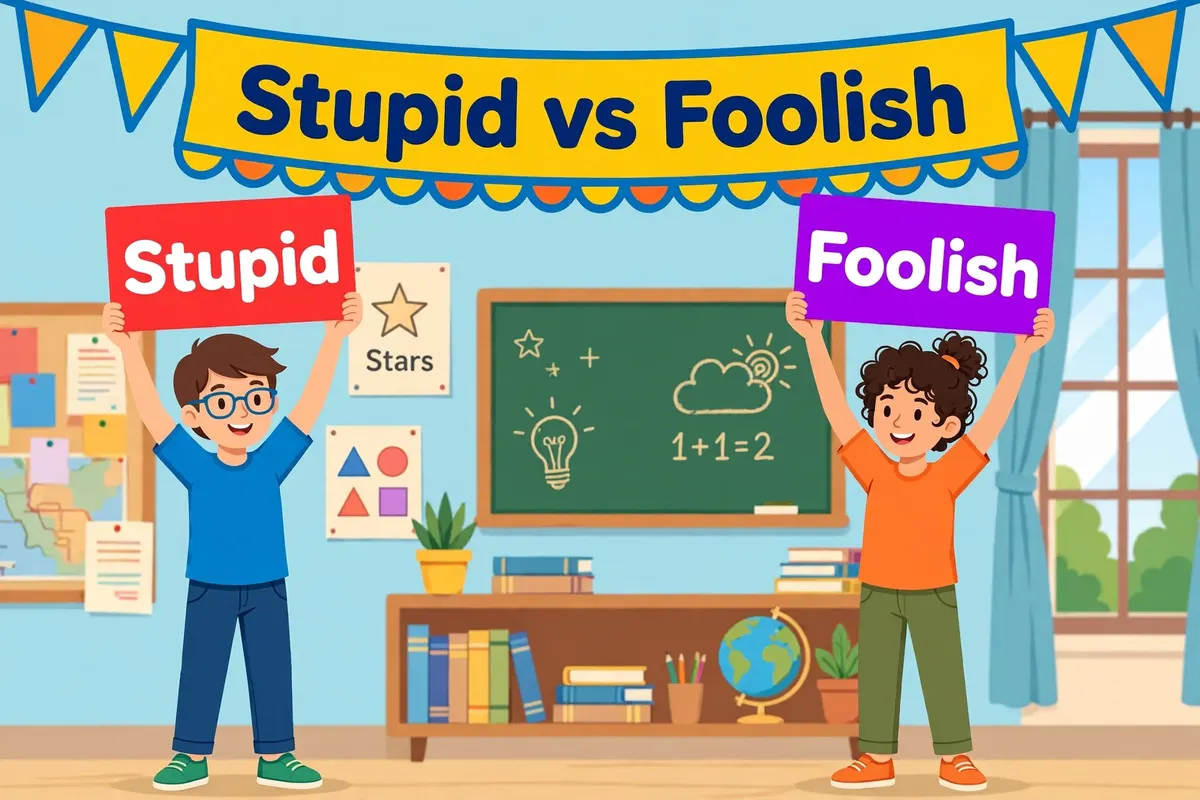
Stupid vs Foolish vs Dumb vs Ignorant
These four words overlap, but they don’t mean exactly the same thing. The biggest difference is whether you’re talking about intelligence, poor judgment or missing knowledge.
| Word | Core idea | Describes a person or an idea? | Tone | Example |
|---|---|---|---|---|
| Stupid | General word for poor judgment or low intelligence | Both, a person or an action | Blunt, often rude | It was stupid of me to try to hide it from you. |
| Foolish | Poor judgment in a choice | Mostly an idea or action | Neutral, polite | She was foolish to quit her job like that. |
| Dumb | Little intelligence or sense, often in a frustrating way | Both, often a person in US speech | Casual US informal | She was terrified of asking dumb questions. |
| Ignorant | Lacking knowledge about a specific subject | A person, in relation to a topic | Neutral when used correctly | They aren’t unintelligent, just ill-informed. |
What makes these four words different?
Stupid is the bluntest general word. It can refer to poor judgment or low intelligence, but it often sounds insulting when aimed at a person.
Foolish focuses on a bad choice. An intelligent person can still do something foolish.
Dumb is an informal US word for someone or something showing little intelligence or sense. Avoid it in formal writing. Never use its old meaning of unable to speak.
Ignorant means lacking knowledge, not lacking intelligence. Someone can be ignorant about one subject and brilliant in another. For example, a skilled doctor may know very little about car repairs.
Stupid vs silly
Silly is lighter and can describe playful behavior or a harmless mistake. Stupid is harsher. A silly mistake sounds minor, while a foolish mistake suggests poor judgment.
Stupid vs absurd
Absurd describes an idea that goes against reason. Stupid can describe poor judgment or intelligence. An argument can be absurd without its creator being unintelligent.
If You Mean a Bad Choice, Say Foolish
Use foolish when someone makes a poor decision. Choose dumb only for casual US speech, and avoid directing it at a person. Use ignorant when someone lacks knowledge about a subject. Don’t confuse missing information with low intelligence.
A few more usage traps deserve attention:
- Stupid as a noun: Calling someone “a stupid” is an insult. Don’t use it as a neutral description. The expression “Don’t lock it, stupid!” is an insulting form of address.
- Crazy and insane: These words aren’t safe replacements for unintelligent. They can be offensive because they refer to mental illness or are used against people with mental disabilities.
- Careless and thoughtless: These describe a lack of attention or consideration, not a lack of intelligence.
- Dumb: Its older meaning of unable to speak is offensive. Use mute when you need to describe someone who cannot speak, and only use dumb in its informal sense of lacking intelligence or sense.

Other Ways to Say “That Was Stupid”
Sometimes replacing one word isn’t enough. A full sentence can make your feedback sound more respectful and explain what needs to change.
Here are six alternatives for conversations, schoolwork and professional settings.
1. That was not well thought out.
Tone: Formal, direct
This is the most useful formal replacement. It says the person didn’t consider the details carefully enough without attacking their intelligence.
Example: “The original schedule was not well thought out, so we need to review it.”
2. That was a poor decision.
Tone: Neutral, formal
This phrase is plain and kind. It focuses on the choice and leaves the person out of the criticism.
Example: “Hiring another contractor without checking the budget was a poor decision.”
3. That idea needs more thought.
Tone: Gentle, professional
Use this for soft feedback at work or school. It suggests that the idea may have potential but needs more planning.
Example: “Your proposal is interesting, but that idea needs more thought before we approve it.”
4. That does not make sense.
Tone: Neutral, conversational
This works when an argument or suggestion has weak logic. It’s direct without calling the person unintelligent.
Example: “Your explanation does not make sense because the figures don’t match.”
5. That was short-sighted.
Tone: Formal, critical
Short-sighted describes a choice that ignores future results. It’s useful when someone focuses on an immediate benefit and overlooks a larger problem.
Example: “Cutting the training budget was short-sighted because the team needs those skills.”
6. That was poorly reasoned.
Tone: Formal, analytical
Use this phrase for essays, debates and reports. It points to weak logic or missing support rather than attacking the writer.
Example: “The final argument was poorly reasoned and lacked enough evidence.”
All six phrases judge an idea, action or decision rather than the person. The first, second and sixth suit formal writing. The third is softer, while the fourth and fifth also work in everyday conversations.
Antonyms of Stupid
There isn’t just one opposite of stupid. The word can describe low intelligence or poor judgment, so its antonyms depend on the meaning.
Opposites related to intelligence
| Antonym | Meaning | Example |
|---|---|---|
| Intelligent | Having good understanding and mental ability | I can’t understand why intelligent people would support this. |
| Smart | Showing intelligence and good sense | She is smart enough to check the facts first. |
| Clever | Quick at learning, thinking or finding answers | The clever student solved the puzzle in minutes. |
| Sharp | Having a quick and clear mind | His sharp mind caught the error immediately. |
Opposites related to judgment
| Antonym | Meaning | Example |
|---|---|---|
| Wise | Showing good judgment | Choosing to save money was a wise decision. |
| Sensible | Showing practical and reasonable judgment | Buying a reliable used car was a sensible choice. |
Opposites related to ideas and reasoning
Reasonable and rational are useful opposites for the Group D sense.
Reasonable: An idea that makes sense and has a fair basis.
Rational: A thought or decision based on reason and logic.
For example, a reasonable proposal has a clear purpose, while an absurd proposal may go against basic logic.
FAQs
Frequently Asked Questions
1. What is another word for stupid?
Foolish is the closest polite replacement when you mean poor judgment. Use unwise in formal writing, silly for a light mistake, and absurd when an idea makes no sense. The right choice depends on context.
2. What is a polite word for stupid?
Foolish, unwise and ill-advised are polite alternatives. They focus on poor choices instead of attacking someone’s intelligence. For workplace feedback, ill-advised is often the safest option because it describes the decision.
3. What is a formal synonym for stupid?
Unwise, ill-advised, imprudent, illogical and irrational work in formal writing. Use unwise for poor judgment, ill-advised for a bad decision, and illogical or irrational when an argument lacks sound reasoning.
4. Is stupid a rude word?
Yes, stupid can sound rude, especially when it describes a person. Oxford also warns against using it for someone with a learning disability. Describe the person’s action, idea or decision instead.
5. What is the difference between stupid and foolish?
Stupid is a blunt word that can criticize someone’s intelligence or judgment. Foolish focuses on a poor choice. An intelligent person can still make a foolish decision without lacking intelligence.
6. What is the difference between stupid and ignorant?
Ignorant means lacking knowledge about a subject, while stupid suggests poor intelligence or judgment. Anyone can be ignorant about a topic, even an expert elsewhere. Ignorance doesn’t mean someone lacks intelligence.