
Encourage Synonyms: 30 Words to Lift and Motivate
Encouraging someone can mean giving them hope, helping them take action or backing something they care about. The best synonym depends on the kind of support you want to express.
Quick Answer
To give someone confidence or hope, use inspire, hearten or embolden.
To give someone a reason to act, use motivate or spur.
To help an idea, skill or activity grow, use promote, foster or nurture.
To back a person or plan in public, use support, champion or endorse.
Encourage is a transitive verb. It needs an object, and the standard pattern is encourage someone to do something.
What Does Encourage Mean?
The verb encourage means giving someone support, confidence or hope. It can also mean helping an action, idea or quality become more likely to happen.
Oxford Advanced Learner’s Dictionary gives three main senses:
Give somebody support, courage or hope.
Persuade somebody to do something by making it easier and helping them believe it is worthwhile.
Make something more likely to happen or develop.
Merriam-Webster groups the meaning around inspiring someone with courage or hope, urging someone to act, stimulating action and giving help or support. Cambridge Dictionary also explains that the verb can make someone more likely to do something or give them the confidence to do it.
The Basic Grammar Pattern
The most common pattern is:
encourage + person + to-infinitive
The teacher encouraged Maya to enter the writing contest.
His friends encouraged him to apply for the job.
We encouraged the team to share its ideas.
Do not leave out the person when you use this pattern. Write “She encouraged him to speak”, not “She encouraged to speak.”
The verb can also take an activity or thing as its object:
The new policy encourages teamwork.
The class encourages asking questions.
Speaking your mind is encouraged at these meetings.
The related forms include encouragement, the support or confidence someone receives; encouraging, an adjective describing something that gives hope; encouragingly, an adverb; and encourager, a person who gives support.
Where Does the Word Come From?
Encourage came into English through French encourager. The French word combines en- with corage, meaning courage. The English verb dates back to Middle English and was formerly also spelled incourage.
Grammar Traps to Avoid
Encourage does not mean force someone to act. Words such as compel, force and pressure suggest stronger control, not supportive guidance.
Do not confuse encouragement with negative influence. Abet, instigate and incite can describe helping someone do something harmful or wrong. They are not everyday substitutes for encourage.
Also keep the grammar of related verbs clear. Encourage someone to do something, but discourage someone from doing it. And do not confuse encouragement with praise: praise recognizes what someone has already done, while encouragement can help them take a next step.
“She encouraged him to apply” is right and “She encouraged him applying” is wrong.
Promote, foster and cultivate take a thing, not a person, so “promote reading” and “foster trust” are right and “promote him to read” is wrong.
When to Use Encourage Synonyms
Choose a synonym based on what the person needs and what you want your words to do. A friend who feels discouraged may need reassurance. A student who doubts their ability may need someone to build their confidence.
When someone needs hope: Use hearten, reassure or uplift. These words suit personal conversations, supportive messages and moments when someone feels low. For example, you might reassure a friend before a difficult interview.
When someone needs a reason to act: Choose motivate, spur, prompt or nudge. These words focus on action. A manager might motivate a team with a clear goal, while a gentle reminder might nudge a colleague to finish a task.
When you want something to develop: Use foster, nurture, cultivate or promote. These choices work well for skills, habits, relationships, ideas and activities. A teacher can foster curiosity, while a community group can promote reading.
When you want to show public support: Choose champion, advocate, endorse or back. These words fit causes, plans, policies and people. A public figure might champion a local project, while a company may endorse a new program.
When a simple word is best: Keep encourage when you mean general support that gives someone confidence or hope. It is clear, familiar and flexible. A more specific synonym helps when you want readers to understand exactly how that support works.
Benefits of Using Encourage Synonyms
Using a range of synonyms makes your writing more precise. Instead of repeating encourage in every paragraph, you can choose a word that describes the kind of support you mean.
You can show the type of support. Hearten suggests lifting someone’s spirits. Motivate points to a reason for action. Champion suggests active public backing. Each word gives readers a clearer picture.
You can match the setting. A friend might cheer you on, while a formal report might say a program fosters innovation. A speech may use inspire, while a business email may use prompt.
You can avoid making support sound like pressure. Urge and exhort are stronger than encourage. If you want to sound gentle, coax or nudge may be a better fit.
You can make your point more direct. If a policy helps an activity grow, promote or foster may explain that effect better than a broad verb. If someone gives public backing to a plan, endorse is more exact.
You can separate encouragement from recognition. Praise and encouragement are related, but they do different jobs. Praise recognizes an effort or result. Encouragement gives someone confidence to continue or try something new.
30 Best Encourage Synonyms at a Glance
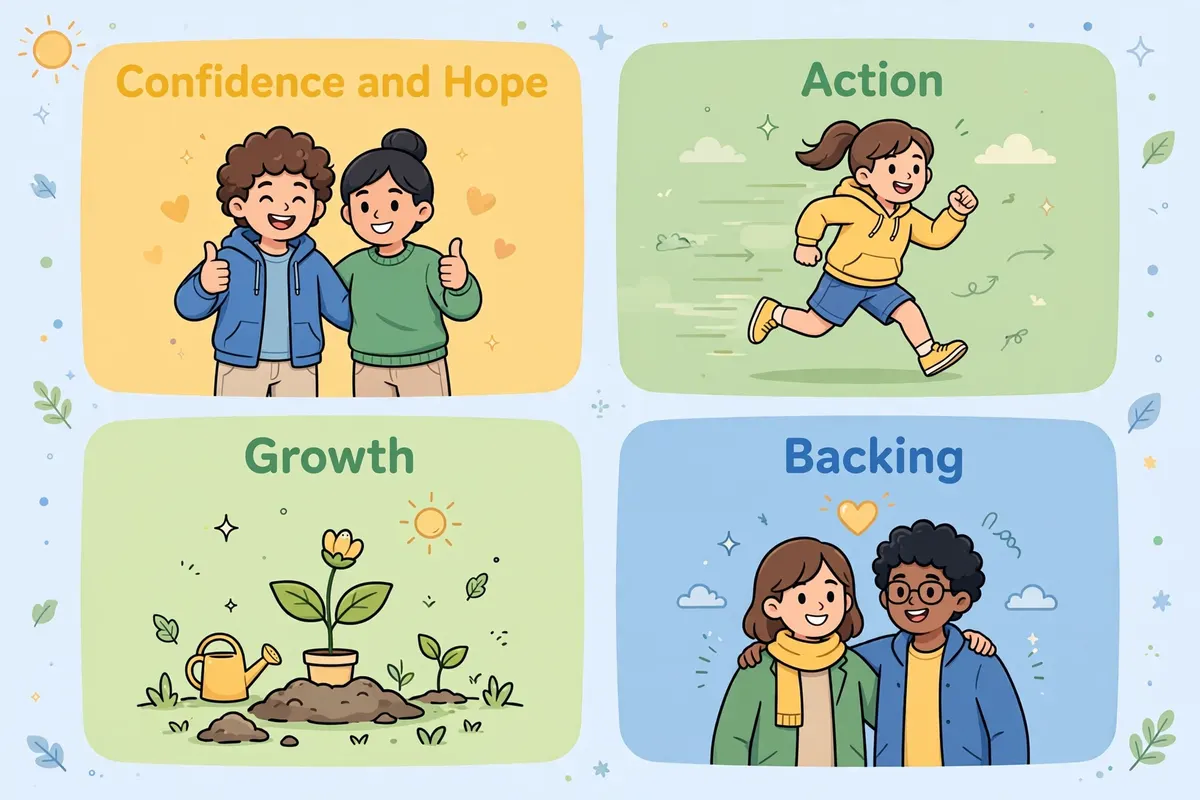
The 30 words below are grouped by their main use: eight for giving confidence and hope, eight for urging someone to act, seven for helping something grow and seven for backing or cheering someone on.
| Synonym | Tone | Best for |
|---|---|---|
| Inspire | Positive, warm | Speeches, stories, essays, everyday talk |
| Hearten | Warm, gentle | Personal notes, stories, everyday talk |
| Embolden | Formal, strong | Essays, reports, formal writing |
| Reassure | Warm, calm | Everyday talk, emails, interviews, coaching |
| Cheer | Casual, warm | Everyday talk, sports, family, friends |
| Uplift | Positive, warm | Speeches, stories, everyday talk |
| Buoy up | Casual, warm | Everyday talk, stories, personal writing |
| Inspirit | Formal, literary | Literary writing, speeches, formal essays |
| Motivate | Neutral, professional | Business, coaching, school, essays |
| Urge | Strong, direct | Formal writing, speeches, advice |
| Spur | Strong, vivid | Stories, speeches, essays |
| Prompt | Neutral, business | Business emails, reports, everyday writing |
| Exhort | Formal, serious | Formal speeches, sermons, essays |
| Persuade | Neutral, strong | Everyday talk, essays, business writing |
| Coax | Gentle, casual | Everyday talk, stories, family writing |
| Nudge | Casual, light | Everyday talk, emails, light business writing |
| Promote | Formal, institutional | Reports, marketing, policy, essays |
| Foster | Formal, warm | Education, business, essays, reports |
| Nurture | Warm, caring | Parenting, teaching, essays, personal writing |
| Cultivate | Formal, careful | Essays, reports, gardening and farming talk |
| Advance | Formal, neutral | Reports, business, academic writing |
| Further | Formal, neutral | Reports, essays, formal writing |
| Stimulate | Neutral, energetic | Essays, reports, science and business writing |
| Support | Neutral, warm | Everyday talk, business, essays, everywhere |
| Champion | Formal, strong | Leadership, policy, essays, reports |
| Advocate | Formal, purposeful | Policy, essays, formal writing |
| Endorse | Formal, official | Business, politics, reports, formal writing |
| Back | Casual, everyday | Everyday talk, business, casual writing |
| Boost | Casual, energetic | Everyday talk, sports, business, coaching |
| Bolster | Formal, supportive | Reports, essays, business writing |
Synonyms for Giving Confidence and Hope
These eight words focus on feelings. Use them when someone needs courage, reassurance, fresh hope or a lift in spirits.
1. Inspire
Tone: Positive, warm · Uses: Speeches, stories, essays, everyday talk
Meaning: Fill someone with the urge or ability to do something, often through an example or idea.
Explanation: Inspire often works through a person, story or experience that makes someone want to act. It is not the same as giving a direct instruction. A person can inspire others without telling them what to do.
Examples:
- Her recovery story inspired the other patients to keep trying.
- The teacher inspired his students to explore science.
2. Hearten
Tone: Warm, gentle · Uses: Personal notes, stories, everyday talk
Meaning: Give someone fresh hope and confidence when they feel low.
Explanation: Hearten is especially useful when someone feels disappointed, worried or discouraged. It suggests lifting a person’s spirits and helping them feel hopeful again. It is warmer and gentler than a strong call to action.
Examples:
- The kind messages heartened Lena after a difficult week.
- Their progress heartened the volunteers who had worked for months.
3. Embolden
Tone: Formal, strong · Uses: Essays, reports, formal writing
Meaning: Give someone courage to act in spite of fear or shyness.
Explanation: Embolden suggests giving someone enough courage to overcome hesitation or reluctance. It is stronger than hearten. Use it when support helps someone take a step they might otherwise avoid.
Examples:
- The mentor’s advice emboldened Carlos to share his research.
- Public support emboldened the residents to speak at the meeting.
4. Reassure
Tone: Warm, calm · Uses: Everyday talk, emails, interviews, coaching
Meaning: Remove someone’s doubts or fears so they feel safe to go on.
Explanation: Reassure focuses on reducing worry rather than pushing someone toward a goal. It works well when someone needs calm, clear words before making a choice or facing a challenge. Reassurance may give confidence, but it does not always call for action.
Examples:
- Her manager reassured her that the team would help.
- I reassured my son that mistakes were part of learning.
5. Cheer
Tone: Casual, warm · Uses: Everyday talk, sports, family, friends
Meaning: Lift someone’s mood with kind words or applause.
Explanation: Cheer can mean making someone happier or showing approval with words and applause. When you mean supporting someone as they try to succeed, the phrase cheer someone on is often more natural. Cheer up is a comfort phrase, not a general substitute for encourage.
Examples:
- We cheered the young runners on from the sidelines.
- Her friends cheered her when she stepped onto the stage.
6. Uplift
Tone: Positive, warm · Uses: Speeches, stories, everyday talk
Meaning: Raise someone’s spirits; make them feel happier and more hopeful.
Explanation: Uplift describes improving someone’s mood or outlook. It is a good choice for support that helps a person feel better, rather than a direct request to act. It can also describe something that raises the mood of a group.
Examples:
- The neighbors’ kindness uplifted the family during a hard month.
- His words uplifted the players before the final match.
7. Buoy up
Tone: Casual, warm · Uses: Everyday talk, stories, personal writing
Meaning: Keep someone’s spirits afloat when things are hard.
Explanation: Buoy up is an informal phrase for helping someone stay hopeful through a difficult time. It often describes emotional support that keeps a person from feeling overwhelmed. The past form is buoyed up.
Examples:
- Her sister’s phone calls buoyed her up during the move.
- The team’s small wins buoyed up the new volunteers.
8. Inspirit
Tone: Formal, literary · Uses: Literary writing, speeches, formal essays
Meaning: Put new life, energy and courage into someone.
Explanation: Inspirit has a formal, somewhat literary feel. It describes putting energy or courage into someone, often through words or an example. It can sound stiff in a casual message, so choose inspire for most everyday situations.
Examples:
- The leader’s speech inspirited the group before its long journey.
- The story inspirited readers who faced similar challenges.
Synonyms for Urging Someone to Act
These eight words focus on action. Some offer a gentle nudge, while others apply pressure or make a strong request.
9. Motivate
Tone: Neutral, professional · Uses: Business, coaching, school, essays
Meaning: Give someone a reason or desire to act.
Explanation: Motivate focuses on what drives a person to do something. That reason might be a goal, reward, personal interest or even fear. Unlike hearten, it does not always suggest emotional warmth or reassurance.
Examples:
- The coach motivated the players to practice with care.
- A clear deadline motivated the staff to finish the report.
10. Urge
Tone: Strong, direct · Uses: Formal writing, speeches, advice
Meaning: Strongly ask someone to act, with pressure behind it.
Explanation: Urge is more forceful than encourage. It suggests that the speaker feels the action is important or needs to happen soon. Use it when a gentle suggestion would not express the strength of your message.
Examples:
- The doctor urged him to get more rest.
- I urge the council to protect the public park.
11. Spur
Tone: Strong, vivid · Uses: Stories, speeches, essays
Meaning: Push someone into action with a sharp reason.
Explanation: Spur suggests a strong push that gets someone moving. The reason may be a challenge, event, reward or sudden need. The phrase spurred by often explains what caused the action.
Examples:
- The award spurred Maya to submit another story.
- Their early success spurred the team to aim higher.
12. Prompt
Tone: Neutral, business · Uses: Business emails, reports, everyday writing
Meaning: Cause someone to act, often by a reminder or a question.
Explanation: Prompt can describe a gentle nudge or a reason that leads to action. It is useful in business writing because it sounds neutral and direct. A prompt may remind someone what needs to happen without applying strong pressure.
Examples:
- The reminder prompted Daniel to send the form.
- Her question prompted the group to review its plan.
13. Exhort
Tone: Formal, serious · Uses: Formal speeches, sermons, essays
Meaning: Earnestly ask or advise someone to do what is right.
Explanation: Exhort is a serious and formal word. It often appears in speeches, public statements or writing about duties and values. It can sound unnatural in everyday conversation, where urge or encourage is usually clearer.
Examples:
- The speaker exhorted the audience to help their neighbors.
- The principal exhorted students to act with honesty.
14. Persuade
Tone: Neutral, strong · Uses: Everyday talk, essays, business writing
Meaning: Convince someone to do something, and they do it.
Explanation: Persuade is not a perfect substitute for encourage because it suggests that the person was convinced. Encouragement may give someone confidence without changing their decision. Use persuade when the effort to convince someone succeeds.
Examples:
- We persuaded the owner to repair the broken steps.
- Her friends persuaded her to join the hiking group.
15. Coax
Tone: Gentle, casual · Uses: Everyday talk, stories, family writing
Meaning: Gently win someone over with kind words or patience.
Explanation: Coax suggests patient, gentle effort. It can describe helping someone feel comfortable enough to try something they are unsure about. It is less direct than urge and often suits personal situations.
Examples:
- Dad coaxed the child to try a bite of soup.
- The guide coaxed the nervous dog into the car.
16. Nudge
Tone: Casual, light · Uses: Everyday talk, emails, light business writing
Meaning: Give someone a small push toward an action.
Explanation: Nudge suggests a gentle reminder or small push, not a strong demand. It works well when someone only needs a little help getting started. The phrase give it a nudge can also describe moving a task along.
Examples:
- I nudged my brother to send his application.
- The email nudged customers to renew their memberships.
Synonyms for Helping Something Grow
These seven words work best when you want an idea, skill, habit, quality or activity to develop. Most take a thing as their object, rather than a person.
17. Promote
Tone: Formal, institutional · Uses: Reports, marketing, policy, essays
Meaning: Actively help an activity, idea or quality to grow.
Explanation: Promote often describes organized efforts to increase interest, use or support. It works naturally with things such as reading, health, safety and education. Write promote reading, not promote him to read.
Examples:
- The school promotes reading through its after-school program.
- The campaign promotes safer cycling in the city.
18. Foster
Tone: Formal, warm · Uses: Education, business, essays, reports
Meaning: Help a skill, quality or relationship develop over time.
Explanation: Foster suggests creating the conditions for steady growth. It often appears with words such as trust, creativity, teamwork and learning. It is a strong choice when development happens over time, rather than through one quick action.
Examples:
- The teacher fostered curiosity through hands-on projects.
- The new policy fosters trust between staff members.
19. Nurture
Tone: Warm, caring · Uses: Parenting, teaching, essays, personal writing
Meaning: Care for something so it grows strong.
Explanation: Nurture suggests patient care and attention. It can describe helping a person, skill, relationship or idea develop. The word often carries a warm tone, so it may not fit a report about a quick or purely practical change.
Examples:
- Her parents nurtured her interest in music.
- The program nurtures young artists through regular workshops.
20. Cultivate
Tone: Formal, careful · Uses: Essays, reports, gardening and farming talk
Meaning: Work at something steadily until it grows.
Explanation: Cultivate emphasizes effort over time. It works well with habits, patience, relationships and skills. Like promote and foster, it usually takes a thing as its object, not a person who is being asked to act.
Examples:
- The course helps students cultivate stronger study habits.
- The group cultivated a culture of open discussion.
21. Advance
Tone: Formal, neutral · Uses: Reports, business, academic writing
Meaning: Move something forward; help it progress.
Explanation: Advance is useful when support helps a cause, plan or area of knowledge make progress. It has a neutral, formal tone. It does not necessarily suggest emotional support or personal reassurance.
Examples:
- The grant advanced research into clean energy.
- The group works to advance equal access to education.
22. Further
Tone: Formal, neutral · Uses: Reports, essays, formal writing
Meaning: Help something move forward or develop.
Explanation: Further can work as a verb meaning to promote progress or development. It is also common as an adjective or adverb, so make sure the sentence clearly uses the verb form. It often suits formal writing about goals, plans and causes.
Examples:
- The new partnership furthered the group’s education goals.
- Their research furthered public understanding of the issue.
23. Stimulate
Tone: Neutral, energetic · Uses: Essays, reports, science and business writing
Meaning: Wake up interest or activity in a person or a thing.
Explanation: Stimulate suggests making interest, thought or activity more active. It often appears with words such as debate, growth, discussion and demand. When used about people, it can sound clinical, so choose a warmer word for personal support.
Examples:
- The question stimulated a lively class discussion.
- The project stimulated interest in local history.
Synonyms for Backing and Cheering On
These seven words show support for a person, plan, cause or effort. Some describe practical help, while others suggest public approval or active backing.
24. Support
Tone: Neutral, warm · Uses: Everyday talk, business, essays, everywhere
Meaning: Stand behind a person, plan or effort with help.
Explanation: Support is one of the broadest alternatives to encourage. It can mean offering kind words, practical help, money or public backing. Check the context because support may describe help without any spoken encouragement.
Examples:
- Her coworkers supported her decision to return to school.
- The community supports the plan to restore the library.
25. Champion
Tone: Formal, strong · Uses: Leadership, policy, essays, reports
Meaning: Fight for a cause or person in public; be its leading voice.
Explanation: Champion suggests active and visible support. Someone who champions a cause speaks up for it and works to move it forward. It is stronger than simply agreeing with an idea or offering private reassurance.
Examples:
- The mayor championed the plan for safer streets.
- She champions access to books in rural communities.
26. Advocate
Tone: Formal, purposeful · Uses: Policy, essays, formal writing
Meaning: Speak or argue in favor of a cause or position.
Explanation: Advocate is useful when someone publicly explains why a cause, policy or idea deserves support. It often appears in formal discussions and public statements. The phrase advocate for is common in American English.
Examples:
- The group advocates for better access to public transit.
- He advocates for more support for new teachers.
27. Endorse
Tone: Formal, official · Uses: Business, politics, reports, formal writing
Meaning: Give public approval or backing to a person or plan.
Explanation: Endorse often suggests an official or public statement of approval. Organizations may endorse a proposal, and public figures may endorse a candidate. It is more specific than general encouragement because it signals clear backing.
Examples:
- The board endorsed the proposal after a long review.
- Several local groups endorsed the plan to expand the park.
28. Back
Tone: Casual, everyday · Uses: Everyday talk, business, casual writing
Meaning: Stand behind a person or plan; give it your support.
Explanation: Back is a simple, conversational alternative to support. It can describe practical or public help, as well as personal loyalty. It sounds less formal than endorse or advocate.
Examples:
- I back your decision to study abroad.
- The local business backed the youth sports program.
29. Boost
Tone: Casual, energetic · Uses: Everyday talk, sports, business, coaching
Meaning: Increase or strengthen confidence, morale or effort.
Explanation: Boost usually describes raising a level or improving something. It works naturally with confidence, morale, energy and sales. It often takes a thing as its object, rather than a person who is being asked to act.
Examples:
- The coach’s feedback boosted the players’ confidence.
- A small grant boosted interest in the neighborhood project.
30. Bolster
Tone: Formal, supportive · Uses: Reports, essays, business writing
Meaning: Strengthen or prop up a person, plan or feeling.
Explanation: Bolster suggests adding strength to something that already exists. It often appears in formal writing about confidence, evidence, teams and plans. Choose it when the support makes an existing effort or position stronger.
Examples:
- The new figures bolstered the case for better funding.
- Her colleagues bolstered her confidence before the presentation.
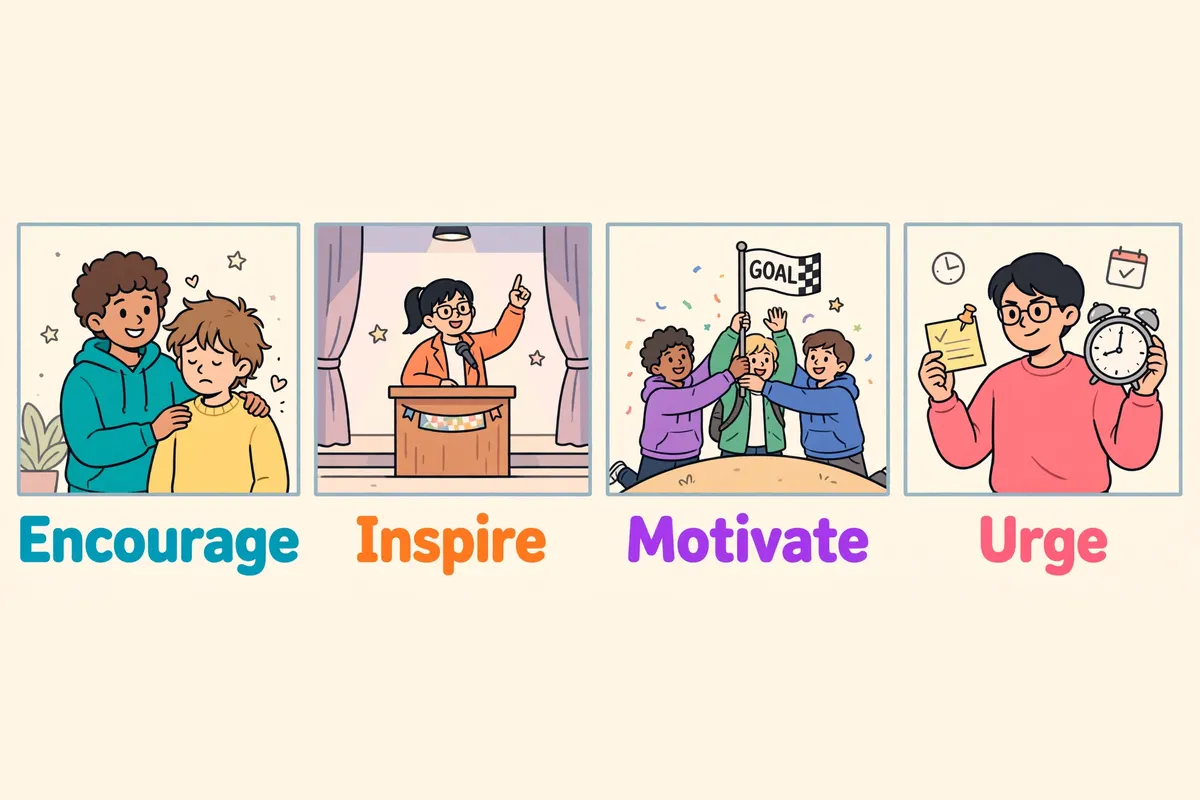
Encourage vs Inspire vs Motivate vs Urge
These four verbs are close in meaning, but each describes a different kind of influence. The right choice depends on whether someone needs confidence, an example, a reason or a firm push.
| Word | Core idea | What it does | Grammar pattern | Example |
|---|---|---|---|---|
| Encourage | Give support, confidence or hope | Lifts confidence so someone feels able to act | encourage + person + to-infinitive | The teacher encouraged her to keep writing. |
| Inspire | Fill someone with a strong desire | Awakens enthusiasm through an example, idea or experience | inspire + person + to-infinitive | Her story inspired him to start again. |
| Motivate | Give a reason or desire to act | Supplies a reason, such as a goal, reward or fear | motivate + person + to-infinitive | The bonus motivated the team to finish early. |
| Urge | Strongly ask someone to act | Pushes with pressure and urgency | urge + person + to-infinitive | I urge you to read the report tonight. |
If you give confidence, use “encourage”; if an example lights the fire, use “inspire”; if a reason drives the action, use “motivate”; if the moment needs pressure, use “urge”.
Encourage vs persuade
Encourage someone to act by giving support or confidence, but the person may still decide not to act. Persuade means the person was convinced.
Encourage vs praise
Encourage someone by helping them take a next step. Praise recognizes something they have already done well.
Motivate vs incentivize: Motivate can refer to many reasons for action, including personal goals or interest. Incentivize focuses on offering a reward or benefit to prompt action.

Other Ways to Say “I Encourage You”
Sometimes a full phrase sounds more natural than a single verb. These six expressions work well in personal conversations, supportive messages and everyday writing.
1. Cheer someone on
Tone: Casual, warm
Use this phrase when you want to show someone that you are on their side while they try to reach a goal. It is common in sports, school, work and personal situations. For example, you can cheer a friend on as they prepare for a race.
2. Build someone’s confidence
Tone: Warm, supportive
This phrase focuses on helping someone trust their own ability. It suits conversations about learning, work, public speaking and personal goals. A teacher might build a student’s confidence by pointing out real progress and offering useful feedback.
3. Give someone a nudge
Tone: Casual, light
Use this phrase when someone needs a small reminder or a gentle push. It works well when the person already wants to act but has not started. A quick message can give a colleague a nudge to finish a task.
4. Lift someone’s spirits
Tone: Warm, caring
This expression means helping someone feel happier or more hopeful. It is especially useful when a person is upset, tired or disappointed. A thoughtful note or a kind conversation can lift someone’s spirits after a hard day.
5. Spur someone on
Tone: Strong, energetic
Use this phrase when a person needs a push to keep going or work harder. It suggests more energy than a gentle nudge. A close deadline or a clear goal can spur someone on to finish a project.
6. Buck someone up
Tone: Casual, informal
This expression means helping someone feel more positive or hopeful. It is common in informal conversation, especially when someone has had a rough day. It may sound too casual for a formal email or business report.
Usage warning: “Egg someone on” can have a negative meaning. It may suggest pushing someone toward foolish, risky or harmful behavior, so it is not a general substitute for encouragement.
Antonyms of Encourage
The direct opposite of encourage is discourage. The best antonym depends on whether the original meaning involves confidence, growth or action.
When the meaning is confidence or hope: Use dishearten, dispirit, depress, deject, demoralize, deter or abash. These words describe lowering someone’s confidence, hope or spirits.
When the meaning is growth or development: Use hinder, hamper, inhibit, prevent, retard, counteract, stifle or suppress. These words describe blocking progress or making development harder.
When the meaning is urging someone to act: Use dissuade, deter or restrain. These words describe talking someone out of an action, putting them off or holding them back.
Encourage and Discourage Use Different Grammar
The two verbs take different patterns:
Encourage someone to do something: The coach encouraged Nina to try again.
Discourage someone from doing something: Her friends discouraged Nina from quitting.
Do not write “They discouraged her to quit.” The correct pattern is discourage someone from doing something.
FAQs
Frequently Asked Questions
1. What is another word for encourage?
Inspire, hearten and embolden work when someone needs confidence or hope. Motivate, spur and urge focus more on action. Use promote or foster when you mean helping an idea, skill or activity develop.
2. What is the difference between encourage and motivate?
Encourage gives someone support, confidence or hope. Motivate gives someone a reason or desire to act. That reason might be a personal goal, a reward or fear, so motivation does not always feel warm.
3. What is the difference between encourage and inspire?
Encourage gives someone support that helps them feel able to act. Inspire creates a strong desire through an example, idea or experience. A person can inspire someone without directly asking them to do anything.
4. What is a formal synonym for encourage?
Use endorse when you mean official approval, advocate when you mean speaking in favor of a cause, or foster when you mean helping something develop. Embolden and exhort also suit formal writing, depending on context.
5. What is the opposite of encourage?
Discourage is the direct opposite of encourage. Use dishearten or demoralize when someone loses confidence, hinder or inhibit when something cannot develop, and dissuade when someone is talked out of taking action.
6. How do you use encourage in a sentence?
Name the person receiving support, then use the infinitive with to. For example: “The coach encouraged her to enter the race.” Do not leave out the person between encourage and the action.