
Influence Synonyms: 36 Words for Power and Effect
Influence describes the power to shape what people think, feel or do. The best synonym depends on whether you mean authority, a noticeable result, persuasion or a stronger form of control.
Quick Answer
For changing an opinion or a decision, use sway.
For formal power that comes from a position or reputation, use authority or prestige.
For a result you can measure, use impact or effect.
As a verb, use affect for a general change and persuade when someone is won over by argument.
Influence is indirect power: it shapes what people think or do without forcing them.
What Does Influence Mean?
Influence is the ability to affect how someone thinks, behaves or makes a decision. It can also describe the effect that a person, event or idea has on something else.
Oxford gives three noun senses: an effect, the power to affect others, and a person or thing that affects how someone thinks or behaves. The verb form means to affect how someone thinks or behaves, or how a situation develops.
Merriam-Webster describes the indirect power sense as producing an effect “without apparent exertion of force.”
Cambridge gives B2 noun and verb senses: the power to have an effect on people or things, and to affect how someone or something develops, behaves, or thinks.
A good or bad influence is a person. Most of the 36 words in this article describe the power, not the person.
The word works as both a noun and a verb.
As a noun, influence can mean:
An effect: Something changes how a person thinks or behaves, or how a situation develops.
The power to affect others: Someone has the ability to shape another person’s actions or decisions.
A person or thing: Someone or something that affects the way another person behaves or thinks.
As a verb, influence means to affect the way someone thinks or behaves. It can also mean to affect how a situation develops.
For example:
Noun: Her teacher had a lasting influence on her career.
Verb: Her teacher influenced her career choice.
Influence usually means indirect power
The key idea is that influence does not always involve orders, force or complete control. A person can influence someone through trust, knowledge, reputation, example or persuasion.
A manager may influence a team’s decisions without making every decision for them. A book may influence how readers see the world without telling them what to believe.
This is why influence and control are not interchangeable in every sentence. Control suggests a more direct ability to decide what happens. Influence often leaves room for another person to make their own choice.
Is influence a noun or a verb?
It is both.
Noun: The coach’s influence helped the team improve.
Verb: The coach influenced the team’s attitude.
Word family
Influential: an adjective describing someone or something with influence.
Influencer: a person who affects the opinions or behavior of others.
Influenced: the past tense or past participle of the verb.
Influencing: the present participle of the verb.
Influenceable: able to be influenced.
Uninfluenced: not affected by someone or something.
“Uninfluence” is not a word.
Where does the word influence come from?
The word comes from Latin influere, meaning “to flow in.” It was used in astrology for a flowing force from the stars. Influenza comes from the same Latin root and is the name of an illness, not a synonym for influence.
What does under the influence mean?
The phrase under the influence commonly means that someone has consumed enough alcohol or drugs to affect their behavior or judgment.
Do not use it to mean “affected by an idea”. “Under the influence of her teacher” (a person) is a different construction.
He was under the influence of alcohol when he made the decision.
The surrounding words make the intended meaning clear.
Common influence phrases and prepositions
These combinations are useful in everyday and formal writing:
Have influence: Her advice has influence within the department.
Gain influence: The organization gained influence over time.
Exert influence: The board exerted influence on the final decision.
Sphere of influence: The country expanded its sphere of influence.
Bring influence to bear: She brought her influence to bear on the discussion.
Influence on: The book had an influence on his writing.
Influence over: The manager has influence over hiring decisions.
Influence with: He has influence with senior members of the team.
Use influence on when naming the thing affected. Use influence over when describing power in relation to a person, group or decision. Use influence with when describing someone’s standing or persuasive power among other people.
Trap words: Juice, heft, and in are slang and informal only. Scepter, mana, and good offices are rare or regional. Coercion and compel involve threats and are the opposite of gentle influence. Fame and popularity are sources of influence, not influence itself. The verb effect in “to effect a change” means to bring a change about, not a synonym for influence.
When to Use Influence Synonyms
In essays and reports, use authority, prestige, weight, and determine when the writing is formal and the power or result needs a clear name.
In business and negotiations, use leverage, exert influence over, and bring your influence to bear on when a decision, advantage, or deliberate action is involved.
In everyday talk, use sway, affect, and impact for short and natural choices.
In stories and speeches, use inspire, move, and guide when feelings, example, or gentle direction shape a choice.
The indirectness rule: Keep influence when the power is gentle, indirect, and hard to name. If the power is direct, the word is control, not influence.
Benefits of Using Influence Synonyms
Choosing the right synonym helps readers understand exactly what kind of power or effect you mean.
Repeating influence makes writing dull, so a precise synonym keeps the text clear.
Different synonyms show how the power works: persuasion, reputation, position, or a result.
Formal words such as authority, prestige, and weight suit essays and reports, while clout and pull suit everyday talk.
Separating the power from the result helps you choose impact or effect for a result, and separating the noun from the verb helps you choose affect as the verb.
36 Best Influence Synonyms at a Glance
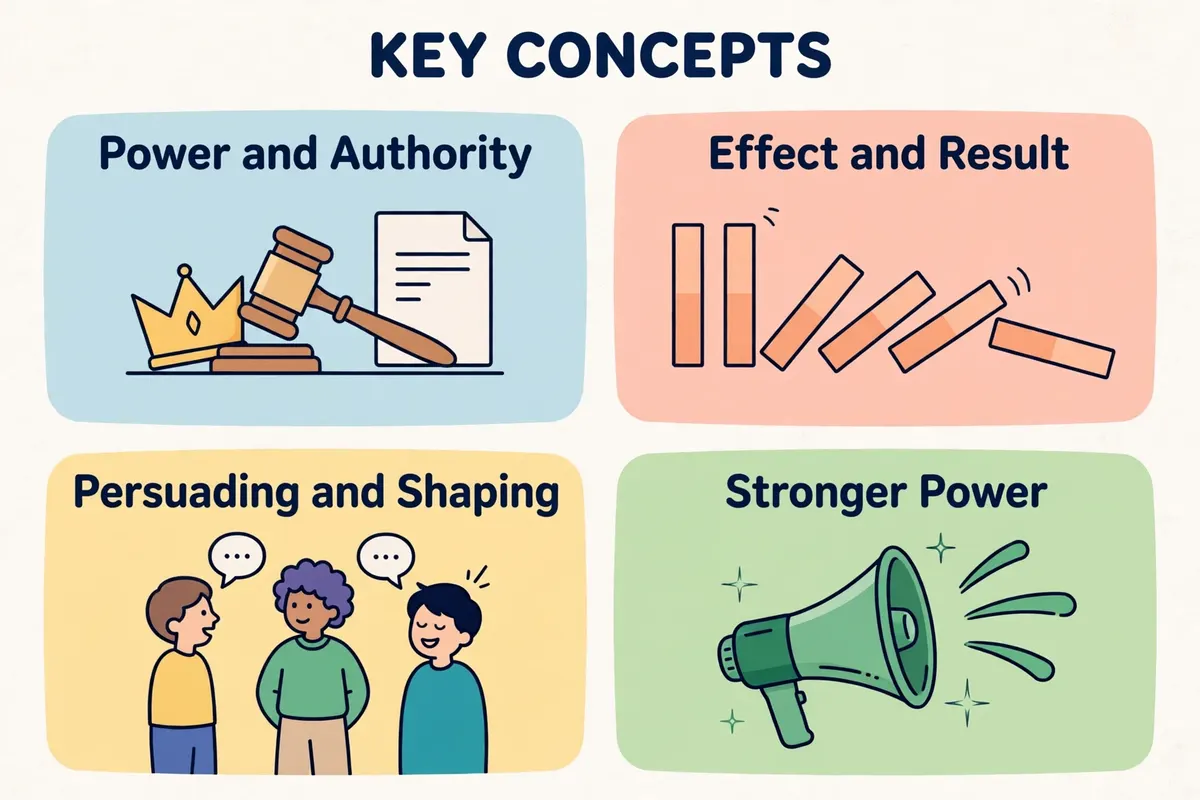
The 36 words below cover four different uses: 10 power and authority nouns, 9 effect and result nouns, 9 persuading and shaping verbs, and 8 stronger and direct words. Manipulation is negative, and dominance, supremacy and command are direct, not indirect.
| Synonym | Tone | Best for |
|---|---|---|
| Sway | Neutral, formal | Essays, reports, everyday formal writing |
| Authority | Formal | Essays, reports, business writing |
| Power | Neutral | Everyday talk, essays, reports |
| Control | Neutral, formal | Business, reports, management writing |
| Leverage | Formal, business | Business, negotiations, reports |
| Clout | Informal | Everyday talk, news, casual writing |
| Pull | Informal | Everyday talk, news, casual writing |
| Weight | Neutral, formal | Essays, reports, discussions |
| Prestige | Formal | Essays, reports, formal writing |
| Credit | Formal | Essays, reports, formal writing |
| Impact | Neutral | Essays, reports, news, business writing |
| Effect | Neutral | Everyday talk, essays, science writing |
| Consequence | Neutral, formal | Essays, reports, formal writing |
| Impression | Neutral | Everyday talk, stories, essays |
| Mark | Neutral | Stories, essays, history writing |
| Significance | Formal | Essays, reports, academic writing |
| Importance | Neutral | Everyday talk, essays, reports |
| Bearing | Formal | Essays, reports, formal writing |
| Repercussion | Formal | News, reports, formal writing |
| Affect | Neutral | Everyday talk, essays, science writing |
| Persuade | Neutral | Essays, stories, everyday talk |
| Inspire | Positive | Stories, speeches, everyday talk |
| Guide | Neutral | Essays, stories, everyday talk |
| Shape | Neutral | Essays, reports, stories |
| Move | Neutral | Stories, speeches, everyday talk |
| Convince | Neutral | Everyday talk, essays, debates |
| Incline | Formal | Essays, formal writing, stories |
| Determine | Formal | Essays, reports, academic writing |
| Dominance | Formal | Essays, history, politics writing |
| Supremacy | Formal | History, politics, formal writing |
| Command | Formal | Military, business, formal writing |
| Mastery | Formal | Essays, reports, formal writing |
| Pressure | Neutral | News, reports, everyday talk |
| Force | Neutral | Essays, news, everyday talk |
| Manipulation | Negative | Essays, news, psychology writing |
| Hold | Neutral | Stories, everyday talk, essays |
Synonyms for Power and Authority
These ten nouns describe the ability to affect decisions, people or events. Some refer to indirect persuasion. Others suggest formal or direct power, so check the meaning before replacing influence.
1. Sway
Tone: Neutral, formal · Uses: Essays, reports, everyday formal writing
Meaning: The power to direct what people think or decide, usually indirectly.
Explanation: Sway is one of the closest noun synonyms for influence when someone changes another person’s opinion or decision. It usually suggests persuasion rather than force. It also works as a verb, as in “sway a voter.”
Examples:
- Her calm argument carried enough sway to change the committee’s decision.
- The newspaper has considerable sway over public opinion.
2. Authority
Tone: Formal · Uses: Essays, reports, business writing
Meaning: The power to make decisions and be obeyed, from a position or rank.
Explanation: Authority often comes from a job, rank, position or recognized knowledge. It can influence people because they respect or accept someone’s right to lead. Unlike ordinary influence, authority may include the power to give orders.
Examples:
- The director’s authority helped settle the disagreement.
- Her experience gave her authority in the research team.
3. Power
Tone: Neutral · Uses: Everyday talk, essays, reports
Meaning: The general ability to affect people or events.
Explanation: Power is broader than influence. It can include indirect persuasion, but it can also involve direct control, resources or the ability to enforce a decision. Use it when you mean general ability rather than a specific persuasive effect.
Examples:
- The community has the power to shape local decisions.
- Money gave the company more power in the negotiations.
4. Control
Tone: Neutral, formal · Uses: Business, reports, management writing
Meaning: The ability to direct people or events completely.
Explanation: Control is stronger and more direct than influence. It suggests that someone can guide what happens or limit another person’s choices. Do not use it as a neutral replacement when you only mean indirect persuasion.
Examples:
- The manager has control over the department’s budget.
- The new rules gave the agency greater control of the process.
5. Leverage
Tone: Formal, business · Uses: Business, negotiations, reports
Meaning: An advantage or connection used to get a result.
Explanation: Leverage describes the advantage that helps someone affect a decision or situation. It often involves useful information, resources, relationships or bargaining strength. It is not simply the ability to persuade someone.
Examples:
- The small supplier used its unique product as leverage in the negotiations.
- Her strong record gave her leverage when she requested a promotion.
6. Clout
Tone: Informal · Uses: Everyday talk, news, casual writing
Meaning: Strong influence from reputation, connections or status.
Explanation: Clout is an informal word for noticeable social or professional influence. Someone with clout can often get attention or affect decisions because others respect their position. It is less suitable for formal academic writing.
Examples:
- The local business owner has enough clout to attract the mayor’s attention.
- Her reputation gave the campaign more clout with young voters.
7. Pull
Tone: Informal · Uses: Everyday talk, news, casual writing
Meaning: Personal access that helps shape decisions behind the scenes.
Explanation: Pull often describes influence that works behind the scenes. A person with pull may know the right people or have access to decision-makers. It is informal and can suggest that connections matter more than official authority.
Examples:
- He used his pull with the board to get the proposal reviewed.
- She has enough pull at the company to arrange a meeting with the director.
8. Weight
Tone: Neutral, formal · Uses: Essays, reports, discussions
Meaning: Influence that counts in a decision; what someone says carries weight.
Explanation: Weight describes how much an opinion, argument or piece of evidence matters. It often appears in phrases such as “carry weight” or “give weight to.” It focuses on importance in a decision rather than control over another person.
Examples:
- Her recommendation carried considerable weight with the hiring panel.
- The latest evidence gave more weight to the team’s concerns.
9. Prestige
Tone: Formal · Uses: Essays, reports, formal writing
Meaning: Influence that comes from a great reputation or excellence.
Explanation: Prestige describes the standing that makes people pay attention or show respect. A respected university, company or expert may have prestige because of its record. Prestige can create influence, but it is not the same as authority from an official position.
Examples:
- The award added prestige to the research institute.
- His professional prestige helped the project attract experienced partners.
10. Credit
Tone: Formal · Uses: Essays, reports, formal writing
Meaning: Influence that comes from other people’s trust in you.
Explanation: Credit can describe the trust or confidence that gives someone’s opinion weight. In this sense, it is close to credibility rather than general power. It is not a direct synonym for every use of influence.
Examples:
- Her careful work gave her credit with the review committee.
- The scientist’s earlier discoveries added credit to his recommendation.
Synonyms for Effect and Result
These nine nouns describe what happens because of an action, event or person. They are useful when influence refers to an outcome rather than the power that caused it.
11. Impact
Tone: Neutral · Uses: Essays, reports, news, business writing
Meaning: A strong, noticeable effect on a person or situation.
Explanation: Impact focuses on the result of an action or event. It often suggests a clear or significant change. It does not usually describe the power behind that change, so use it when the outcome matters most.
Examples:
- The new schedule had a positive impact on employee morale.
- Her speech made a lasting impact on the audience.
12. Effect
Tone: Neutral · Uses: Everyday talk, essays, science writing
Meaning: The change that something causes.
Explanation: Effect is a broad word for a result. It can describe a small or large change, whether positive, negative or neutral. It usually works as a noun, while affect is usually the verb meaning to have an effect on something.
Examples:
- The medication had a noticeable effect on his sleep.
- The teacher’s support had a positive effect on the class.
13. Consequence
Tone: Neutral, formal · Uses: Essays, reports, formal writing
Meaning: Something that follows from an action or event.
Explanation: Consequence points to what follows from something else. It can be positive, negative or neutral, although people often use it when discussing serious or unwanted results. It describes an outcome, not the power that produced it.
Examples:
- One consequence of the change was a shorter waiting time.
- The company considered the consequences before changing its policy.
14. Impression
Tone: Neutral · Uses: Everyday talk, stories, essays
Meaning: The effect a person or thing leaves on someone’s mind.
Explanation: Impression focuses on how a person, event or experience affects someone’s thoughts or feelings. It often describes a personal reaction rather than measurable power. Use it when the effect is mainly mental or emotional.
Examples:
- The speaker made a strong impression on the audience.
- Her first impression of the new manager was positive.
15. Mark
Tone: Neutral · Uses: Stories, essays, history writing
Meaning: A lasting effect something leaves behind.
Explanation: Mark often appears in the phrase “leave a mark.” It suggests that something has affected a person or situation in a way that remains noticeable. It is less useful when you mean formal authority or the ability to persuade.
Examples:
- Her early mentor left a mark on the way she taught.
- The difficult year made a lasting mark on the community.
16. Significance
Tone: Formal · Uses: Essays, reports, academic writing
Meaning: How important or meaningful an effect is.
Explanation: Significance describes why an event, result or detail matters. It can help explain the importance of an influence, but it does not mean the power to affect someone. Use it when you want to discuss meaning or importance.
Examples:
- The report explains the significance of the policy change.
- Researchers discussed the long-term significance of the discovery.
17. Importance
Tone: Neutral · Uses: Everyday talk, essays, reports
Meaning: How much something matters or counts.
Explanation: Importance describes how much something matters. It can refer to the value of an idea or the role of a person in a decision. It is not a direct replacement for influence when you mean the ability to change someone’s behavior.
Examples:
- The manager explained the importance of clear communication.
- Her advice gained importance as the project developed.
18. Bearing
Tone: Formal · Uses: Essays, reports, formal writing
Meaning: The way something affects a decision or outcome.
Explanation: Bearing usually appears in the phrase “have a bearing on.” It describes relevance or an effect on how something develops. It is more precise than influence when you mean that a fact matters to a particular decision.
Examples:
- The witness’s statement had a bearing on the final decision.
- Her previous experience has little bearing on the current problem.
19. Repercussion
Tone: Formal · Uses: News, reports, formal writing
Meaning: An effect that follows, often an unwanted one.
Explanation: Repercussion usually refers to a consequence that creates further problems or changes. It often carries a negative tone, unlike the more neutral word effect. Use it when the later result deserves attention.
Examples:
- The company faced financial repercussions after the failed launch.
- The decision had serious repercussions for the local community.
Synonyms for Persuading and Shaping
These nine words are verbs. They describe ways that a person, action or event can change someone’s thoughts, feelings, behavior or choices.
20. Affect
Tone: Neutral · Uses: Everyday talk, essays, science writing
Meaning: To have an effect on someone or something.
Explanation: Affect is a common verb that describes causing a change. It can refer to direct or indirect effects, depending on the situation. Do not confuse it with effect, which is usually a noun meaning the result.
Examples:
- The long commute affected her energy throughout the week.
- His comments affected the way the team viewed the proposal.
21. Persuade
Tone: Neutral · Uses: Essays, stories, everyday talk
Meaning: To win someone over by argument or reasoning.
Explanation: Persuade is more specific than influence. It usually involves an effort to win someone over through reasons, evidence or an appeal to feelings. It does not automatically suggest pressure or manipulation.
Examples:
- The lawyer persuaded the client to accept the revised agreement.
- Her explanation persuaded the team to try a different approach.
22. Inspire
Tone: Positive · Uses: Stories, speeches, everyday talk
Meaning: To fill someone with the urge to do or create something good.
Explanation: Inspire describes an effect that gives someone motivation or a desire to act. It often carries a positive tone, unlike the broader word influence. Use it when the change involves hope, effort, creativity or ambition.
Examples:
- Her teacher inspired her to study environmental science.
- The team’s progress inspired other volunteers to join the project.
23. Guide
Tone: Neutral · Uses: Essays, stories, everyday talk
Meaning: To lead someone toward a choice or direction, gently.
Explanation: Guide suggests helpful direction rather than complete control. A person can guide someone by sharing knowledge, offering advice or setting an example. It is a good choice when the influence supports another person’s own decision-making.
Examples:
- The counselor guided him through the college application process.
- Her experience guided the team’s response to the problem.
24. Shape
Tone: Neutral · Uses: Essays, reports, stories
Meaning: To decide or influence the form something takes.
Explanation: Shape describes an effect that helps determine what something becomes. It often suggests a gradual process rather than one sudden change. Use it when a person or experience helps form someone’s beliefs, choices or future.
Examples:
- Her childhood experiences shaped her views on education.
- The early discussions shaped the final version of the plan.
25. Move
Tone: Neutral · Uses: Stories, speeches, everyday talk
Meaning: To stir someone’s feelings or push them toward action.
Explanation: Move often describes an emotional effect. A story, gesture or experience can move someone to feel sympathy, change their mind or take action. It is more personal and emotional than the general verb influence.
Examples:
- The documentary moved viewers to support the shelter.
- His honest apology moved her to reconsider her decision.
26. Convince
Tone: Neutral · Uses: Everyday talk, essays, debates
Meaning: To make someone believe something is true.
Explanation: Convince focuses on changing someone’s belief or judgment. It often involves facts, reasons or a clear explanation. Like persuade, it is more specific than influence, but it does not always mean that the person will take action.
Examples:
- The evidence convinced the panel that the report was accurate.
- She convinced her parents that the course was worth taking.
27. Incline
Tone: Formal · Uses: Essays, formal writing, stories
Meaning: To make someone lean toward a choice or opinion.
Explanation: Incline often describes a gentle tendency toward a choice or opinion. It does not mean that someone has made a final decision. Its formal tone makes it more common in careful writing than in casual conversation.
Examples:
- The new evidence inclined the committee toward approval.
- His experience inclined him to support the proposal.
28. Determine
Tone: Formal · Uses: Essays, reports, academic writing
Meaning: To decide or fix how something turns out.
Explanation: Determine is stronger than ordinary influence. It suggests that something decides or fixes an outcome rather than simply shaping it. Use it when the effect is decisive, not when several factors still leave room for choice.
Examples:
- The final vote will determine the project’s future.
- Several factors determined how the team responded.
Stronger Synonyms for Influence
These eight words describe more forceful forms of power or control. They are not all safe replacements for influence. Some suggest authority, pressure or unfair behavior.
29. Dominance
Tone: Formal · Uses: Essays, history, politics writing
Meaning: Power and influence over others, in a commanding way.
Explanation: Dominance describes a strong position in which one person or group has more power than another. It is more direct than ordinary influence and can suggest that others have limited freedom. Use it when the power imbalance matters.
Examples:
- The company maintained its dominance in the regional market.
- His dominance in the discussion made it difficult for others to speak.
30. Supremacy
Tone: Formal · Uses: History, politics, formal writing
Meaning: The highest power; being above everyone else.
Explanation: Supremacy is stronger than influence. It suggests being above others in power, status or control. It is not a gentle form of persuasion and should only be used when the highest position or level of power is meant.
Examples:
- The two companies competed for market supremacy.
- The treaty challenged the country’s claim to regional supremacy.
31. Command
Tone: Formal · Uses: Military, business, formal writing
Meaning: The power to give orders and be obeyed.
Explanation: Command suggests direct authority rather than indirect influence. A person in command can make decisions and issue instructions within their role. It can also be a verb, but this entry focuses on the noun.
Examples:
- The officer had command of the rescue operation.
- Her position gave her command over the entire department.
32. Mastery
Tone: Formal · Uses: Essays, reports, formal writing
Meaning: Complete control or great skill over something.
Explanation: Mastery can describe expert skill or control over a situation. It is not a general synonym for influence because it often focuses on ability or command of a subject. Use it when expertise or control is central to the meaning.
Examples:
- Her mastery of the subject influenced the training program.
- The team showed mastery of the new software.
33. Pressure
Tone: Neutral · Uses: News, reports, everyday talk
Meaning: Influence pushed on someone to make them act.
Explanation: Pressure is stronger than ordinary influence because it suggests that someone feels pushed to act. It can come from a person, group, deadline or difficult situation. It may be reasonable or unfair, depending on the context.
Examples:
- The public put pressure on the council to review the decision.
- She felt pressure from her colleagues to accept the offer.
34. Force
Tone: Neutral · Uses: Essays, news, everyday talk
Meaning: Strength or power that causes change.
Explanation: Force usually suggests direct power, not subtle persuasion. It can refer to physical strength, authority or a powerful effect. Use it only when the situation involves a strong push or direct action.
Examples:
- The force of the storm damaged homes across the town.
- The force of her argument changed the committee’s decision.
35. Manipulation
Tone: Negative · Uses: Essays, news, psychology writing
Meaning: Hidden, unfair influence used to control someone.
Explanation: Manipulation is a negative form of influence. It suggests that someone uses hidden tactics, emotional pressure or misleading information to get the result they want. Do not use it as a neutral synonym for persuasion.
Examples:
- The report exposed the manager’s manipulation of the staff.
- She recognized the manipulation and refused to change her decision.
36. Hold
Tone: Neutral · Uses: Stories, everyday talk, essays
Meaning: The grip or power someone has over people.
Explanation: Hold often appears in the phrase “have a hold over.” It suggests that a person or thing has a strong effect on someone’s thoughts or actions. Depending on the context, it can imply control or emotional dependence.
Examples:
- The old tradition still has a strong hold over the community.
- His reputation gave him a hold over the group’s decisions.
Influence vs Power vs Impact vs Affect
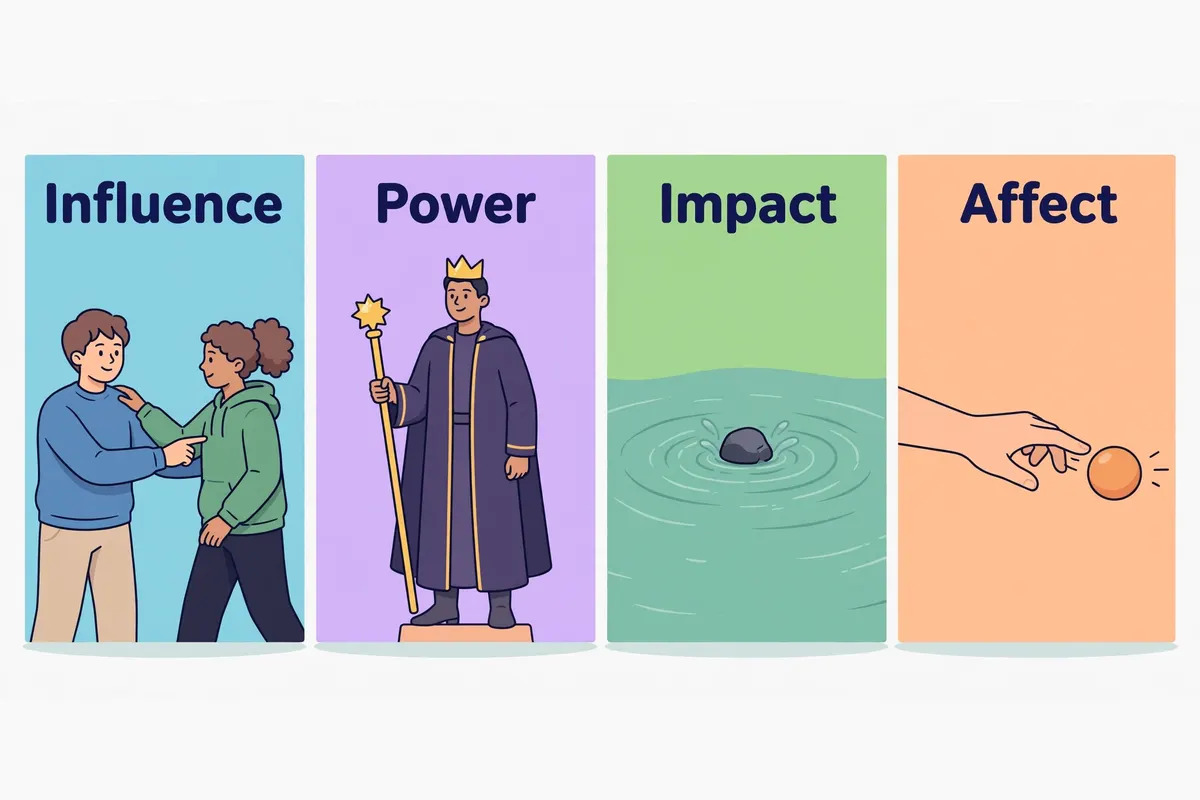
These four words are related, but they do different jobs. The main difference is whether you mean indirect power, general ability, a result or the act of causing a change.
| Word | Core idea | Noun or verb | How direct | Example |
|---|---|---|---|---|
| Influence | Indirect power that shapes thoughts or actions | Both noun and verb | Indirect; suggests, does not force | Her teacher had a great influence on her career. |
| Power | The general ability to affect or control | Noun | Can be direct or indirect | She has the power to change company decisions. |
| Impact | A strong, noticeable effect or result | Noun (also verb) | Direct and immediate; the result itself | The new policy had a big impact on sales. |
| Affect | To have an effect on someone or something | Verb | Direct; it acts on its object | The weather affected her mood. |
Influence vs authority
Authority comes from a recognized position, role or expertise. It can include the right to give orders. Influence can come from character, ability, reputation or personal relationships, even when someone has no official power.
Influence vs control
Control means directing or managing something more directly. Influence means shaping what happens without necessarily deciding the outcome.
Influence vs persuade
Persuade usually involves an argument, reason or appeal that wins someone over. Influence is broader. A person can influence someone through example, reputation or repeated experience without making a direct argument.
Influence vs effect
An effect is the result of an action or event. Influence is the power or process that helps bring about a change.
If you name the power itself, use “influence” when it is indirect and “power” when it is general; if you name the result, use “impact” for a strong one and “effect” for a neutral one; if you need a verb, use “affect”.

Other Ways to Say “Influence”
Sometimes a phrase sounds more natural than a single word. These six expressions can help you describe an effect, a deliberate use of power or a person’s hold over someone.
1. Have an effect on
Tone: Everyday, neutral
Meaning: To cause a change in someone or something.
This is one of the plainest ways to express the verb meaning of influence. It works in conversation and formal writing.
Example: Her advice had an effect on the way I handled the problem.
2. Have an impact on
Tone: Neutral, professional
Meaning: To cause a strong or noticeable change.
Use this phrase when the result matters or can be measured. It is common in reports, presentations and discussions of social or business outcomes.
Example: The new training program had an impact on employee performance.
3. Bring your influence to bear on
Tone: Formal
Meaning: To use your power or position deliberately to affect a situation.
This phrase describes an intentional use of influence. It often appears in formal writing about negotiations, public affairs or leadership.
Example: The chair brought her influence to bear on the final discussion.
4. Exert influence over
Tone: Formal
Meaning: To use power or persuasion to affect someone or a decision.
This phrase is useful when describing influence over a person, group or process. It can sound stronger than simply having an effect on something.
Example: The board exerted influence over the company’s long-term plans.
5. Have a bearing on
Tone: Formal
Meaning: To be relevant to or affect a decision or result.
This expression is about a factor’s relevance to an outcome. It does not mean that someone has power over another person.
Example: The employee’s earlier experience had a bearing on the hiring decision.
6. Be under someone’s spell
Tone: Everyday, expressive
Meaning: To be strongly charmed or captivated by someone.
This phrase describes a person’s effect on someone else. It can suggest admiration, attraction or a powerful emotional hold. It is not a direct replacement for formal authority or general power.
Example: The audience seemed to be under the speaker’s spell.
Antonyms of Influence
The opposite of influence depends on what you mean. If you mean the power to affect people or events, look for words that describe a lack of power. If you mean the act of influencing someone, use verbs that describe stopping or discouraging an action.
Noun antonyms
Powerlessness
Meaning: Having no power or ability to change a situation.
This is the clearest general opposite of influence when influence means the ability to affect events or decisions.
Weakness
Meaning: A lack of strength, ability or power.
Weakness is a milder opposite. It can describe limited influence, but it does not always mean that someone has no power.
Impotence
Meaning: A complete or serious lack of power to act or produce a result.
Impotence is formal and often suggests an inability to change something despite wanting to do so.
Helplessness
Meaning: The state of being unable to help yourself or take effective action.
Use helplessness when someone lacks the ability or resources to respond to a situation.
Ineffectiveness
Meaning: The failure to produce the intended result.
This word focuses on an unsuccessful effect rather than a lack of authority or personal power.
Insignificance
Meaning: The quality of being too small or unimportant to matter.
Insignificance is useful when something has little importance or little effect on a larger situation.
Verb antonyms
These verbs describe actions that prevent someone from being influenced or acting on an idea.
Deter, discourage, dissuade, hinder, prevent.
Two related words need a small distinction: Ignore means to pay no attention to someone or something. It describes a person’s response, not the absence of influence. Resist means to oppose or refuse to accept an influence. It describes an active response to pressure or persuasion.
Choose the opposite that matches the sentence. Powerlessness opposes influence as power, while dissuade and prevent oppose the act of encouraging or causing an action.
FAQs
The following questions cover common choices, grammar points and differences between related words.
Frequently Asked Questions
1. What is another word for influence?
Sway works when someone changes an opinion or decision. Authority describes formal power, while impact and effect describe results. For verbs, use affect for causing change or persuade for winning agreement.
2. What is the difference between influence and power?
Power is the general ability to affect people, events or decisions. Influence is often indirect. It shapes what someone thinks or does without necessarily forcing them or taking away their freedom to choose.
3. What is the difference between influence and impact?
Influence describes the power or process that shapes thoughts, behavior or decisions. Impact describes the strong or noticeable result. A teacher may influence a student, and that guidance may have a lasting impact.
4. What is the difference between influence and affect?
Affect is usually a verb meaning to have an effect on someone or something. Influence works as both a noun and a verb, and often describes indirect power that shapes behavior or decisions.
5. Is influence a noun or a verb?
Influence is both a noun and a verb. In “her influence on the team,” it is a noun. In “her words influenced the team,” it is a verb. Influential is the related adjective.
6. What is the opposite of influence?
Powerlessness is a strong general opposite when influence means the ability to affect events or decisions. Weakness and impotence also describe a lack of power. For the verb, deter or dissuade may fit.