Mistake Synonyms: 39 Words for Errors Big and Small
A mistake can be a tiny typing error, a poor decision, or a costly failure of judgment. These 39 mistake synonyms help you name the problem clearly, without repeating the same word in every sentence.
Quick Answer
- General, everyday use: Mistake is the most general word for something done, said, or believed incorrectly.
- Formal, technical, or written use: Error fits reports, essays, calculations, and technical writing.
- A big, careless, or embarrassing mistake: Blunder is stronger and often suggests blame.
- A small accidental mistake: Slip or slipup describes a minor mistake, often made without thinking.
- Something missed: Oversight describes an item or detail that someone failed to notice.
- Core rule: You make a mistake; never “do a mistake”.
What Does Mistake Mean?
A mistake is something incorrect that a person does, says, writes, or believes. It can also describe a decision or action that produces an unwanted result.
The Oxford Advanced Learner’s Dictionary gives two main noun senses:
- A word, figure, or other detail that is not said or written correctly.
- An action or opinion that is incorrect or produces an unwanted result.
Merriam-Webster also describes a mistake as a wrong judgment or misunderstanding, or something incorrect that comes from faulty judgment, inadequate knowledge, or inattention. The Cambridge Thesaurus describes a mistake as something, such as an action or decision, that accidentally produces an unwanted and often bad result.
Oxford’s “Which word?” note
Oxford explains that mistake is the most general word. Error is more formal. A slip is a small careless mistake. A howler is a stupid, embarrassing mistake. An inaccuracy is a piece of information that is not exactly correct. A misprint is a small mistake in a printed text.
Oxford’s synonym group for sense 1 is: error, inaccuracy, slip, misprint, howler.
Mistake as a noun and a verb
Mistake works as both a noun and a verb, but the two uses have different patterns.
- Noun: I made a mistake in the address.
- Verb: I mistook him for his brother.
- Verb: Don’t mistake my silence for agreement.
The 39 words in this guide are noun alternatives. They describe mistakes rather than replace the verb mistake in every sentence.
The verb has three important forms:
| Form | Example |
|---|---|
| Present | I sometimes mistake one name for another. |
| Past | I mistook the entrance for the exit. |
| Past participle | I have mistaken the date before. |
| -ing form | Mistaking one person for another can be awkward. |
The adverb is mistakenly: “I mistakenly sent the file to the wrong person.”
Other forms in the word family include mistaker, a person who makes a mistake, and mistakingly, a rare adverb that is not common in everyday writing.
Common expressions with mistake
These expressions use mistake in established ways:
- By mistake: Something happens accidentally. “I deleted the wrong file by mistake.”
- Make no mistake: A speaker stresses that a statement is true or important. “Make no mistake, this decision matters.”
- Mistake about something: A person has an incorrect idea. “I was wrong about the meeting time.”
- Make the mistake of doing something: Someone takes an action that turns out to be wrong. “She made the mistake of ignoring the warning.”
Oxford also records the older expression “in mistake for something.” It is not a recommended everyday alternative to “by mistake.” In ordinary modern writing, use “by mistake” for an accidental action.
Common collocations
A collocation is a group of words that commonly appear together. These combinations sound natural:
- Make a mistake
- Commit an error
- Repeat a mistake
- Correct a mistake
- Realize a mistake
- Admit a mistake
- A big mistake
- A colossal mistake
- A great mistake
- Mistakes happen
- Mistakes occur
Oxford traces mistake to late Middle English and the Old Norse word mistaka, meaning “take in error.” The word may also have been influenced by the Old French mesprendre.
When to Use Mistake Synonyms
The best alternative depends on what happened, how serious it was, and who will read your words. A table can help you choose quickly.
| Situation | Words that fit | Why they work |
|---|---|---|
| Essays and reports | Error, inaccuracy, misjudgment | These words suit careful, formal writing. |
| Business emails and apologies | Oversight, misstep, error in judgment | They describe a missed detail or poor decision without automatically assigning harsh blame. |
| Everyday conversation | Slip, slipup, mix-up, goof | These words sound natural in casual speech. |
| Stories and news reports | Blunder, gaffe, faux pas | They can describe a serious or embarrassing public mistake. |
| Editing and publishing | Typo, misprint, erratum | Each word points to a particular kind of written or printed error. |
Make a mistake, not do a mistake
The standard English expression is make a mistake. Do not use do a mistake as though it were the correct form.
You can also say:
- Commit a mistake
- Repeat a mistake
- Correct a mistake
- Realize a mistake
- Admit a mistake
For example, write “I made a mistake in the report,” not “I did a mistake in the report.”
When to keep the word mistake
Sometimes the general word is the clearest choice. Use mistake when you do not know the exact cause, when the size of the problem is unclear, or when a more specific word would sound forced. For example, “I made a mistake” works in a quick apology. You do not need to call it a blunder unless it was a serious, careless error.
Benefits of Using Mistake Synonyms
A well-chosen synonym makes your meaning more exact. It can also help you avoid repeating the same word again and again.
Avoid repetition
Repeating mistake several times can make a paragraph sound dull. A more specific word can improve the flow. Instead of writing, “The mistake caused another mistake,” you could write, “The oversight caused a second error.” The replacement should add meaning, not just variety.
Match the seriousness of the problem
Words signal different levels of seriousness. A slip is usually small and accidental. A blunder is more serious and often suggests poor judgment. Calling a minor typo a blunder may make the situation sound worse than it is.
Show what caused the problem
Some synonyms reveal why something went wrong:
- An oversight means someone missed a detail.
- A lapse suggests a brief failure of attention, memory, or standards.
- A miscalculation points to an incorrect calculation or estimate.
- A misinterpretation means someone understood words, data, or events incorrectly.
These distinctions help readers understand the problem without needing a long explanation.
Set the right tone
A word can make an apology sound more serious, more formal, or more relaxed. “I made an error in judgment” suits a professional setting. “I goofed” sounds casual and may fit a friendly conversation, but it would sound out of place in a formal report.
Do not confuse related words with synonyms
Some words describe a related event or result rather than the mistake itself.
- Accident describes an unplanned event.
- Failure describes an unsuccessful result.
- Flaw or defect describes a weakness in something.
- Mishap describes an unlucky event.
- Crime, sin, and transgression describe wrongdoing, often involving intent or a rule.
- Delusion describes a false belief, while fallacy often describes faulty reasoning.
- Bug usually refers to a software problem.
These words may appear in discussions about mistakes, but they are not direct replacements in every sentence.
39 Best Mistake Synonyms at a Glance
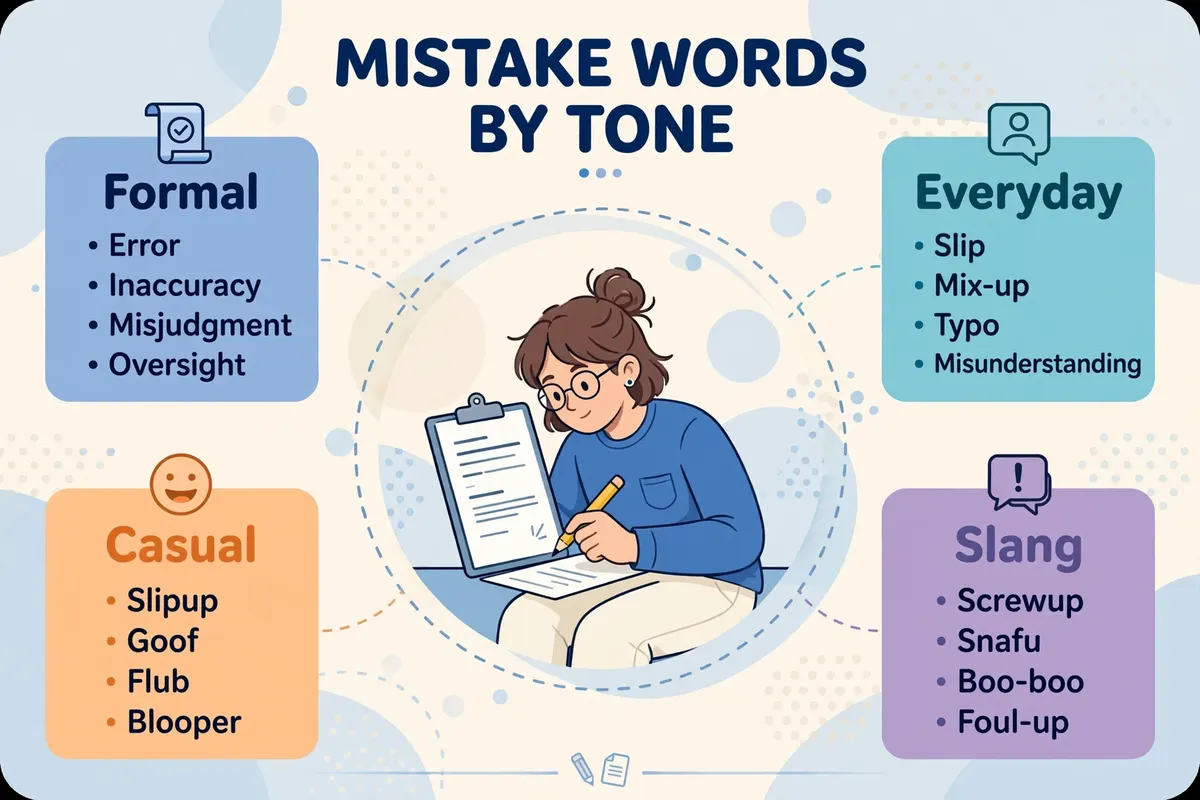
The list has five groups: 10 general and formal words, 8 words about understanding, 9 everyday terms, 6 written and printed terms, and 6 big and costly terms. Some choices need extra care. Boo-boo is childish, screwup is slang, and howler and clanger are informal British terms.
| Synonym | Tone | Best for |
|---|---|---|
| Error | Formal, neutral | Essays, reports, technical and scientific writing |
| Blunder | Neutral, strong | News, stories, serious reports |
| Slip | Neutral, everyday | Everyday talk, emails, apologies |
| Lapse | Formal | Reports, formal writing, apologies |
| Fault | Neutral, formal | Essays, arguments, reports |
| Inaccuracy | Formal | Reports, articles, academic writing |
| Miscalculation | Formal, business | Business, finance, strategy |
| Misjudgment | Formal | Essays, reports, business writing |
| Oversight | Formal, business | Reports, emails, apologies at work |
| Misstep | Neutral, formal | Business, politics, stories |
| Misunderstanding | Neutral | Everyday talk, emails, explanations |
| Misapprehension | Formal | Formal writing, essays |
| Misconception | Formal, neutral | Essays, education, science writing |
| Misinterpretation | Formal | Reports, academic writing, law |
| Misconstruction | Formal | Legal, academic writing |
| Misimpression | Formal | Formal writing, essays |
| Misreading | Neutral | Everyday talk, essays, reviews |
| Wrong impression | Neutral, everyday | Everyday talk, explanations |
| Slipup | Casual | Everyday talk, casual writing |
| Flub | Casual, American | Everyday talk, entertainment, sport |
| Goof | Casual, American | Everyday talk, casual writing |
| Gaffe | Neutral, social | News, stories, social situations |
| Blooper | Casual | Everyday talk, entertainment |
| Boo-boo | Casual, childish | Everyday talk with children, light writing |
| Screwup | Slang, American | Casual speech, informal writing |
| Mix-up | Neutral, everyday | Everyday talk, travel, offices |
| Faux pas | Formal, social | Social writing, stories, etiquette |
| Typo | Neutral, everyday | Everyday talk, emails, editing |
| Misprint | Neutral, formal | Publishing, editing, formal writing |
| Misstatement | Formal | Law, news, official reports |
| Erratum | Very formal | Publishing, academic books |
| Howler | Informal, British | British writing, humor, stories |
| Clanger | Informal, British | British talk, sport, casual writing |
| Foul-up | Casual | Everyday talk, stories, casual writing |
| Snafu | Slang, American | Casual speech, stories, military contexts |
| Pratfall | Casual | Comedy, stories, casual writing |
| Stumble | Neutral | Stories, essays, everyday talk |
| Trip | Neutral | Stories, everyday talk |
| Fumble | Neutral, sport | Sport, stories, everyday talk |
General and Formal Mistakes
These ten words work well when you need to describe an incorrect action, decision, detail, or judgment in clear, often formal language.
1. Error
Tone: Formal, neutral · Uses: Essays, reports, technical and scientific writing
Meaning: Something incorrect; a departure from what is right or accurate.
Explanation: Error is a formal, flexible word for something wrong in a calculation, statement, process, or judgment. It is the standard choice in technical writing, but it can sound stiff in casual conversation.
Examples:
- The report contains an error in its final calculation.
- She corrected the spelling error before sending the letter.
2. Blunder
Tone: Neutral, strong · Uses: News, stories, serious reports
Meaning: A big, careless mistake, often from not thinking.
Explanation: Blunder describes a serious mistake that often results from poor judgment or carelessness. It can suggest stupidity or ignorance, so use it only when the mistake deserves that weight.
Examples:
- The manager’s blunder cost the company an important client.
- His public blunder became the main topic of the meeting.
3. Slip
Tone: Neutral, everyday · Uses: Everyday talk, emails, apologies
Meaning: A small, careless mistake, usually an accident.
Explanation: Slip is useful for a minor mistake that happens without intention. It also means a physical loss of balance and a small piece of paper, so the context should make the meaning clear.
Examples:
- It was a slip, and I corrected the name right away.
- Her slip of the tongue revealed the surprise.
4. Lapse
Tone: Formal · Uses: Reports, formal writing, apologies
Meaning: A brief failure of attention, memory or standards.
Explanation: Lapse points to a temporary failure, often involving attention, memory, or self-control. It is common in the phrase a lapse in judgment, but it is not the best word for a simple typing error.
Examples:
- A brief lapse in attention caused the mistake.
- The missed deadline was an unusual lapse in his usual standards.
5. Fault
Tone: Neutral, formal · Uses: Essays, arguments, reports
Meaning: Something wrong; also, responsibility for what went wrong.
Explanation: Fault can describe a mistake or a weakness, but it can also assign responsibility. Check the sentence carefully: a fault in the argument is the mistake itself, while it was her fault names the blame.
Examples:
- There was a fault in the original calculation.
- She accepted that the missed appointment was her fault.
6. Inaccuracy
Tone: Formal · Uses: Reports, articles, academic writing
Meaning: A fact or figure that is not exactly correct.
Explanation: Inaccuracy refers to information that does not match the facts or the correct figures. Use it for a report, a statistic, or a claim, not for a careless action.
Examples:
- The editor found an inaccuracy in the published figures.
- The article was revised to remove a factual inaccuracy.
7. Miscalculation
Tone: Formal, business · Uses: Business, finance, strategy
Meaning: A wrong calculation or wrong judgment about numbers or chances.
Explanation: Miscalculation is appropriate when someone gets a calculation, estimate, or assessment of risk wrong. It needs numbers or a judgment behind it, so it does not fit a simple typo.
Examples:
- A miscalculation left the project over budget.
- The team made a serious miscalculation about customer demand.
8. Misjudgment
Tone: Formal · Uses: Essays, reports, business writing
Meaning: A wrong judgment about a person, situation or decision.
Explanation: Misjudgment describes a poor assessment rather than a small mechanical error. It works when someone reads a person, a market, or a situation incorrectly.
Examples:
- Hiring the wrong contractor was a costly misjudgment.
- His misjudgment of the situation delayed the response.
9. Oversight
Tone: Formal, business · Uses: Reports, emails, apologies at work
Meaning: Something missed because nobody noticed it.
Explanation: Oversight is a useful, often softer word for a detail that someone failed to notice. It usually suggests that something was overlooked, not done badly on purpose.
Examples:
- The missing attachment was an oversight on my part.
- An oversight in the schedule caused a short delay.
10. Misstep
Tone: Neutral, formal · Uses: Business, politics, stories
Meaning: A wrong move or wrong step in a plan.
Explanation: Misstep often describes a poor choice during a process, campaign, or relationship. It can sound less harsh than blunder and often suggests that the person can recover from the mistake.
Examples:
- The company recovered from an early misstep in its launch.
- His public misstep damaged trust with local residents.
Mistakes of Understanding
These eight alternatives describe mistakes that happen when someone misunderstands words, information, or other people.
11. Misunderstanding
Tone: Neutral · Uses: Everyday talk, emails, explanations
Meaning: A failure to understand something correctly.
Explanation: Misunderstanding is a mild, useful word when people interpret a message or situation differently. It blames nobody, so it works well in polite explanations and apologies.
Examples:
- A misunderstanding about the start time delayed the meeting.
- We resolved the misunderstanding after comparing our notes.
12. Misapprehension
Tone: Formal · Uses: Formal writing, essays
Meaning: A wrong idea about something; a mistaken belief.
Explanation: Misapprehension describes an incorrect belief or understanding. It is more formal than misunderstanding, so it usually belongs in essays, reports, or careful explanations rather than relaxed conversation.
Examples:
- The decision was based on a misapprehension of the rules.
- Her misapprehension about the deadline caused unnecessary worry.
13. Misconception
Tone: Formal, neutral · Uses: Essays, education, science writing
Meaning: A wrong idea or belief, often shared by many people.
Explanation: Misconception usually refers to a belief that is incorrect, sometimes one held by a group. It is useful in education and science writing, where a wrong idea needs a clear correction.
Examples:
- The lesson corrected a common misconception about climate.
- One misconception about the process delayed the discussion.
14. Misinterpretation
Tone: Formal · Uses: Reports, academic writing, law
Meaning: A wrong reading of words, data or events.
Explanation: Misinterpretation means that someone understood information in the wrong way. Use it when the problem involves a text, a result, a remark, or an event that needed interpretation.
Examples:
- A misinterpretation of the contract led to a dispute.
- The report corrected a misinterpretation of the survey results.
15. Misconstruction
Tone: Formal · Uses: Legal, academic writing
Meaning: A wrong reading of what words or a law mean.
Explanation: Misconstruction is a highly formal term for an incorrect interpretation, especially of written language such as a law, a contract, or a text. It is not an everyday word for a simple mistake.
Examples:
- The judge rejected the misconstruction of the statute.
- The paper examined a misconstruction of the author’s argument.
16. Misimpression
Tone: Formal · Uses: Formal writing, essays
Meaning: A wrong impression left by something seen or heard.
Explanation: Misimpression refers to an incorrect idea formed from what someone sees, hears, or reads. It focuses on the impression itself, not on a fact that can be checked in a table.
Examples:
- The brief description gave readers a misimpression of the project.
- She wanted to correct the misimpression left by her earlier comment.
17. Misreading
Tone: Neutral · Uses: Everyday talk, essays, reviews
Meaning: A wrong reading of a text, a situation or a person.
Explanation: Misreading can refer to reading written words incorrectly or interpreting a person or situation the wrong way. It works for books and for people, as long as the context shows what was read wrongly.
Examples:
- His misreading of the instructions caused the delay.
- The review offered a misreading of the novel’s ending.
18. Wrong impression
Tone: Neutral, everyday · Uses: Everyday talk, explanations
Meaning: A mistaken idea formed from what was seen or heard.
Explanation: Wrong impression is a plain, everyday phrase for an idea that does not match reality. It is a phrase, not a single word, and it is the everyday form of misimpression.
Examples:
- I got the wrong impression from her short message.
- The first photograph gave us the wrong impression of the room.
Small and Everyday Mistakes
These nine words fit casual conversations, social situations, and light writing. Some are playful, while others are blunt or childish, so check the tone before you use them.
19. Slipup
Tone: Casual · Uses: Everyday talk, casual writing
Meaning: A small, careless mistake; a slip.
Explanation: Slipup is an informal word for a minor mistake caused by carelessness or inattention. The hyphenated form slip-up is also used, but both forms refer to the same kind of mistake.
Examples:
- The missed call was a small slipup.
- I made a slipup when I entered the wrong date.
20. Flub
Tone: Casual, American · Uses: Everyday talk, entertainment, sport
Meaning: A small, clumsy mistake, often in speaking or performing.
Explanation: Flub is an informal American term for a clumsy mistake, especially during a performance, speech, or game. It often describes a fluffed line or a dropped ball.
Examples:
- The actor laughed after his flub during rehearsal.
- One flub cost the team a chance to score.
21. Goof
Tone: Casual, American · Uses: Everyday talk, casual writing
Meaning: A silly, harmless mistake.
Explanation: Goof makes a mistake sound light and often forgivable. It works for everyday errors that do not cause serious harm, but it is never the word for a serious error.
Examples:
- I made a goof when I saved the wrong version.
- The small goof gave everyone a reason to laugh.
22. Gaffe
Tone: Neutral, social · Uses: News, stories, social situations
Meaning: An embarrassing mistake in what you say or do in public.
Explanation: Gaffe usually describes an awkward social or public mistake. It often involves an inappropriate comment or action, and it is common in news and stories about public figures.
Examples:
- The speaker made a gaffe during the live interview.
- Her comment became an embarrassing gaffe at the dinner.
23. Blooper
Tone: Casual · Uses: Everyday talk, entertainment
Meaning: A funny mistake, usually on TV, in a film or in sport.
Explanation: Blooper often describes a funny mistake caught during filming, broadcasting, or a performance. It usually makes people laugh, so it is not the word for a serious problem.
Examples:
- The director included a blooper in the film’s closing credits.
- The television show shared a blooper from the live broadcast.
24. Boo-boo
Tone: Casual, childish · Uses: Everyday talk with children, light writing
Meaning: A small, silly mistake (or a small hurt).
Explanation: Boo-boo is a playful, childish word for a minor mistake, and it can also mean a small injury. Keep it in light, casual writing and do not use it in essays or reports.
Examples:
- I made a little boo-boo when I wrote the wrong name.
- The child called the missing sticker a boo-boo.
25. Screwup
Tone: Slang, American · Uses: Casual speech, informal writing
Meaning: A mistake that messes something up badly.
Explanation: Screwup is blunt American slang for a mistake that causes trouble or disrupts a plan. It can sound rude in formal settings, so never use it in formal writing. The hyphenated form screw-up is also common.
Examples:
- The scheduling screwup left two teams without a room.
- He admitted that the screwup was his responsibility.
26. Mix-up
Tone: Neutral, everyday · Uses: Everyday talk, travel, offices
Meaning: A mistake in which two things are confused with each other.
Explanation: Mix-up describes confusion between two or more things, such as names, dates, orders, or bags. It is the right word when two items have been swapped, not when only one detail is wrong.
Examples:
- A mix-up at the hotel put us in the wrong room.
- The office corrected the mix-up in the delivery records.
27. Faux pas
Tone: Formal, social · Uses: Social writing, stories, etiquette
Meaning: An embarrassing mistake in behavior or manners.
Explanation: Faux pas is a French borrowing used for a social mistake that breaks an expected rule of manners or behavior. It describes a social error, not a spelling mistake.
Examples:
- Asking about his salary was a social faux pas.
- She apologized for the faux pas at the formal dinner.
Written and Printed Mistakes
These six words help identify mistakes in typing, printed material, official statements, and published books.
28. Typo
Tone: Neutral, everyday · Uses: Everyday talk, emails, editing
Meaning: A small mistake made while typing.
Explanation: Typo is short for typographical error and usually refers to a mistake made while typing. It is common in emails and online writing, but it does not fit a mistake in printed material.
Examples:
- I noticed a typo in the subject line.
- The editor fixed the typo before publishing the page.
29. Misprint
Tone: Neutral, formal · Uses: Publishing, editing, formal writing
Meaning: A small mistake in printed text.
Explanation: Misprint refers to an error in printed material, such as a book, label, or newspaper. It is more specific than mistake and should not replace typo when the problem happened only while typing.
Examples:
- A misprint changed the date in the printed program.
- The publisher issued a correction for the misprint.
30. Misstatement
Tone: Formal · Uses: Law, news, official reports
Meaning: A statement that is wrong, often in an official setting.
Explanation: Misstatement describes an incorrect statement, especially in formal, legal, or public settings. It can be a simple error that needs a correction, or it can become a legal problem.
Examples:
- The official corrected a misstatement in the public report.
- The filing contained a misstatement about the company’s earnings.
31. Erratum
Tone: Very formal · Uses: Publishing, academic books
Meaning: A printing error, listed in a book’s errata.
Explanation: Erratum is a very formal publishing term for an error in printed material. Its plural is errata, which often appears in a list of corrections; it is not a natural word for an everyday mistake.
Examples:
- The publisher added an erratum to the back of the book.
- The erratum corrected a page number in the first edition.
32. Howler
Tone: Informal, British · Uses: British writing, humor, stories
Meaning: A stupid, embarrassing mistake that shows ignorance.
Explanation: Howler is an informal British term for an obvious or foolish mistake. It can sound mocking, and many readers would find it too rude for a formal report.
Examples:
- The newspaper printed a howler in its match report.
- His answer contained a howler that the whole class noticed.
33. Clanger
Tone: Informal, British · Uses: British talk, sport, casual writing
Meaning: A very obvious, embarrassing mistake.
Explanation: Clanger is an informal British word for a noticeable and embarrassing mistake. The expression drop a clanger is common in British usage, but American readers may not recognize it without context.
Examples:
- The presenter dropped a clanger during the interview.
- His clanger changed the score in the final minutes.
Big and Costly Mistakes
These six words describe mistakes that can disrupt a plan, create public embarrassment, or cause serious harm.
34. Foul-up
Tone: Casual · Uses: Everyday talk, stories, casual writing
Meaning: A mistake that messes up a plan or a job.
Explanation: Foul-up is an informal term for a mistake that disrupts a task or plan. The related verb is foul up, as in “We fouled up the schedule.” Avoid the noun in formal business writing.
Examples:
- A foul-up in the booking system delayed the event.
- The team fixed the foul-up before the customers arrived.
35. Snafu
Tone: Slang, American · Uses: Casual speech, stories, military contexts
Meaning: A confused, messed-up situation caused by mistakes.
Explanation: Snafu is American slang for a confused or disorganized situation, often involving several mistakes. It names the whole mess, not one single mistake, and it comes from military use.
Examples:
- A delivery snafu left the store without its supplies.
- The office worked late to resolve the paperwork snafu.
36. Pratfall
Tone: Casual · Uses: Comedy, stories, casual writing
Meaning: A clumsy fall or a humiliating public mistake.
Explanation: Pratfall first refers to a clumsy physical fall, often used for comic effect. It can also describe a humiliating public mistake, but it does not fit a typo or a quiet error.
Examples:
- The actor’s pratfall brought laughter from the audience.
- His public pratfall became the subject of the next day’s jokes.
37. Stumble
Tone: Neutral · Uses: Stories, essays, everyday talk
Meaning: A mistake that trips you up; a wrong step, literal or not.
Explanation: Stumble can describe a physical loss of balance or a mistake that interrupts progress. The mistake sense needs context, or readers may picture a literal fall on the stairs.
Examples:
- The team recovered from an early stumble in the project.
- One stumble in the presentation did not affect the final result.
38. Trip
Tone: Neutral · Uses: Stories, everyday talk
Meaning: A wrong step or a small mistake that makes you falter.
Explanation: Trip can refer to a wrong step or a minor error that causes someone to falter. Its mistake sense is the least common of its three senses, because trip usually means a physical trip or a journey.
Examples:
- The missed question was a small trip in an otherwise strong interview.
- One trip in the process slowed the team for a day.
39. Fumble
Tone: Neutral, sport · Uses: Sport, stories, everyday talk
Meaning: A clumsy mistake, often dropping or mishandling something.
Explanation: Fumble is common in sports when someone drops or mishandles the ball. It can also describe a clumsy mistake in everyday work, and it keeps that hands-on, clumsy feeling.
Examples:
- The quarterback’s fumble gave the other team a chance to score.
- His fumble with the presentation remote interrupted the meeting.
Mistake vs Error vs Blunder vs Slip
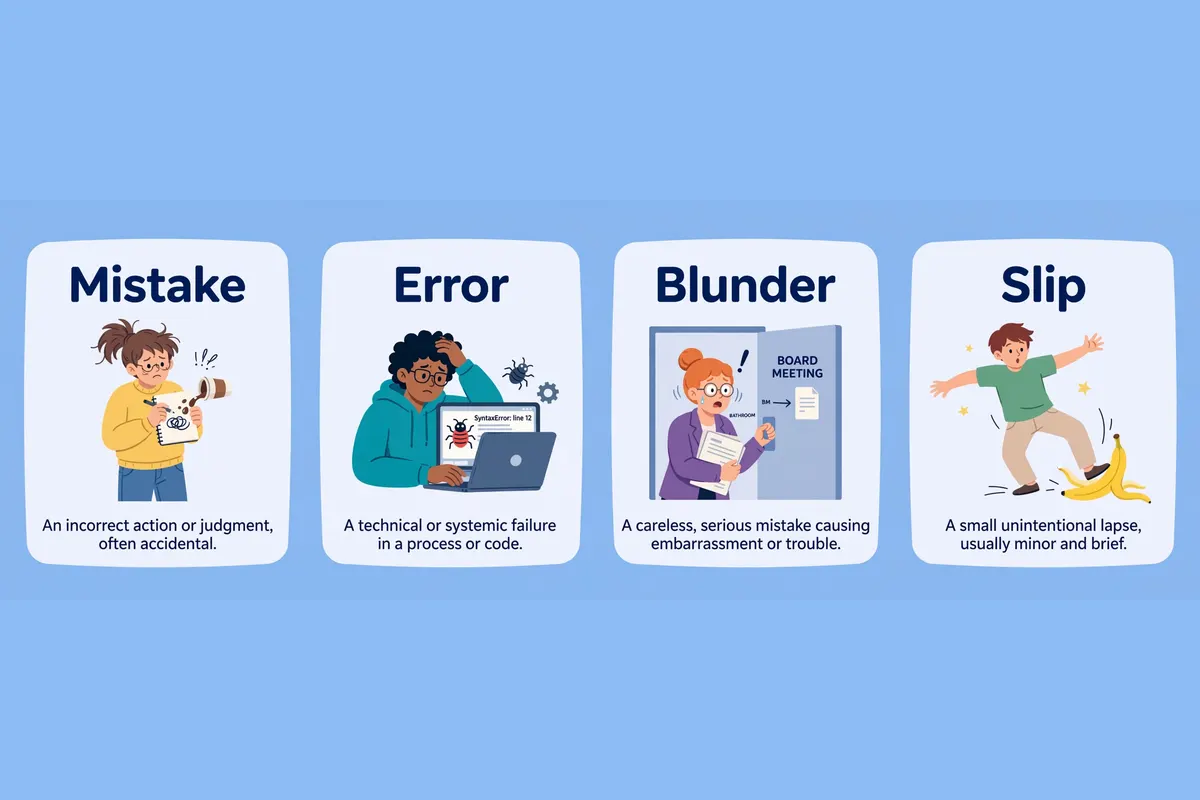
Mistake, error, blunder, and slip all describe something wrong, but they do not carry the same tone or level of seriousness.
| Word | Core idea | How serious? | Best for | Example |
|---|---|---|---|---|
| Mistake | A general word for something done, said, or believed wrongly | Any size | Everyday talk and writing | I made a mistake in the address. |
| Error | A formal word for a departure from a standard or guide | Medium to serious | Reports, science, computing, law | There are too many errors in your work. |
| Blunder | A big, careless mistake that carries blame | Serious | News, stories, serious reports | The tax rise was a major political blunder. |
| Slip | A small, accidental mistake | Small | Everyday talk, apologies | It was just a slip of the tongue. |
If it is small and accidental, call it a slip; if it is formal or technical, call it an error; if it is big and careless, call it a blunder; if you are not sure, mistake is always safe
Mistake vs lapse: a lapse stresses forgetfulness or weakness as the cause.
Mistake vs oversight: an oversight is something missed, not done badly.
Error vs mistake in technical use: error owns the technical senses, including margin of error, syntax errors, harmless error in law, and baseball error, and mistake does not take their place in those phrases.
Other Ways to Say “I Made a Mistake”
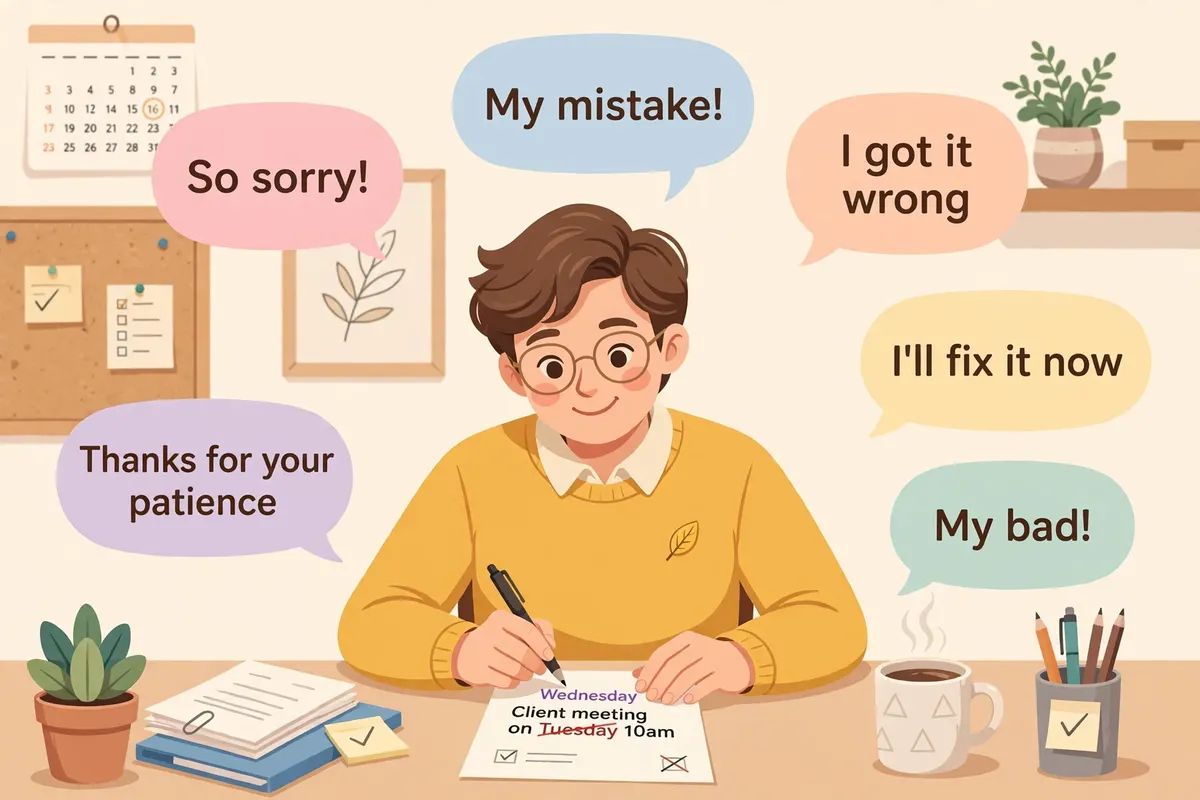
You can admit a mistake without repeating the same sentence every time. These six phrases range from the shortest apology to a formal admission.
1. My mistake
Tone: Neutral, everyday
This is the shortest apology in English. It accepts responsibility without giving a long explanation.
Example: “The meeting starts at 8:00. My mistake, it starts at 8:30.”
2. I got it wrong
Tone: Casual, neutral
Use this when you want to admit that your answer, understanding, or judgment was incorrect. It sounds honest and direct.
Example: “I got it wrong when I said the store closed at six.”
3. That was on me / That was my fault
Tone: Casual, direct
These phrases clearly accept responsibility. “That was on me” sounds conversational, while “That was my fault” is more neutral and works in a wider range of situations.
Example: “I forgot to send the file. That was on me.”
4. I made an error in judgment
Tone: Formal
This phrase suits a poor decision or assessment, especially in professional settings. It is more specific than a general apology.
Example: “I made an error in judgment when I approved the original plan.”
5. I mixed things up
Tone: Casual, everyday
Use this when you confuse two names, dates, places, orders, or pieces of information. It is a good choice for a mix-up.
Example: “I mixed things up and sent the message to the wrong group.”
6. I slipped up
Tone: Casual, everyday
This phrase admits a small mistake, often caused by carelessness or a momentary loss of attention. It softens the admission.
Example: “I slipped up when I entered the wrong number.”
Antonyms of Mistake
There is no single exact opposite of mistake. The best antonym depends on whether you mean correct information, careful work, sound judgment, or a corrected result.
| Antonym or contrast | Meaning | Example |
|---|---|---|
| Accuracy | The quality of being correct and free from errors | The accuracy of the final figures impressed the reviewer. |
| Correctness | The state of being right or true | The teacher checked the correctness of each answer. |
| Precision | Exactness and careful attention to detail | Precision matters when measuring the parts. |
| Perfection | A state without faults or mistakes | The team aimed for perfection in the final design. |
| Sound judgment | The ability to make sensible decisions | Her sound judgment helped the group avoid a costly problem. |
| Correction | A change that fixes an error | The correction appeared in the next edition. |
Correction deserves special attention. It is not the opposite meaning of mistake. It is the act of fixing one. Likewise, success can contrast with a mistake when discussing an outcome, but it is not a strict antonym. A successful person can still make several mistakes along the way.
FAQs
Frequently Asked Questions
1. What is another word for mistake?
Another word for mistake is error, especially in formal writing. Other choices include slip, blunder, oversight, misstep, and miscalculation. The best option depends on whether the problem was minor, careless, technical, or related to judgment.
2. What is the difference between a mistake and an error?
Mistake is the more general word for something done, said, or believed incorrectly. Error sounds more formal and often appears in technical, academic, legal, or scientific contexts where a standard has not been met.
3. What is the difference between a mistake and a blunder?
A mistake can be small, accidental, or serious. A blunder usually describes a major, careless mistake and can suggest poor judgment or blame. Use blunder when the error is especially obvious or damaging.
4. What is a formal word for mistake?
Error is a common formal word for mistake. Depending on the situation, you can also use oversight, misjudgment, miscalculation, misinterpretation, or misstatement. Choose the word that identifies what went wrong rather than making the sentence sound formal.
5. What is the opposite of mistake?
Accuracy, correctness, and precision can contrast with mistake, depending on the sentence. There is no single exact opposite. Correction means fixing an error, while success describes a favorable result rather than the opposite meaning.
6. Do you say “make” or “do” a mistake?
The standard expression is “make a mistake.” You can also say “commit,” “repeat,” “admit,” or “correct” a mistake. Do not use “do a mistake” as the correct expression in standard English.