
Efficient Synonyms: 31 Words That Save Time and Effort
Efficient describes a person, process or system that gets a result without wasting time, money or energy. These 31 efficient synonyms help you choose the right word for essays, resumes, business writing and everyday conversations.
Quick Answer
For something that gets the desired result, use effective or productive.
For a skilled person, use competent, capable or proficient.
For a process with fewer wasted steps, use streamlined or optimized.
For saving money, time or energy, use economical, cost-effective or time-saving.
Remember the main difference: efficient describes how little is wasted on the way to a result; effective describes whether the desired result happens at all. Something can be effective without being efficient, and efficient without being effective.
What Does Efficient Mean?
Efficient is an adjective that describes doing something well without wasting time, money, energy or effort.
The Oxford Advanced Learner’s Dictionary defines it as doing something in a good, careful and complete way, with no waste of time, money or energy.
Merriam-Webster’s first sense describes something capable of producing desired results with little or no waste. Cambridge’s B1 learner definition describes something that works well without wasting time or energy.
These definitions share one central idea: getting the desired result while using resources carefully.
There are two main ways to use efficient:
Describing a person: An efficient person completes work in an organized, competent way. They know what needs doing, manage their time and avoid unnecessary effort. Example: Maria is an efficient office manager who handles requests without wasting time.
Describing a thing, system or process: An efficient system or machine produces the intended output while using fewer resources. It may save fuel, energy, materials or working hours. Example: The new heating equipment is efficient because it warms the building while using less fuel.
Efficient vs Effective: The Main Difference
These words are related, but they don’t mean the same thing.
Efficient: Focuses on how little time, money or energy is wasted.
Effective: Focuses on whether the intended result happens.
Consider two examples.
A medicine can be effective because it treats an illness, even if producing it requires expensive materials and lengthy procedures. A heater can be efficient because it uses little electricity, yet still fail to warm a particular room.
The first example concerns the result. The second concerns resource use.
Word Family and Related Forms
| Word | Part of speech | Meaning |
|---|---|---|
| Efficient | Adjective | Gets results with little waste |
| Efficiency | Noun, uncountable | The quality of using resources well |
| Efficiently | Adverb | In a way that avoids unnecessary waste |
| Inefficient | Adjective | Wastes time, effort or resources |
| Inefficiency | Noun | The condition of wasting resources |
For example, you might describe the efficiency of a heating system or say that a manager works efficiently.
The direct opposite of efficient is inefficient.
Common Compounds
Several compounds describe particular kinds of efficiency:
Cost-efficient: Provides results while controlling costs.
Fuel-efficient: Uses relatively little fuel.
Energy-efficient: Uses less energy to perform a task.
Time-efficient: Uses time carefully and avoids unnecessary delays.
These compounds are useful when you want to identify the resource being saved. They are related expressions, not additional entries in our 31-word list.
Word Origin
Efficient comes from late Middle English, originally meaning making or causing something. Its roots trace back to the Latin efficient-, meaning accomplishing, from efficere, meaning to accomplish.
The Latin word combines ex-, meaning out or thoroughly, and facere, meaning do or make.
The modern sense of efficient, connected with avoiding wasted time, money and energy, dates from the late 18th century.
Grammar Traps to Avoid
Efficient does not mean effective. A medicine can be effective and wasteful. A heater can be efficient and still leave the room cold. Choose the word according to whether you mean resource use or the final result.
Fast does not mean efficient. Speed is only one part of efficiency. A fast worker can waste materials, make mistakes and repeat unnecessary tasks. Never treat fast, quick or rapid as direct synonyms for efficient.
Proficient describes people, not machines. Use proficient for a person’s practiced skill. Say “proficient at Excel” or “proficient in French.” Don’t describe a machine as proficient.
Know the difference between efficient at and efficient in. Oxford records these patterns: Efficient at something: a skill or task. Efficient in something: the use of a resource. Efficient in doing something: an activity. For example, someone can be efficient at handling customer requests. A boiler can be efficient in fuel use. A manager can be efficient in organizing an event.
Economical is not economic. Economical describes something that saves money or resources. Economic usually relates to the economy. Wrong: An economic car. Right: An economical car.
Use American spelling. This article uses skillful, organized, well-organized and optimized. Don’t mix these with British spellings.
Avoid misleading thesaurus suggestions. Killer is slang, not a suitable general synonym for efficient. Tasty is also unsuitable. Hyperefficient, ultraefficient and superefficient are compounds, not separate synonyms. Workmanlike sounds old-fashioned and is tied to craftsmanship. Scalable describes the ability to handle growth, not efficiency by itself.
Use the correct comparative form. The correct forms are more efficient and most efficient. Don’t write efficienter or efficientest.
When to Use Efficient Synonyms
The best synonym depends on what you’re describing and who will read your writing. A word that works in a business report may sound stiff in an everyday conversation.
Here are four common situations.
For essays and school writing: Academic writing often needs precise vocabulary. Consider these choices: Effectual: When discussing a measure that achieved its intended result. Efficacious: When describing something with the power to produce a specific effect, especially in science or medicine. Expeditious: When discussing formal service or handling without delay. Systematic: When describing a clearly ordered method. Methodical: When emphasizing careful, step-by-step work. These choices give your writing more precision. However, effectual, efficacious and expeditious are very formal. They’re essay choices, not everyday replacements.
For CVs and references: When describing a person’s work, choose words that show their actual ability. Competent: The person has the necessary skills. Proficient: The person has practiced and developed a particular skill. Adept: The person is genuinely good at something. Accomplished: The person has achieved a high level of success. Experienced: The person has done the work before. For example, “a competent project coordinator” communicates that the person can handle the role. “A proficient analyst” points to a practiced skill.
For business emails and reports: Business writing often discusses processes, spending and results. Useful choices include: Streamlined: A process has fewer unnecessary steps. Optimized: Something has been adjusted to work at its best. Cost-effective: The results offer good value for the money. Lean: Operations avoid unnecessary resources. Businesslike: Someone or something has a practical, orderly manner. These words help explain what a company has improved instead of simply repeating efficient.
For everyday conversation: For ordinary conversations, familiar words usually sound more natural. Try: Organized: When someone keeps things in order. Time-saving: When a tool reduces the time needed. Practical: When something works in real situations. Capable: When someone can handle a task. Successful: When a plan achieves its goal. Keep efficient itself when the idea of using fewer resources is exactly what you mean. There’s no need to replace a perfectly suitable word.
Benefits of Using Efficient Synonyms
Choosing a more precise word can make your writing clearer and easier to understand.
Here are four reasons to use these alternatives.
Avoid repeating the same word. Repeating efficient several times in one paragraph can make your writing sound dull. For example: “The efficient team created an efficient schedule using an efficient process.” You could write: “The capable team created a well-organized schedule using a cost-effective process.” Each alternative gives the reader a more specific picture.
Match the word to the person or process. A person and a machine don’t always need the same description. Use competent or proficient for a skilled person. Use streamlined or systematic for a process. Use effective when the result itself matters. The right word makes your meaning easier to understand.
Explain what is being saved. Efficiency can involve different resources. Economical emphasizes careful spending. Time-saving emphasizes reduced working time. Energy-saving emphasizes lower energy use. Lean emphasizes reduced waste in business operations. A specific word tells the reader what has improved.
Avoid confusing efficiency with effectiveness. A successful result doesn’t automatically mean the method was efficient. A company might complete a project successfully but spend twice its planned budget. The project was successful, but the process wasn’t efficient. Choosing the right synonym helps you describe both sides accurately.

31 Best Efficient Synonyms at a Glance
The 31 words below fall into four groups.
8 words describe getting results.
8 words describe skilled people.
8 words describe organized systems and processes.
7 words describe saving time, money and energy.
Three words deserve special attention in formal writing. Effectual, efficacious and expeditious are very formal choices. They’re suitable for essays and specialized writing, but they can sound stiff in everyday conversation.
| Synonym | Tone | Best for |
|---|---|---|
| Effective | Neutral, formal | Essays, reports, policies, methods |
| Productive | Neutral | Work, teams, days, meetings |
| Successful | Neutral, everyday | Plans, projects, everyday writing |
| Fruitful | Formal, literary | Essays, reports, formal writing |
| Effectual | Very formal | Formal essays, legal and official writing |
| Efficacious | Very formal | Formal essays, science and medicine writing |
| Potent | Formal | Essays, science, formal writing |
| Workable | Neutral, practical | Plans, systems, everyday and business writing |
| Competent | Neutral, formal | CVs, reports, references, essays |
| Capable | Neutral, everyday | Everyday writing, CVs, emails |
| Proficient | Formal | CVs, essays, academic writing |
| Skillful | Neutral | Everyday writing, reviews, essays |
| Adept | Formal | Essays, CVs, formal writing |
| Expert | Neutral | CVs, reports, everyday writing |
| Experienced | Neutral, everyday | CVs, references, everyday writing |
| Accomplished | Formal | CVs, formal writing, essays |
| Organized | Neutral, everyday | Everyday writing, emails, essays |
| Well-organized | Neutral, everyday | Everyday writing, CVs, descriptions of teams |
| Systematic | Formal | Essays, reports, academic writing |
| Methodical | Formal | Essays, reports, formal writing |
| Streamlined | Neutral, business | Business writing, reports, essays |
| Optimized | Neutral, business | Business and technical writing, reports |
| Businesslike | Neutral, business | Business writing, emails, descriptions of people |
| Practical | Neutral, everyday | Everyday writing, essays, advice |
| Economical | Neutral, formal | Essays, reports, descriptions of machines and habits |
| Cost-effective | Neutral, business | Business writing, reports, essays |
| Time-saving | Neutral, everyday | Everyday writing, product and app descriptions |
| Energy-saving | Neutral, everyday | Appliances, homes, everyday writing |
| Lean | Neutral, business | Business writing, reports, operations |
| Expeditious | Very formal | Formal essays, legal and official writing |
| Resourceful | Neutral, positive | Essays, CVs, everyday writing |
Synonyms for Getting Results
These eight words describe results or the ability to produce them. However, they don’t all carry the same meaning as efficient.
1. Effective
Tone: Neutral, formal · Uses: Essays, reports, policies, methods
Meaning: Produces the result that was wanted.
Explanation: Effective is the closest common alternative when you mean that something works as intended. However, it says the result happens, NOT that little was wasted. A method can be effective but still require too much time, money or energy.
Examples:
- The new training method was effective in improving employee performance.
- We need an effective policy that addresses the problem.
2. Productive
Tone: Neutral · Uses: Work, teams, days, meetings
Meaning: Produces a lot of useful output.
Explanation: Productive focuses on how much useful work gets completed. It doesn’t measure how many resources were wasted along the way. A busy day can be productive and wasteful at the same time, so don’t treat productive as a complete replacement for efficient.
Examples:
- The team had a productive meeting and finished its project plan.
- She enjoys productive mornings because she completes several important tasks.
3. Successful
Tone: Neutral, everyday · Uses: Plans, projects, everyday writing
Meaning: Achieves what it set out to do.
Explanation: Successful describes a good outcome rather than the method used to reach it. A successful project may still involve unnecessary costs, delays or repeated work. It’s a useful everyday word, but it’s weaker than efficient when resource use matters.
Examples:
- The successful campaign brought more customers to the store.
- Their successful project stayed within its original goals.
4. Fruitful
Tone: Formal, literary · Uses: Essays, reports, formal writing
Meaning: Produces good, worthwhile results.
Explanation: Fruitful has a formal flavor and often describes discussions, research, relationships or efforts that produce valuable results. Think of the harvest of results, not the method used to obtain them. It works well in essays but isn’t a direct substitute in every sentence.
Examples:
- The research team had a fruitful discussion about its findings.
- Their fruitful partnership produced several useful ideas.
5. Effectual
Tone: Very formal · Uses: Formal essays, legal and official writing
Meaning: Accomplishes the desired result, seen after the fact.
Explanation: Merriam-Webster’s distinction suggests that effectual describes accomplishment, especially as viewed after the fact. It sounds stiff in everyday writing, so reserve it for formal essays, legal documents and official discussions. It describes the result, not the resources used.
Examples:
- The court accepted the effectual measures taken by the organization.
- Researchers examined whether the proposed solution was effectual.
6. Efficacious
Tone: Very formal · Uses: Formal essays, science and medicine writing
Meaning: Has a special quality that gives it real power to work.
Explanation: Efficacious describes something that has the power to produce a particular effect. Merriam-Webster uses a detergent that removes grease as an example. Don’t use this word to describe a person’s general work habits, as it is a very formal choice for science, medicine and academic writing.
Examples:
- The study examined whether the treatment was efficacious.
- Scientists developed an efficacious detergent for removing stubborn grease.
7. Potent
Tone: Formal · Uses: Essays, science, formal writing
Meaning: Strong and powerful in its effect.
Explanation: Potent describes the strength of an effect rather than how little was wasted. A potent drug can produce a strong reaction while still requiring wasteful production methods. Use it when strength matters, especially in science and formal discussions.
Examples:
- The researchers discovered a potent substance during the experiment.
- The report examined the effects of a potent chemical compound.
8. Workable
Tone: Neutral, practical · Uses: Plans, systems, everyday and business writing
Meaning: Can function successfully in real use.
Explanation: Workable means something can operate or be put into practice. It doesn’t promise that the method is cheap or uses few resources. A workable plan may still waste time, so this is a practical alternative rather than a precise synonym.
Examples:
- The manager proposed a workable schedule for the new team.
- We finally found a workable solution to the storage problem.
Synonyms for Skilled People
Efficient often describes someone who handles work well. These eight words focus on skill, knowledge, experience or achievement.
9. Competent
Tone: Neutral, formal · Uses: CVs, reports, references, essays
Meaning: Has the skill needed to do the job properly.
Explanation: Competent is a safe essay word for describing someone who can perform a task correctly. It means good enough to meet the requirements, not necessarily brilliant or outstanding. Use it in professional references, performance reports and formal descriptions.
Examples:
- The company hired a competent accountant to manage its records.
- She is a competent supervisor who handles daily responsibilities well.
10. Capable
Tone: Neutral, everyday · Uses: Everyday writing, CVs, emails
Meaning: Able to do things well.
Explanation: Capable is a broad word that describes someone’s ability to handle work or responsibilities. However, a capable person can still be slow or wasteful. Pair it with a clear task to make the meaning more precise, such as capable of managing a busy office.
Examples:
- We need a capable assistant to organize the new schedule.
- He is capable of managing several customer accounts.
11. Proficient
Tone: Formal · Uses: CVs, essays, academic writing
Meaning: Skilled through practice, usually in one activity.
Explanation: Merriam-Webster notes that proficient typically describes people and often takes the preposition at. You can also use in for a language or subject, as in proficient at Excel or proficient in French. Never describe a machine as proficient.
Examples:
- The applicant is proficient at Excel and other office programs.
- She is proficient in Spanish and German.
12. Skillful
Tone: Neutral · Uses: Everyday writing, reviews, essays
Meaning: Performs tasks with talent and precision.
Explanation: Skillful describes someone who performs an activity with good judgment and control. It’s a natural choice for writing about employees, artists, managers and craftspeople. Use the American spelling skillful, not the British spelling skilful.
Examples:
- The skillful technician repaired the computer without damaging its parts.
- Her skillful handling of the difficult conversation impressed the team.
13. Adept
Tone: Formal · Uses: Essays, CVs, formal writing
Meaning: Very skilled and capable at something.
Explanation: Adept is stronger than competent. It suggests that someone is genuinely good at a particular activity, rather than simply meeting the basic requirements. It’s a useful formal choice when describing a person’s developed ability.
Examples:
- She is adept at solving complicated customer problems.
- The adept negotiator reached an agreement between both companies.
14. Expert
Tone: Neutral · Uses: CVs, reports, everyday writing
Meaning: Has deep knowledge and skill in a field.
Explanation: Expert describes a person with advanced knowledge or experience in a subject. It focuses on what someone knows, not how quickly or carefully they work. An expert can still be slow or waste resources, so the word doesn’t always mean efficient.
Examples:
- The expert mechanic identified the engine problem within minutes.
- We asked an expert consultant to review the financial report.
15. Experienced
Tone: Neutral, everyday · Uses: CVs, references, everyday writing
Meaning: Has done it many times before, so does it well.
Explanation: Experienced tells readers that someone has previous practice in a job or activity. That background may help the person work efficiently, but experience doesn’t guarantee a low-waste method. Use it when previous work is the main point.
Examples:
- The experienced manager trained three new employees.
- We need an experienced driver for the long-distance delivery.
16. Accomplished
Tone: Formal · Uses: CVs, formal writing, essays
Meaning: Highly skilled and has achieved a lot.
Explanation: Accomplished describes someone with a strong record of achievement and ability. It focuses on standing and past success rather than the method used to complete work. It’s the most formal word in this group and suits professional biographies and academic writing.
Examples:
- The accomplished architect received several national awards.
- She is an accomplished researcher with years of academic experience.
Synonyms for Organized Systems and Processes
These words describe order, planning and the way work is carried out. Some focus on the method, while others describe a process that uses fewer unnecessary steps.
17. Organized
Tone: Neutral, everyday · Uses: Everyday writing, emails, essays
Meaning: Arranged in a clear, logical way.
Explanation: Organized describes something arranged so people can find information and complete tasks in a sensible order. It can describe a person, office, event or system. However, being organized doesn’t guarantee high output or low resource use.
Examples:
- The organized office made it easier to find important documents.
- She keeps an organized calendar for all her appointments.
18. Well-organized
Tone: Neutral, everyday · Uses: Everyday writing, CVs, descriptions of teams
Meaning: Arranged very clearly, so nothing is lost or delayed.
Explanation: Well-organized is the fuller, warmer form of organized. It often describes a person, team, event or workplace with clear arrangements. Keep the hyphen and avoid using well-organized and organized together in the same paragraph when one will do.
Examples:
- The well-organized team completed its preparations before the event.
- We attended a well-organized conference with a clear schedule.
19. Systematic
Tone: Formal · Uses: Essays, reports, academic writing
Meaning: Follows a clear, ordered method, step by step.
Explanation: Systematic describes a process that follows an established method. It emphasizes the system itself rather than the final result. A systematic process can still fail if its assumptions are wrong, so don’t use it as a guarantee of success.
Examples:
- The researchers used a systematic approach to examine the evidence.
- A systematic review helped the team identify missing information.
20. Methodical
Tone: Formal · Uses: Essays, reports, formal writing
Meaning: Careful, step-by-step and orderly.
Explanation: Methodical is close to systematic, but the focus is slightly different. Methodical emphasizes careful order and attention during the work, while systematic emphasizes the structure of the method itself. It’s a strong choice for formal descriptions of research and planning.
Examples:
- The methodical researcher checked every document before submitting the report.
- Her methodical approach helped the team avoid repeated mistakes.
21. Streamlined
Tone: Neutral, business · Uses: Business writing, reports, essays
Meaning: Simplified so wasted steps and delays are removed.
Explanation: Streamlined is especially useful when a process has had unnecessary steps cut out. It suggests a simpler route with fewer delays or repeated tasks. It says nothing about the people running that process, so use it for procedures and systems.
Examples:
- The company introduced a streamlined approval process.
- A streamlined booking system reduced unnecessary paperwork.
22. Optimized
Tone: Neutral, business · Uses: Business and technical writing, reports
Meaning: Adjusted deliberately to work at its best.
Explanation: Optimized describes something that has been adjusted to achieve the best possible performance under particular conditions. It implies that someone made deliberate changes. Don’t use it casually for a natural process that hasn’t been adjusted.
Examples:
- The engineers created an optimized design for the new equipment.
- The company adopted an optimized schedule to reduce operating costs.
23. Businesslike
Tone: Neutral, business · Uses: Business writing, emails, descriptions of people
Meaning: Practical, orderly and direct.
Explanation: Businesslike describes a professional manner that focuses on practical matters. It can describe a meeting, conversation or person’s behavior. However, an orderly businesslike meeting isn’t necessarily fast or resource-efficient.
Examples:
- The manager maintained a businesslike tone during the negotiations.
- Their businesslike meeting covered every item on the agenda.
24. Practical
Tone: Neutral, everyday · Uses: Everyday writing, essays, advice
Meaning: Useful and suited to real situations.
Explanation: Practical describes something that works in real life rather than existing only as an idea. However, practical says nothing about whether time, money or energy is wasted. It’s the weakest synonym in this group because a practical solution may still be inefficient.
Examples:
- The teacher suggested a practical way to organize the classroom.
- We need a practical plan that fits the available budget.
Synonyms That Save Time, Money and Energy
Efficiency often involves using fewer resources. These seven words identify the particular savings or qualities involved.
25. Economical
Tone: Neutral, formal · Uses: Essays, reports, descriptions of machines and habits
Meaning: Uses money, time or materials carefully, with little waste.
Explanation: Economical is a useful choice when discussing careful spending or resource use. Don’t confuse it with economic, which usually relates to the economy. An economical car saves money through careful fuel use, while economic growth describes changes in a country’s economy.
Examples:
- The family chose an economical car to reduce fuel expenses.
- An economical heating system can lower household energy bills.
26. Cost-effective
Tone: Neutral, business · Uses: Business writing, reports, essays
Meaning: Gives strong value for what it costs.
Explanation: Cost-effective describes something that offers good value for the money spent. It doesn’t mean the cheapest available option. An expensive tool can be cost-effective if it lasts longer, performs better and reduces future expenses.
Examples:
- The company selected a cost-effective software package for its employees.
- Reusable packaging proved more cost-effective over the long term.
27. Time-saving
Tone: Neutral, everyday · Uses: Everyday writing, product and app descriptions
Meaning: Cuts down the time a task takes.
Explanation: Time-saving describes something that helps people complete an activity in less time. It focuses on time alone, not every resource. A time-saving tool can still waste money or energy, so don’t assume it is efficient in every way.
Examples:
- The time-saving app helps students organize their daily assignments.
- A time-saving kitchen appliance made meal preparation easier.
28. Energy-saving
Tone: Neutral, everyday · Uses: Appliances, homes, everyday writing
Meaning: Uses less energy to do the same job.
Explanation: Energy-saving focuses on reducing energy consumption. It doesn’t automatically mean that a product saves money or time. Energy-efficient is the related compound form recorded by Oxford, while energy-saving is a useful everyday description.
Examples:
- The energy-saving bulbs reduced electricity use throughout the house.
- We installed energy-saving appliances in the new kitchen.
29. Lean
Tone: Neutral, business · Uses: Business writing, reports, operations
Meaning: Runs with little waste and nothing extra.
Explanation: Lean is common in business discussions about operations and resource use. It describes a system that avoids unnecessary materials, steps and expenses. In everyday writing, lean can also mean thin, so keep this use in a business context.
Examples:
- The manufacturer introduced lean operations to reduce material waste.
- A lean production system helped the company control unnecessary expenses.
30. Expeditious
Tone: Very formal · Uses: Formal essays, legal and official writing
Meaning: Done quickly and efficiently, with no delay.
Explanation: Expeditious is a very formal choice for describing service, handling or action completed without unnecessary delay. It suits legal, official and academic writing. It sounds stiff in everyday conversation, so choose a simpler word when speaking casually.
Examples:
- The court requested expeditious handling of the pending application.
- The department promised expeditious service for urgent requests.
31. Resourceful
Tone: Neutral, positive · Uses: Essays, CVs, everyday writing
Meaning: Finds clever ways to get things done with what is available.
Explanation: Resourceful describes someone who finds clever solutions when resources are limited. However, it focuses on cleverness in a tight spot, not a low-waste system. It is the loosest synonym in this list.
Examples:
- The resourceful employee found a way to finish the project with limited supplies.
- She is a resourceful manager who handles unexpected problems calmly.
Efficient vs Effective vs Productive vs Proficient
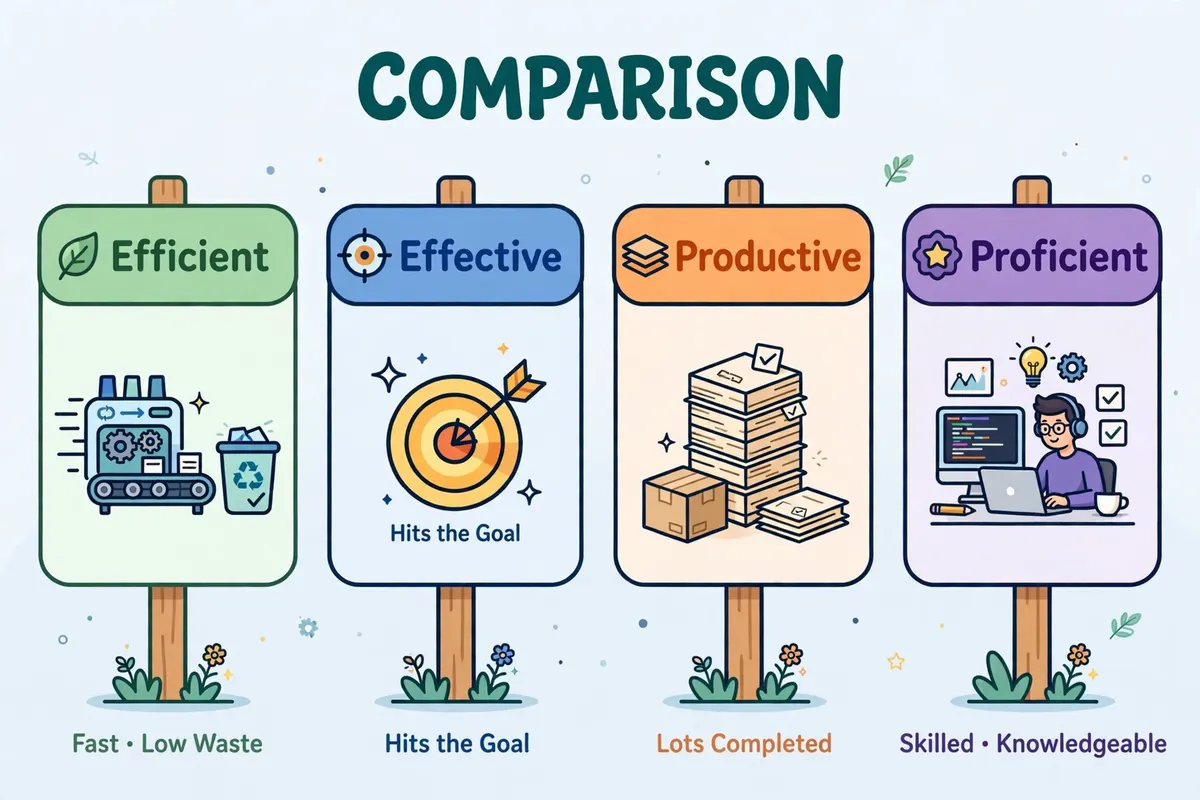
These four words are easy to mix up because they all describe positive qualities. However, each one answers a different question.
| Word | Core idea | Who or what it describes | What it stresses | Example |
|---|---|---|---|---|
| Efficient | Gets the result with little waste | Mostly things: machines, systems, processes, organizations; also people | How little is wasted on the way | The new heater is efficient because it warms the room using less fuel. |
| Effective | Gets the result that was wanted | Mostly things: policies, treatments, arguments, techniques; also people | Whether the result happens at all | The new medicine is effective because it clears the infection. |
| Productive | Produces a lot of useful output | People, teams, days, meetings, land | How much comes out | She had a productive morning and finished five reports. |
| Proficient | Skilled through practice in one activity | People only | Skill at something, usually with at or in | He is proficient at Excel and finishes the report in 15 minutes. |
If you mean “it works”, say effective; if you mean “a lot comes out”, say productive; if you mean “skilled at it”, say proficient; only say efficient when little time, money or energy is wasted on the way.
Efficient vs economical
Economical saves money or resources, so it is narrower than efficient.
Efficient vs fast
Fast is speed only, while an efficient process is fast AND low-waste.
Other Ways to Say “Efficient”
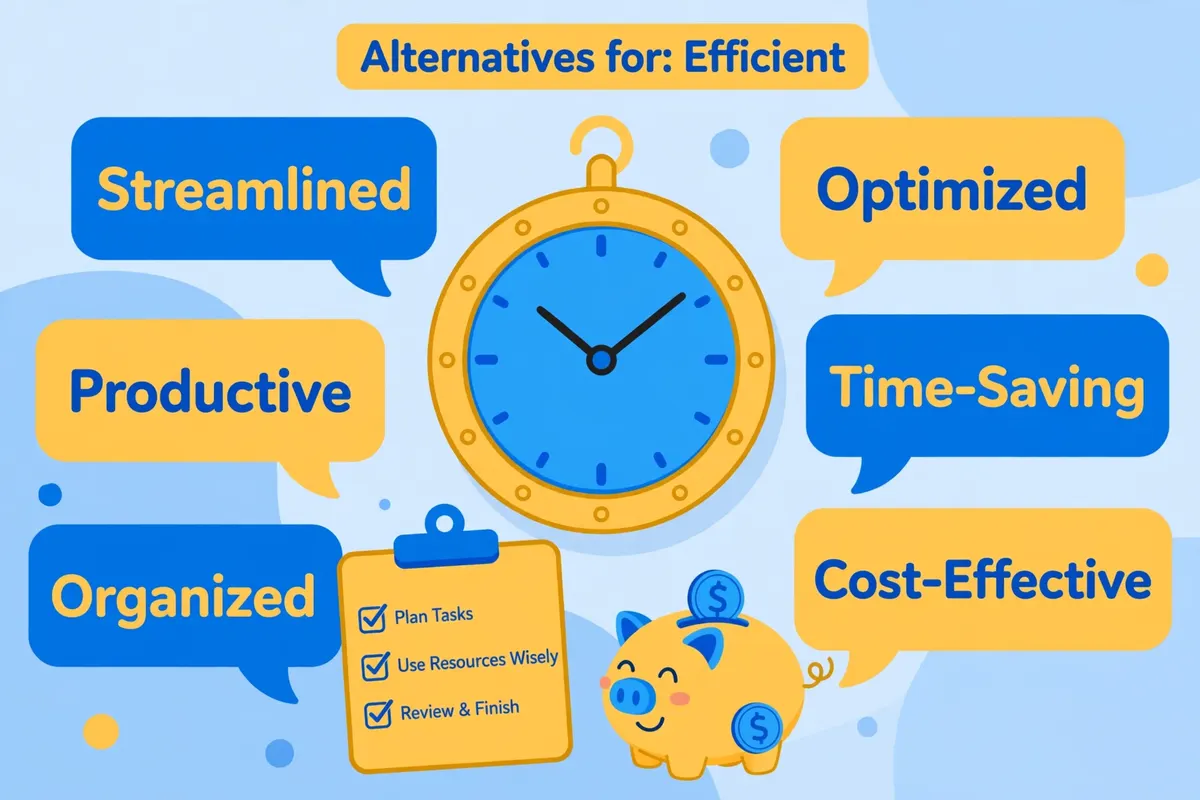
Sometimes a short phrase sounds more natural than a single synonym. These six expressions offer alternatives for business writing, everyday conversations and formal descriptions.
1. Gets the job done with no waste
Tone: Plain, everyday.
This phrase explains the basic meaning of efficient in simple language. It works well when describing a person, tool or process that completes its task without unnecessary effort.
Example: “Our new filing system gets the job done with no waste.”
2. Does more with less
Tone: Business.
This is a common business expression for producing more output while using fewer resources. Use it when discussing teams, budgets, production or company operations.
Example: “The small department does more with less by sharing equipment and responsibilities.”
3. Makes the most of every minute
Tone: Everyday, time-focused.
Use this phrase when talking about schedules, study habits or work routines. It emphasizes careful use of available time.
Example: “A good study plan makes the most of every minute before an exam.”
4. Saves time and money
Tone: Everyday.
This straightforward expression works when a service, tool or system reduces both time and spending. It’s easy to understand and fits casual as well as professional conversations.
Example: “The new booking service saves time and money for customers.”
5. Runs like clockwork
Tone: Casual idiom.
This expression describes a system that works smoothly and reliably every time. Cambridge includes clockwork among terms related to efficient use. It’s especially useful for describing regular routines and well-managed operations.
Example: “The delivery schedule runs like clockwork every morning.”
6. Well-planned and well-run
Tone: Formal.
This is a formal way to describe an event, project or organization with good planning and careful management. Use it when you want to emphasize preparation and orderly execution.
Example: “The well-planned and well-run conference finished without unnecessary delays.”
Antonyms of Efficient
Unlike some related adjectives, efficient has a direct opposite: inefficient.
Oxford gives inefficient as the direct opposite of efficient. It describes someone or something that wastes time, effort, energy or other resources.
However, several other words oppose particular meanings of efficient. Choose one based on what you’re describing.
1. Inefficient
Meaning: Wastes time, effort or resources.
This is the direct opposite of efficient. It describes a person, machine, system or process that uses more resources than necessary.
Example: The old system was inefficient and wasted time.
2. Wasteful
Meaning: Uses more than it needs.
Wasteful focuses on unnecessary use of money, materials, energy or other resources.
Example: He is quite wasteful with his resources.
3. Unproductive
Meaning: Produces little or nothing.
Unproductive opposes the output-focused sense of efficient or productive. It describes work that fails to produce useful results.
Example: The team was unproductive and failed to meet the deadline.
4. Ineffective
Meaning: Does not produce the wanted result.
Ineffective is the opposite of effective. It describes a method, treatment, policy or action that fails to achieve its intended purpose.
Example: The plan turned out to be ineffective and a failure.
5. Incompetent
Meaning: Lacks the skill to do the job.
Incompetent is the people-focused opposite when efficient describes someone who performs work competently. It suggests that the person lacks the necessary ability or judgment.
Example: The incompetent supervisor failed to manage the team’s responsibilities.
6. Disorganized
Meaning: Lacks clear order or arrangement.
Disorganized opposes the organized-systems sense. A disorganized workflow can cause confusion, repeated work and unnecessary delays.
Example: The disorganized office struggled to locate important records.
7. Uneconomical
Meaning: Wastes money or resources.
Uneconomical describes something that costs too much to operate or uses resources poorly. It is useful when discussing spending, equipment and production.
Example: The old heating system was uneconomical to operate.
Useless is Cambridge’s thesaurus antonym for the USEFUL sense, but it is the weakest opposite, since a thing can be useful without being efficient.
FAQs
Frequently Asked Questions
1. What is another word for efficient?
Effective or productive works when discussing results. For a person, try competent, capable or proficient. For a process, streamlined or economical may fit better. Choose the word that describes the specific quality you mean.
2. What is the difference between efficient and effective?
Efficient means achieving something while wasting little time, money or energy in the process. Effective means producing the intended result. Something can be effective without being efficient, and efficient without being effective.
3. What is a formal synonym for efficient?
Effectual suits results judged after completion, efficacious fits science and medicine, and expeditious describes prompt service or handling. All three are very formal choices, so they’re better suited to essays and official writing than everyday conversation.
4. What is the opposite of efficient?
Inefficient is the direct opposite because it describes wasted time, effort or resources. Wasteful focuses on unnecessary use, unproductive describes poor output, and ineffective means something fails to produce its intended result.
5. What is a good word for an efficient person?
Competent is a safe general choice for someone who handles work properly. Proficient describes a practiced skill and takes at or in. Adept is stronger and suggests genuinely high ability in a particular activity.
6. Is productive a synonym for efficient?
Partly. Productive measures how much useful work gets completed, while efficient measures how little is wasted. A productive day can still involve wasted time or money, so use productive when output is your main point.